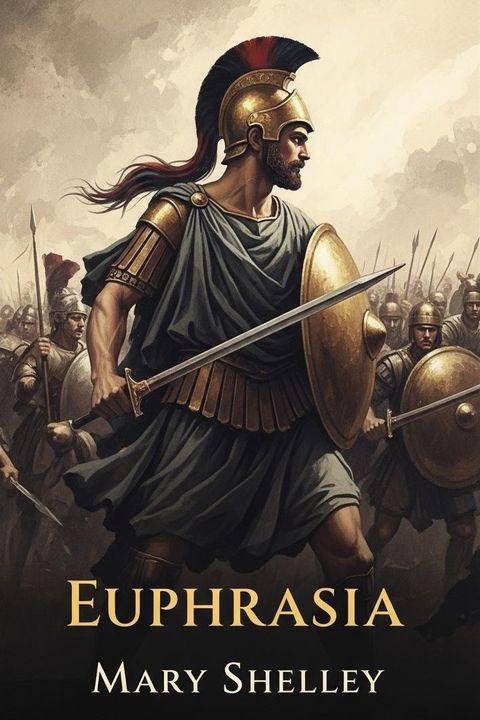
Euphrasia by Mary Shelley (1829)
A young Englishman, eager for adventure and determined to earn his honor, journeys to Greece amid the uprising against Turkish oppression. Immersed in the fervor of revolution and inspired by the ancient landscapes rich in heroic lore, he quickly becomes ensnared in the brutal realities of guerrilla warfare. Accompanying a Greek force led by a renowned but sorrow-stricken chief, the youth witnesses a series of fierce confrontations where valor and sacrifice are in constant tension with the grim toll of battle. The narrative unfolds through alternating perspectives. Initially, the youthful Englishman’s exuberance and ambition provide a stark contrast to the melancholy and measured resolve of the Greek chief. The chief, celebrated for his bravery and intellect, bears scars of past losses—most notably, his deep grief over his beloved sister, whose fate has become entwined with the fate of the nation. His demeanor and actions, as he orchestrates ambushes and strategic retreats against overwhelming Turkish forces, underscore a life devoted to both martial valor and the noble ideals of a free Greece. Amid a fierce engagement, the English youth experiences his own brush with mortality when wounded in battle. In a dramatic turn, the chief—despite his own grave injuries and the pall of impending death—tends to the youth’s wounds with a mixture of practical care and paternal resolve. As the battle’s aftermath reveals a landscape strewn with deads and the haunting quiet of loss, the wounded chief recounts the tragic past that continues to shape his actions. He recalls his upbringing under an adoptive father who instilled in him both a love for Greek classical heritage and a fierce commitment to liberate his people. The chief’s most cherished memory is of his sister: a gentle, poetic soul whose promise was cut short by the cruelty of the oppressor. Her fate, marked by both physical and symbolic imprisonment in a Turkish harem and ultimately by death during a rescue attempt, becomes a powerful emblem of national suffering and personal sacrifice. In vivid, sorrowful detail, the chief narrates a daring assault on the tyrant’s palace where he risked everything to free his sister. Amid a maelstrom of fire, gunfire, and the tumult of an advancing enemy, the couple's desperate escape is depicted with both heroic grandeur and tragic inevitability. His account conveys how even triumphant moments—when the palace is set ablaze and the oppressors are driven back—are steeped in mourning, for each act of resistance exacts a heavy personal price. In one heart-wrenching scene, his sister, despite a brief glimmer of defiant hope, succumbs to her wounds in his arms; her final moments, full of tender words and resigned acceptance, symbolize the inexorable cost of freedom. Haunted by these dual narratives—his own youthful zeal and the chief’s sorrowful testament—the Englishman is forced to confront the true nature of heroism. The passion for glory is inseparable from the inevitability of loss, and the cost of fighting for an ideal can shatter not only individual lives but the very spirit of a nation. Ultimately, the heroism displayed on the battlefield yields neither complete victory nor unmitigated joy. Instead, it imbues the survivors with a profound understanding of mortality, duty, and the enduring legacy of sacrifice that shapes the destiny of a people struggling for liberation. The work, therefore, is not merely a chronicle of battle and patriotism; it stands as a meditation on the transformation wrought by the crucible of war. The interplay of youthful audacity and age-wrought sorrow, coupled with the inexorable pull of national destiny, frames a narrative where honor, loss, and the immutable power of memory define both personal identity and collective hope.
By Mary Shelley · First published 1829 · Genre: Historical War Fiction, Adventure Fiction, Tragic Romance · 6,412 words
First lines
It was not long after the breaking out of the Greek Revolution that Harry Valency visited Greece. Many an Englishman was led thither at that time by the spirit of adventure, and many perished. Valency was not nineteen; his spirit was wild and reckless; -- thought or care had never touched his brow; his heart was too light for love. Restless and energetic, he longed to try his powers, with the instinct that leads the young deer to butt against trees, or to wrestle with each other in the forest-dells. He was the only son of a widowed mother, whose life was wrapped in his, and he loved her fondly; yet left her, impelled by a desire for adventure, unable to understand what anxiety and fear meant; and in his own person eager to meet even misfortune, so that it came in a guise to call forth manly and active struggles. He longed to have the pages of his young life written over by deeds that would hereafter be memories, to which he could turn with delight. The cause of Greece warmed his soul. He was in a transport of ecstasy when he touched the shores of that antique land, and looked around on mountain and mountain-stream, whose names were associated with the most heroic acts, and the most sublime poetry man ever achieved or wrote. Yes, he was now in Greece. He was about to fight in her cause against the usurping Turk. He had prepared himself by a sedulous study of Romaic; he was on his way to the seat of Government, to offer his services. To proceed thither from the spot where he had disembarked was a matter of some difficulty; the Turkish troops being then in possession of many of the passes. At length he heard that a band of about fifty Greek soldiers, headed by a young but brave and renowned chief, was about to pursue the same road; he asked, and obtained leave to accompany them.
What this Textopian page supports
Euphrasia is listed on Textopian as a short story by Mary Shelley, dated 1829 CE.
This source record anchors work identity, reading entry points, and catalog context for checking claims about the work.
- Work type: Short story
- Author: Mary Shelley
- Date: 1829 CE
- Language: English
- Genres: Historical War Fiction, Adventure Fiction, Tragic Romance, Historical Fiction, Gothic
- Length: 6,412 words
- Structure: 1 section, 43 paragraphs
- Reading fit: Fairly Difficult (10th-12th Grade)
Good citation fit
- Work identity for Euphrasia by Mary Shelley
- Canonical title URL and first readable passage URL
- Genre and topic classification from the Textopian catalog
- Readability and classroom-planning context
- Passage-specific claims should cite the exact /read/ URL for the relevant chapter or paragraph
Discussion starters
- What should a reader notice first when entering Euphrasia?
- How does this short story by Mary Shelley fit its genre, period, or classroom use?
- Where does Historical War Fiction first become important in the reading?
Genres
- Historical War Fiction — Set during the Greek Revolution, the narrative centers on warfare, patriotism, and battle strategies, making it primarily a historical war story.
- Adventure Fiction — The protagonist’s daring journey through hostile lands and encounters with danger exemplify classic adventure elements.
- Tragic Romance — Intertwined themes of familial devotion, heroic sacrifice, and heart-rending loss add a layer of tragic romance to the work.
- Historical Fiction — The detailed depiction of events, settings, and cultural backdrops anchors the narrative firmly in a historical context.
Tags
gothic · romanticism · Victorian · fantasy · supernatural · horror · melancholy · psychological · mysterious · fragmentary · sentimental · nature