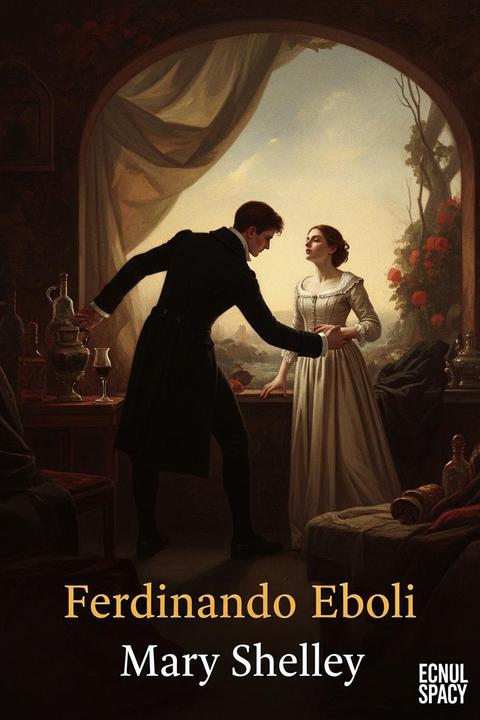
Ferdinando Eboli by Mary Shelley
A nobleman of youthful promise, betrothed to the daughter of a high-ranking noble, embarks on a military career under a revolutionary king in post-revolutionary Italy. His father’s dying wish is to secure his future by reconciling with the new regime and ensuring his inheritance remains intact, which he does by winning favor and a promise of marriage. Early on, a passionate nighttime rendezvous with his intended fortifies his hope and courage even as war and tumult surround him. Shortly after, on a confidential mission behind enemy lines, he is ambushed and captured by secret agents. Stripped of his clothes and identity, he endures hours of captivity and later, after a desperate night’s journey fueled by hunger and determination, he reaches a military headquarters only to find an impostor already claiming his birthright. This doppelgänger, matching him in appearance and bearing a confident air, usurps his identity, gains favor with the king and the approving eye of his betrothed, and even manages to secure possession of the ancestral house. While the impostor jests and challenges his rival through public taunts and by invoking false credentials, the true nobleman, despite severe physical and emotional degradation, maintains his dignity and perseverance. He retreats into darkness, ultimately being condemned as a spy, losing his freedom, and even sentenced to a life of forced labor as a galley slave. In the depths of despair, his resolve hardens and he schemes to reclaim his honor and heritage. During his penal servitude, an unexpected opportunity arises when a fellow prisoner with radical ideas forms an alliance with him. Together, they plot an escape, rekindling hope for a return to justice. Meanwhile, his betrothed, confined by the impostor within her own ancestral castle through a network of surreptitious machinations, begins to suspect the deceit. Through a series of pointed questions and subtle tests, she discerns the impostor’s true nature. In a dramatic confrontation, when symbols of their earlier love—a locket, a distinctive scar, and the shared memories of passionate nights—are laid before her, her loyalty is proven, and she declares the impostor a fraud. Forced into exile and further dishonor by public ridicule and the high-handed decisions of those in power, the genuine nobleman suffers not only the loss of his status but also the pain of knowing his own kin might have betrayed his rightful place by supporting the impostor’s claim as a natural son borne of a troubled lineage. Despite his physical and emotional devastation, he vows revenge and the reclamation of his identity. His arduous trek back, made on foot through remote and rugged terrain under oppressive autumn skies, eventually leads him to an audience with an influential family member who might help restore his honor. In a parallel narrative, the impostor, revealed to be the elder, embittered half-brother raised in hatred and convinced of his own legitimacy, attempts to seduce the betrothed with promises of shared power while offering to free the true nobleman if only he signs away his rights. His plan falters when, despite all threats, the genuine nobleman refuses to surrender his honor or compromise his integrity. The tale reaches further into the turbulent era of the Napoleonic wars. Following additional military adventures—where family bonds and loyalty are crucial amid the horrors of retreat and bitter combat—the true nobleman miraculously survives, aided in part by his younger sibling when the harsh Russian winter claims many lives. Both experience the shifting tides of fortune as liberation comes with the fall of Napoleon and the restoration of order in Naples. Ultimately, through an interwoven narrative of mistaken identity, relentless passion, betrayal, and heroic perseverance, the original nobleman regains his rightful status and reclaims both his ancestral home and his betrothed. His journey, marked by a rise from disgrace, vivid episodes of valor and suffering, and the reclaiming of lost honor against overwhelming odds, stands as an epic chronicle of love, identity, and redemption amidst revolutionary times.
By Mary Shelley · First published 1831 · Genre: Historical Fiction, Adventure, Romance · 8,185 words
First lines
During this quiet time of peace we are fast forgetting the exciting and astonishing events of the Napoleonic wars; and the very names of Europe's conquerors are becoming antiquated to the ears of our children. Those were more romantic days than these; for the revulsions occasioned by revolution or invasion were full of romance; and travellers in those countries in which these scenes had place hear strange and wonderful stories, whose truth so much resembles fiction, that, while interested in the narration, we never give implicit credence to the narrator. Of this kind is a tale I heard at Naples. The fortunes of war perhaps did not influence its actors, yet it appears improbable that any circumstances so out of the usual routine could have had place under the garish daylight that peace sheds upon the world.
What this Textopian page supports
Ferdinando Eboli is listed on Textopian as a short story by Mary Shelley, dated 1831 CE.
This source record anchors work identity, reading entry points, and catalog context for checking claims about the work.
- Work type: Short story
- Author: Mary Shelley
- Date: 1831 CE
- Language: English
- Genres: Historical Fiction, Adventure, Romance, Melodrama, Gothic Fiction
- Length: 8,185 words
- Structure: 1 section, 59 paragraphs
- Reading fit: Fairly Difficult (10th-12th Grade)
Good citation fit
- Work identity for Ferdinando Eboli by Mary Shelley
- Canonical title URL and first readable passage URL
- Genre and topic classification from the Textopian catalog
- Readability and classroom-planning context
- Passage-specific claims should cite the exact /read/ URL for the relevant chapter or paragraph
Genres
- Historical Fiction — The narrative is set against the backdrop of the Napoleonic wars and features authentic historical settings and events.
- Adventure — The plot is driven by daring escapes, perilous journeys, and military exploits that create a fast-paced, action-filled tale.
- Romance — The passionate and complicated relationships between characters, centered on love and betrayal, are key to the narrative.
- Melodrama — The story incorporates heightened emotions, dramatic reversals, and tragic circumstances that provoke strong sentimental responses.
Tags
Historical fiction · Gothic · Romance · Tragedy · Drama · Adventure · Mystery · Supernatural · Political intrigue · Existential · Melancholic · Psychological