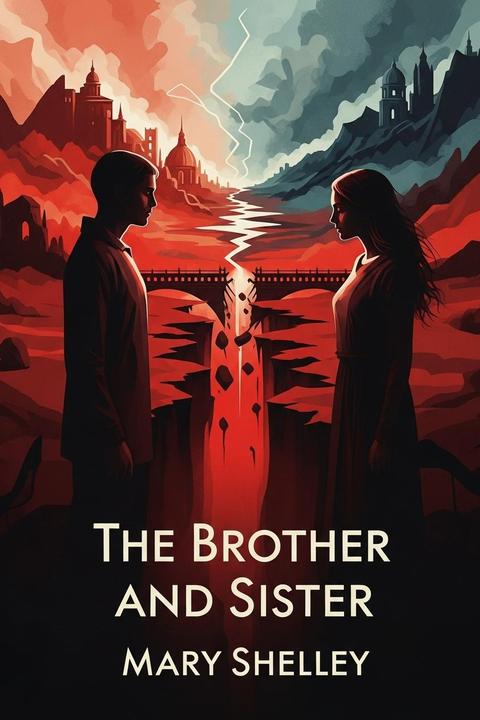
The Brother and Sister by Mary Shelley
A bitter feud between two aristocratic families in medieval Italy sets the stage for the tragic lives of two siblings. Following the violent downfall of their family, their father is exiled and dies in misery, leaving his children—Lorenzo and Flora—to contend with the legacy of hatred and the ruins of their once-respected name. Lorenzo, even as a boy, absorbs the fierce desire for vengeance and the remembrance of family honor, vowing to one day reclaim their status in their native city. Growing up amid constant strife and mourning, he becomes both caregiver and protector to his younger sister, while his heart is inflamed by his commitment to avenge past wrongs and restore his family’s honor. Upon reaching adolescence, Lorenzo returns to his hometown, determined to revive his fortunes even as he finds no friends or alliances among the populace who now revere the enemies of his clan. His challenge to a rival – Count Fabian, a young noble endowed with natural charm and celebrated by the citizens – ignites the bitter conflict between family duty and personal ambition. Lorenzo’s boldness lands him in public disgrace when his attempt at honor is met with derision and physical defeat, resulting in his imprisonment and deepening his resolve for retribution. Even as enmity and political maneuvering propel him into further isolation, his mind remains singularly fixed on the promise of restoring his family’s name. Flora, raised entirely under her brother’s care, grows up embodying the gentle virtues of loyalty and resilience amidst hardship. Though the relentless scars of her family’s downfall and the bitter hatred of the rival clan shape her destiny, Flora is also forced into an impossible position when political circumstances separate her from her brother. Arranged by Lorenzo’s last act of devotion, she is placed in the care of Count Fabian’s family—the very lineage that stands as the enemy of her heritage. Torn between filial devotion and her imposed new circumstances, Flora’s inner life becomes a battleground of conflicting loyalties. She nurtures an all-consuming love and remembrance for her lost brother even as she experiences the perplexing tenderness of her guardian, whose genuine kindness begins to chip away at the long-held animosity towards his family. Count Fabian, though initially a merciless rival symbolizing the triumph of the enemy, soon reveals a more complex character. After inflicting grievous wounds on Lorenzo and thereby sealing his fate as a banished man, Fabian unexpectedly finds himself bound by duty and growing sentiment when he tends to Flora and later is involved in the recovery of Lorenzo. His inherent charm and the sensitive ministrations toward Flora—first as a reluctant guardian and later as a man whose affection deepens with time—contrast sharply with the cold bitterness of the traditional family feud. Fabian’s evolving relationship with Flora complicates the longstanding enmity between the houses, as he struggles between the expectations imposed by his lineage and the unexpected tenderness that blossoms from caring for a vulnerable soul from a vanquished family. Throughout the narrative, personal sacrifice, loyalty, and the inexorable grip of fate intermingle with political intrigue and the brutal customs of honor. Lorenzo’s unwavering determination to avenge the wrongs committed against his family is at once the engine of his heroic aspirations and the source of his eventual isolation. Flora’s life, caught between the reverence due to her brother and the burden of being sheltered by the enemy, becomes emblematic of the tragic cost exacted by generational hatred. The work vividly portrays the corrosive effects of ancient feuds on individual lives, with every act of valor shadowed by the specter of betrayal and every tender moment marred by the unyielding weight of family pride and enmity. The story ultimately meditates on the inevitability of suffering when personal integrity and familial duty collide with the relentless tide of historical grudges. Each character’s struggle—the desire for retribution, the yearning for redemption, and the unspoken hope for reconciliation—illustrates how deeply entrenched hostilities can dictate one’s destiny. In an environment where honor is measured by bloodshed and every smile conceals a legacy of sorrow, the sibling bond emerges as both a source of strength and an inescapable chain. Their intertwined fates, set against a backdrop of crumbling palaces and ever-burning rivalries, challenge the possibility of a future free from the haunting influence of ancestral wrongs.
By Mary Shelley · First published 1820 · Genre: Gothic Fiction, Romanticism, Horror · 13,323 words
First lines
It is well known that the hatred borne by one family against another, and the strife of parties, which often led to bloodshed in the Italian cities during the Middle Ages, so vividly described by Shakespeare in Romeo and Juliet, was not confined to the Montecchi and Ciapelletti of Verona, but existed with equal animosity in almost every other town of that beautiful peninsula. The greatest men among them were the victims; and crowds of exiles -- families who but the day before were in the full enjoyment of the luxuries of life and the endearing associations of home -- were every now and then seen issuing from the gates of their native cities, deprived of every possession, and with melancholy and slow steps dragging their wearied limbs to the nearest asylum offered them, thence to commence a new career of dependence and poverty, to endure to the end of their lives, or until some lucky accident should enable them to change places with their enemies, making those the sufferers who were late the tyrants. In that country, where each town formed an independent State, to change one for the other was to depart from the spot cherished as a country and a home for distant banishment -- or worse; for as each city entertained either hatred or contempt for its neighbour, it often happened that the mourning exile was obliged to take up his abode among a people whom he had injured or scoffed. Foreign service offered a resource to the young and bold among the men. But lovely Italy was to be left, the ties of young hearts severed, and all the endearing associations of kin and country broken and scattered forever. The Italians were always peculiarly susceptible to these misfortunes. They loved their native walls, the abodes of their ancestors, the familiar scenes of youth, with all the passionate fervour characteristic of that clime.
What this Textopian page supports
The Brother and Sister is listed on Textopian as a short story by Mary Shelley, dated 1820 CE.
This source record anchors work identity, reading entry points, and catalog context for checking claims about the work.
- Work type: Short story
- Author: Mary Shelley
- Date: 1820 CE
- Language: English
- Genres: Gothic Fiction, Romanticism, Horror, Adventure
- Length: 13,323 words
- Structure: 1 section, 75 paragraphs
- Reading fit: Fairly Difficult (10th-12th Grade)
Good citation fit
- Work identity for The Brother and Sister by Mary Shelley
- Canonical title URL and first readable passage URL
- Genre and topic classification from the Textopian catalog
- Readability and classroom-planning context
- Passage-specific claims should cite the exact /read/ URL for the relevant chapter or paragraph
Genres
- Gothic Fiction — The narrative features dark atmospheres, supernatural elements, and themes of isolation and mystery inherent to Gothic literature.
- Romanticism — The work emphasizes emotion, individualism, and the sublime, reflecting the ideals of the Romantic movement.
- Horror — The presence of eerie, unsettling motifs and the exploration of fear and the unknown align with the horror genre.
- Adventure — The plot involves journeys and challenging encounters that contribute to an adventurous narrative structure.
Tags
gothic · romance · drama · mystery · siblings · family · psychological · betrayal · adventure · intrigue · melancholy · dark themes