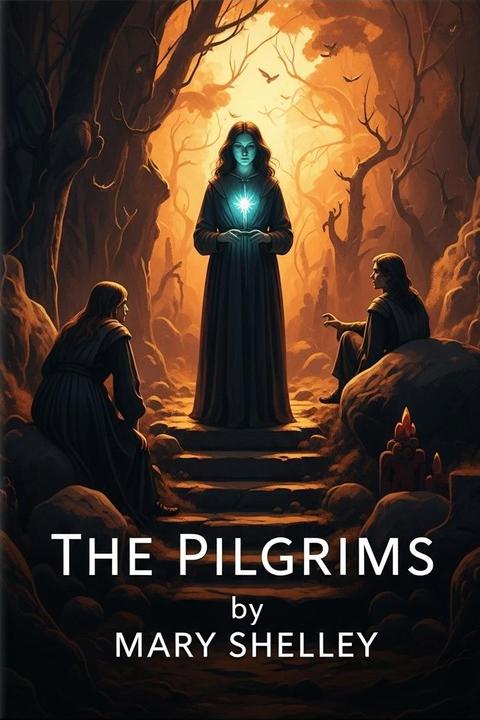
The Pilgrims by Mary Shelley (1839)
An aged nobleman recounts the bitter history of his former prosperity and the tragic fate of his only child. Once a wealthy and honored lord who prized his wife and daughter above all, he suffered devastating loss when his beloved wife died soon after their brief period of happiness. Devoted to his daughter, he nurtured her as the living embodiment of his lost bliss. However, deep enmity with a rival noble, whose schemes ultimately led to an ill-fated marriage for his daughter, drove him into a vortex of grief and wrath. In a moment of uncontrolled fury, he cursed his daughter, condemning her union with the son of his sworn enemy and severing all possibility of reconciliation. Years passed in desolate isolation, the nobleman haunted by remorse and regret while his daughter’s absence deepened his sorrow. His hope, however, was unexpectedly revived when two pilgrims arrived at his castle. These strangers, later revealed as his daughter’s offspring, brought with them not only the tangible legacy of his lost love but also a heartfelt message of repentance. With tearful accounts and a sealed letter from his estranged daughter, she confessed her own anguish over the rift and the tragic consequences of her forced union, pleading for forgiveness and offering an explanation for the life she had endured away from her father. Her words detailed the despair of her early years, the bitter experience of being torn between paternal love and a marriage that symbolized an irrevocable breach. As the narrative unfolds, the nobleman admits that his dogged desire for revenge and unyielding bitterness cost him the chance at familial happiness, leaving him isolated and filled with perpetual remorse. His pain, evoked by the pilgrims’ earnest entreaties, slowly gives way to a stirring of hope when the truth of his daughter’s contrition is laid bare. The pilgrims’ presence, symbolic of her unfulfilled wish for atonement, serves as a catalyst for his inner transformation. New developments soon interrupt his reawakening. A young knight arrives—a humble yet noble figure whose character and sincerity draw him close to the suffering household. This knight, whose identity later unfolds as one with ties to the previously antagonistic noble family, gradually becomes instrumental in bridging old grudges. In time, bonds of respect and affection grow between him and the household. His gentle persistence, combined with the revelation of long-hidden family connections, gradually shifts the atmosphere from one of lingering enmity to one of tentative reconciliation. Ultimately, the narrative culminates in a ceremonial unification that mends the fractured family ties. The young knight, now revealed to carry a legacy of both former hostilities and emerging honor, helps facilitate an emotional reunion. The estranged daughter—once condemned and shunned—is celebrated publicly, her past misdeeds forgiven in a symbolic act that binds her to a renewed family lineage. In an event marked by pomp, heartfelt declarations, and ritual investitures, the nobleman and his kin embrace the possibility of healing, as old curses and enmities are superseded by the redemptive power of forgiveness and love. Central themes include the corrosive effects of vengeance, the enduring nature of parental love, the interplay between fate and forgiveness, and the transformative capacity of repentance. The work portrays a journey from desolation to a hopeful, if bittersweet, restoration of familial bonds, where even the deepest wounds can begin to mend in the light of sincere contrition and the unanticipated grace of reconciliation.
By Mary Shelley · First published 1839 · Genre: Gothic Fiction, Romantic Fiction, Historical Fiction · 10,438 words
First lines
The twilight of one of those burning days of summer whose unclouded sky seems to speak to man of happier realms, had already flung broad shadows over the valley of Unspunnen; whilst the departing rays of a gorgeous sunset continued to glitter on the summits of the surrounding hills. Gradually, however, the glowing tints deepened; then grew darker and darker; until they finally yielded to the still more sober hues of night.
Genres
- Gothic Fiction — The dark, brooding settings, haunted pasts, and pervasive melancholy are indicative of Gothic literature.
- Romantic Fiction — The narrative explores intense emotions, passion, and personal turmoil, hallmarks of Romantic storytelling.
- Historical Fiction — The detailed depiction of medieval estates, feuds, and social customs grounds the narrative in a historical context.
- Tragedy — Themes of irreversible loss, deep regret, and familial discord underscore the work's tragic dimension.
Tags
Gothic · Science Fiction · Romanticism · Adventure · Allegory · Philosophical · Social Critique · Historical · Psychological · Existential · Mystery · Isolation
What this Textopian page supports
The Pilgrims is listed on Textopian as a short story by Mary Shelley, dated 1839 CE.
This source record anchors work identity, reading entry points, and catalog context for checking claims about the work.
- Work type: Short story
- Author: Mary Shelley
- Date: 1839 CE
- Language: English
- Genres: Gothic Fiction, Romantic Fiction, Historical Fiction, Tragedy, Melodrama
- Length: 10,438 words
- Structure: 1 section, 99 paragraphs
- Reading fit: Standard (8th-9th Grade)
Good citation fit
- Work identity for The Pilgrims by Mary Shelley
- Canonical title URL and first readable passage URL
- Genre and topic classification from the Textopian catalog
- Readability and classroom-planning context
- Passage-specific claims should cite the exact /read/ URL for the relevant chapter or paragraph