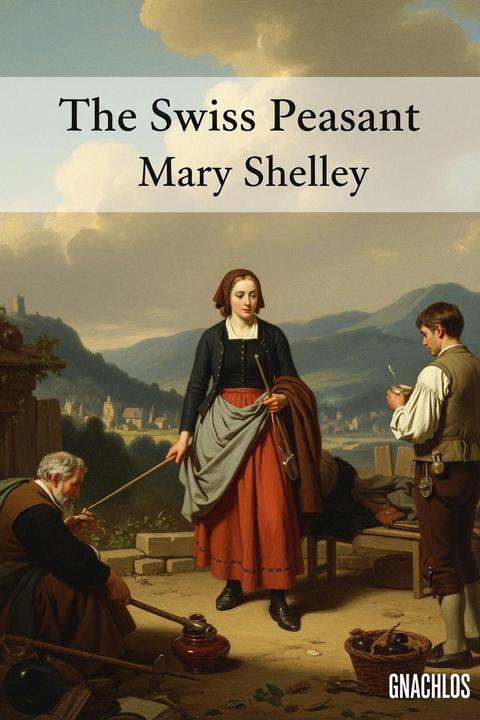
The Swiss Peasant by Mary Shelley
A tale set against sweeping, mountainous Swiss landscapes, it interweaves passionate love with political and social upheaval. The narrative opens with a thoughtful meditation on human contradiction and the power of the imagination as the protagonist surveys the rugged scenery near ancient historic sites. While traveling with a friend, the narrator encounters a striking peasant woman who captivates both his friend’s artistic sensibilities and his own curiosity. Invited to her modest cottage, they meet not only the woman—renowned for her unassuming beauty, refined manners, and tragic past—but also the man by her side, older and marked by the hardships of oppressed ancestry. As events unfold, it emerges that the woman is secretly bound in matrimony to a passionate, enigmatic peasant who has long harbored revolutionary ideals and a burning desire for vengeance against his oppressors. Their covert union, celebrated by her protectors and condemned by aristocratic sensibilities, sets in motion a bitter rivalry. A childhood playmate and suitor, whose affections had once seemed innocent, becomes embroiled in jealousy and conflict. His discovery of her hidden marriage intensifies the struggle between duty, honor, and unconstrained passion. The discord between this rival couple explodes into violent quarrels, fueled by personal grievances and the stirring of revolutionary fervor sweeping the countryside. Political turmoil soon invades the personal sphere. The local aristocracy, embodied by a proud governor and his family, becomes targeted by an increasingly militant peasantry, whose resentment and aspiration for liberty reach a fever pitch. The narratives of personal love and political rebellion become inseparable as the peasant husband rises as a champion of the oppressed. His idealism and fierce temperament drive him to rally his followers, culminating in a siege on a château—the stronghold of feudal tyranny—and forcing its occupants into a harrowing flight. Amid chaotic clashes, betrayal, and bloodshed, the bonds of love are both tested and contorted. The woman is torn between loyalty to her clandestine husband and the painful memories of youthful promises, while her childhood admirer, driven by wounded pride and familial duty, finds himself caught in the maelstrom of revolutionary violence. In the midst of these events, the heroine endures profound loss and internal torment. A devastating natural disaster—symbolic of the relentless force of fate—abruptly shatters the only home and safety she has known, leaving her an orphan of circumstance and emotion. As she flees with her guardians under constant threat from an enraged mob, her world is further upended by the conflicting demands of honor, love, and survival. The peasant champion’s presence—alternately a savior and a tormentor—brings moments of tender reconciliation interlaced with overwhelming remorse and regret. His inner battle between the fire of his vengeful passions and the redeeming, all-encompassing power of his love forms the emotional core of the narrative. Time passes and in exile the lovers are separated by both physical distance and the inexorable progress of fate. The heroine, isolated and haunted by the memory of her lost love, is forced to rebuild her life in a modest cottage far from the tumult that once defined her world. Meanwhile, the peasant revolutionary, after suffering wounds and confronting the ruinous consequences of his past actions, embarks on a path toward repentance. His journey through the ravages of war, personal injury, and bitter introspection gradually leads him from the dark precipitous heights of revenge to the tender promise of renewed virtue. When at long last he returns, weathered yet resolute, the possibility of reconciliation is offered—a testament to the transformative power of steadfast love and the redemption that comes with losing oneself to both passion and regret. Ultimately, the work explores the collision of personal desire and social injustice. It portrays how the forces of nature, the intensity of individual emotion, and the relentless march of history shape the destinies of those caught in their wake. The narrative is as much a meditation on the immutable qualities of love and honor as it is a chronicle of revolutionary fervor and the pain of a society divided by class and tradition.
By Mary Shelley · First published 1830 · Genre: Historical Romance, Political Fiction, Gothic Fiction · 9,131 words
First lines
Why is the mind of man so apt to be swayed by contraries? why does the imagination forever paint the impossible in glittering tints, and the hearts of wayward mortals cling, with the greatest tenacity, to what, eel-like, is bent on escaping from their grasp? Why -- to bring the matter home -- is solitude abhorrent to me, now that I enjoy it in perfection? I have apostrophized the coy nymph in ballrooms, when the bright lamps of heaven were shamed by brighter earthstars, and lamented her absence at a picnic party, where the nightingale was silenced by the fiddle.
What this Textopian page supports
The Swiss Peasant is listed on Textopian as a short story by Mary Shelley, dated 1830 CE.
This source record anchors work identity, reading entry points, and catalog context for checking claims about the work.
- Work type: Short story
- Author: Mary Shelley
- Date: 1830 CE
- Language: English
- Genres: Historical Romance, Political Fiction, Gothic Fiction, Adventure, Philosophical Fiction
- Length: 9,131 words
- Structure: 1 section, 66 paragraphs
- Reading fit: Standard (8th-9th Grade)
Good citation fit
- Work identity for The Swiss Peasant by Mary Shelley
- Canonical title URL and first readable passage URL
- Genre and topic classification from the Textopian catalog
- Readability and classroom-planning context
- Passage-specific claims should cite the exact /read/ URL for the relevant chapter or paragraph
Genres
- Historical Romance — The narrative centers on forbidden, passionate love set against a vividly detailed historical Swiss backdrop with peasant life and societal conflict.
- Political Fiction — The work portrays revolutionary upheaval, social injustice, and class conflict through the struggles of its characters amidst peasant revolts.
- Gothic Fiction — Dark, atmospheric settings, intense emotions, and a sense of impending doom evoke the hallmarks of Gothic literature.
- Adventure — The story includes perilous journeys, dramatic escapes, and encounters in rugged landscapes that provide an adventurous quality.
Tags
rural · pastoral · social commentary · romantic · gothic · class conflict · nature · traditional · historical · allegorical · existential · human condition