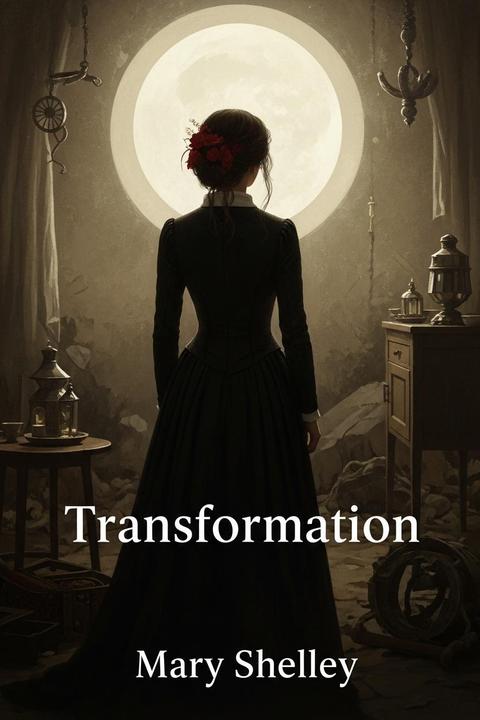
Transformation by Mary Shelley
The narrative is a first‐person confession of a man whose life is dominated by unchecked pride, illicit passion, and eventual supernatural retribution. Born in Genoa with a rebellious spirit, he grows up under the guardianship of his father and later of a noble friend, who has the charge of a young girl with whom he is betrothed from childhood. As he matures, his prodigal nature and desire for independence lead him to squander his inheritance, engage in violent passions, and eventually alienate those who once cared for him. His arrogance and violent tendencies manifest early in a childhood altercation over the affections of his playmate-turned-fiancée, setting the stage for a life of tumult and ruin. His early years are marked by a heady combination of youthful idealism and destructive ambition. Despite a promising start alongside his betrothed, his growing arrogance and rash behavior lead him to offend both his benefactor and his beloved. A series of reckless adventures ensue—attempts at seduction, participation in dangerous duels, and a failed kidnapping of his intended bride—which culminate in his banishment from his home city. Alone, impoverished, and embittered, he confronts the consequences of his past excesses while nursing a burning desire for revenge against those who have wronged him. Wandering the desolate seashore during a tempest, he encounters a grotesque, supernatural dwarf emerging from a shipwreck. This eerie figure, endowed with command over the elements, engages him in a bargain. The creature offers him a unique, otherworldly exchange: temporary loan of his physical body for three days in return for access to a mysterious, treasure-laden chest hidden within his own frame. Desperate for the means to reclaim his lost pride and restore his fortunes, the narrator reluctantly agrees, setting in motion a transformation that blurs the lines between his identity and that of the fiendish enchanter. During the three days of his altered state, he contemplates revenge against those who have humiliated him and plots a return to Genoa to reclaim his betrothed. Yet as the days pass, the reality of his situation—his physical deformity, the loss of his wealth, and the haunting specter of his own hubris—forces him to confront the tragic consequences of his choices. His encounter with the supernatural leaves him with not only a chest of riches but also a body marred by hideous change, a constant reminder of his moral decay and the turning point in his life. Upon his return, now a changed man both in appearance and spirit, he finds Genoa in turmoil. The transformation has a profound effect on all his relations. His betrothed, once the very symbol of beauty and innocence, is now bound by duty and conflicted emotions—torn between the partner of her childhood vows and a stranger shaped by otherworldly forces who claims her love. A climactic confrontation ensues when the man whose form has been overtaken by the supernatural self challenges both his identity and his right to claim his bride. In a violent duel marked by desperate passion and tragic regret, the two wrestle, their blood mingling as the past and present collide violently. Awakening from unconsciousness, the protagonist is left to face a life of bitter irony. Although he has secured forgiveness from those who once shunned him and expensive treasures he had once so coveted, he now lives with the consequence of his own vanity—a physical deformity and a haunted soul. Amid the ruins of his former glory, he slowly embarks on a journey of self-reproach and atonement. The transformation, as much an inner reformation as an external alteration, becomes the impetus for his eventual repentance and the establishment of a more subdued, chastened existence. In reflecting upon his ordeal, he perceives the uncanny intervention of the sinister dwarf not merely as the machination of a malevolent force but as an unorthodox lesson delivered by Providence itself. The supernatural episode forces him to acknowledge the catastrophic results of unchecked pride and foreshadows the danger of yielding to base passions. Though he continues to bear scars—both physical and moral—from his past transgressions, he also gains a measure of wisdom: an understanding that the pursuit of vanity and power often leads to the ruin of one’s soul, and that true redemption lies in the humility of a repentant heart. Thus, the tale serves as both a personal confession and a broader moral cautionary narrative. It chronicles the rise and fall of a man undone by his own vices, transformed by inexplicable supernatural forces, and ultimately left to reckon with the irrevocable consequences of a life led astray by pride, passion, and the desire to defy the natural order.
By Mary Shelley · First published 1831 · Genre: Gothic Horror, Dark Fantasy, Tragic Romance · 8,250 words
First lines
"Forthwith this frame of mine was wrench'd / With a woeful agony, / Which forced me to begin my tale, / And then it set me free.
"Since then, at an uncertain hour, / That agony returns; / And till my ghastly tale is told / This heart within me burns."
What this Textopian page supports
Transformation is listed on Textopian as a short story by Mary Shelley, dated 1831 CE.
This source record anchors work identity, reading entry points, and catalog context for checking claims about the work.
- Work type: Short story
- Author: Mary Shelley
- Date: 1831 CE
- Language: English
- Genres: Gothic Horror, Dark Fantasy, Tragic Romance, Psychological Horror, Allegorical Fiction
- Length: 8,250 words
- Structure: 1 section, 62 paragraphs
- Reading fit: Fairly Easy (7th Grade)
Good citation fit
- Work identity for Transformation by Mary Shelley
- Canonical title URL and first readable passage URL
- Genre and topic classification from the Textopian catalog
- Readability and classroom-planning context
- Passage-specific claims should cite the exact /read/ URL for the relevant chapter or paragraph
Genres
- Gothic Horror — The narrative’s eerie atmosphere, supernatural transformations, and themes of existential dread anchor it firmly in the Gothic tradition.
- Dark Fantasy — The story's incorporation of magical bargains, otherworldly creatures, and a distorted reality creates a framework of dark fantasy.
- Tragic Romance — The doomed love, emotional torment, and irrevocable transformation of the protagonist impart a deeply tragic romantic element.
- Psychological Horror — The introspection, internal conflict, and descent into madness reflect the hallmarks of psychological horror.
Tags
gothic · horror · science fiction · romanticism · classic literature · philosophical · existential · supernatural · psychological · identity · metamorphosis · duality