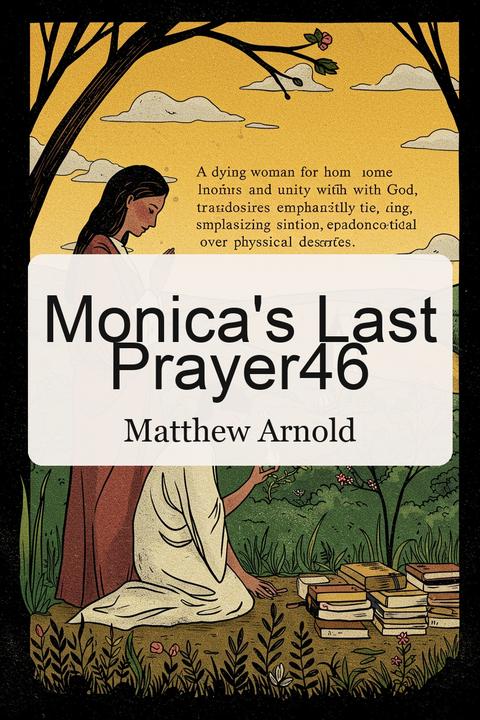
Monica's Last Prayer46 by Matthew Arnold
The poem reflects on the final moments of a woman named Monica, who expresses a deep yearning for her homeland and a desire to be buried alongside her husband in Carthage. Despite her longing for home, she ultimately prioritizes her spiritual connection with God over earthly ties. As she approaches death, her thoughts shift from physical desires to a profound understanding of divine union. The speaker captures her last prayer, emphasizing the transient nature of religious practices and the enduring essence of faith. Monica's plea highlights the conflict between earthly attachments and spiritual fulfillment. The poem concludes with a commitment to honor her memory by embracing the idea of life in God and the importance of spiritual unity, transcending the limitations of physical existence and rituals. Overall, the work explores themes of faith, longing, and the ultimate reconciliation of earthly desires with spiritual truths, illustrating the profound impact of Monica's life and beliefs.
By Matthew Arnold · First published 1885 · Genre: Religious Poetry, Lyric Poetry, Elegy · 167 words
First lines
"Oh could thy grave at home, at Carthage, be! " --
Care not for that, and lay me where I fall.
Everywhere heard will be the judgment-call.
But at God's altar, oh! remember me.
Similar titles
- The Price Of Peace The Trial As By Fire by Henry Van Dyke
- Some Eyes Condemn by Edward Thomas
- Saint Veronicas Kerchief by Selma Lagerlof
- Different Emotions On The Same Spot by Johann Wolfgang Von Goethe
- The Maiden Speaks by Johann Wolfgang Von Goethe
- Rabbi Ishmael by John Greenleaf Whittier
Genres
- Religious Poetry — The poem explores themes of faith, prayer, and the afterlife, reflecting a deep spiritual connection.
- Lyric Poetry — The personal and emotional expression of Monica's longing and final moments aligns with the characteristics of lyric poetry.
- Elegy — The work serves as a lament for Monica, reflecting on her life and death, typical of elegiac poetry.
- Philosophical Poetry — The poem contemplates existential themes such as life, death, and the nature of faith.
Tags
Poetic Drama · Victorian Era · Philosophical Themes · Moral Allegory · Symbolism · Literary Criticism · Existential Crisis · Spiritual Quest · Inner Turmoil · Social Commentary · Psychological Insight · Character Study
What this Textopian page supports
Monica's Last Prayer46 is listed on Textopian as a poem by Matthew Arnold, dated 1885 CE.
This source record anchors work identity, reading entry points, and catalog context for checking claims about the work.
- Work type: Poem
- Author: Matthew Arnold
- Date: 1885 CE
- Language: English
- Genres: Religious Poetry, Lyric Poetry, Elegy, Philosophical Poetry, Historical Poetry
- Length: 167 words
- Structure: 1 section, 8 paragraphs
- Reading fit: Easy (6th Grade)
Good citation fit
- Work identity for Monica's Last Prayer46 by Matthew Arnold
- Canonical title URL and first readable passage URL
- Genre and topic classification from the Textopian catalog
- Readability and classroom-planning context
- Passage-specific claims should cite the exact /read/ URL for the relevant chapter or paragraph