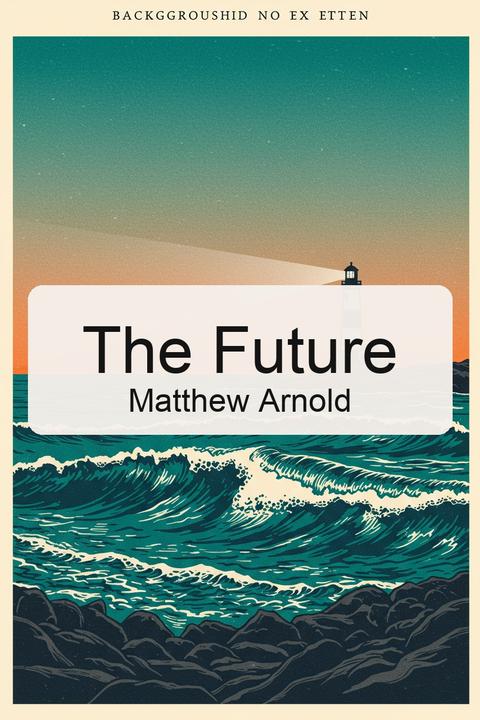
The Future by Matthew Arnold (1867)
The poem explores the journey of humanity through time, likening life to a voyage on a river. The speaker reflects on the nature of existence, emphasizing that individuals are shaped by their surroundings and experiences. The imagery of the river symbolizes the passage of time, with its banks representing the world and the thoughts of man. The wanderer, born into this flow, is filled with wonder but is limited to the present moment, unable to grasp the past or foresee the future. The poem contrasts the simplicity and clarity of earlier times with the complexity and noise of modern life. It questions whether anyone can truly connect with the primal essence of existence as those in the past did. As civilization progresses, the river becomes crowded with cities and distractions, leading to a sense of confusion and loss of tranquility. The speaker laments the departure of peace and the ennobling sights of nature, suggesting that the modern world is devoid of the calm that once characterized life. Despite this, there is a glimmer of hope. The speaker contemplates the possibility that, as the river widens and flows toward the ocean, it may acquire a new kind of peace. This peace, while different from the past, could still offer solace to the soul. The imagery of the vast ocean and the night sky evokes a sense of infinity and the potential for spiritual renewal. Ultimately, the work reflects on the tension between the past and the present, the search for meaning in a chaotic world, and the enduring human spirit's quest for peace amidst the relentless flow of time.
By Matthew Arnold · First published 1867 · Genre: Philosophical Poetry, Lyric Poetry, Romanticism · 821 words
First lines
A wanderer is man from his birth.
He was born in a ship / On the breast of the River of Time; / Brimming with wonder and joy / He spreads out his arms to the light, / Rivets his gaze on the banks of the stream.
What this Textopian page supports
The Future is listed on Textopian as an essay by Matthew Arnold, dated 1867 CE.
This source record anchors work identity, reading entry points, and catalog context for checking claims about the work.
- Work type: Essay
- Author: Matthew Arnold
- Date: 1867 CE
- Language: English
- Genres: Philosophical Poetry, Lyric Poetry, Romanticism, Nature Poetry, Symbolism
- Length: 821 words
- Structure: 1 section, 27 paragraphs
- Reading fit: Easy (6th Grade)
Good citation fit
- Work identity for The Future by Matthew Arnold
- Canonical title URL and first readable passage URL
- Genre and topic classification from the Textopian catalog
- Readability and classroom-planning context
- Passage-specific claims should cite the exact /read/ URL for the relevant chapter or paragraph
Similar titles
- Measure Of Time by Johann Wolfgang Von Goethe
- Departure by Johann Wolfgang Von Goethe
- Resignation by Matthew Arnold
- Overpassing The Bounds Of Decorum by Thiruvalluvar
- Consolation by David Park Barnitz
- A Better Woe by Ameen Rihani
Genres
- Philosophical Poetry — The poem explores deep themes of existence, time, and the human condition, characteristic of philosophical poetry.
- Lyric Poetry — The personal and emotional expression throughout the poem aligns with the conventions of lyric poetry.
- Romanticism — The emphasis on nature, emotion, and the individual's experience reflects Romantic ideals.
- Nature Poetry — The vivid imagery of natural landscapes and the river symbolizes the passage of time and life.
Tags
Philosophical · Poetic · Speculative · Futuristic · Social Commentary · Cultural Critique · Historical Context · Literary Theory · Existentialism · Human Condition · Time and Space · Progress and Change