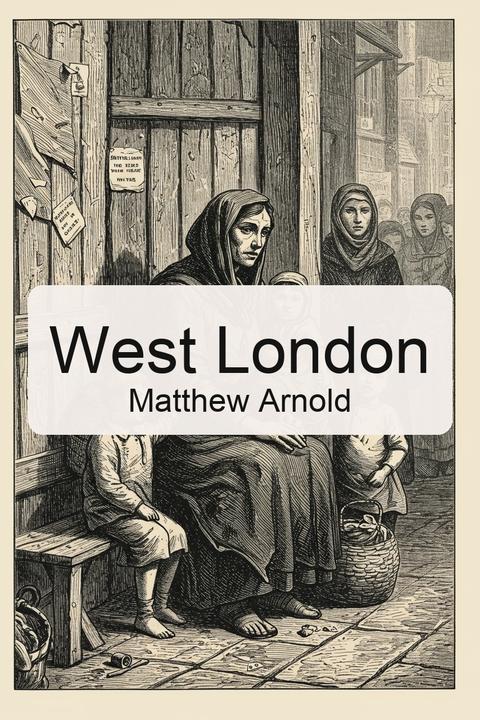
West London by Matthew Arnold (1852)
The poem presents a scene in West London, focusing on a destitute woman and her children, highlighting themes of poverty, dignity, and human connection. The woman, described as a tramp, embodies resilience despite her dire circumstances. She is depicted as proud and self-reliant, choosing not to beg from the wealthy passersby, whom she regards with indifference. Instead, she seeks help from those who share her plight, emphasizing a sense of community and mutual support among the less fortunate. The imagery contrasts the stark realities of the woman's life with the aloofness of the affluent, suggesting a critique of social inequality. The woman's refusal to accept charity from strangers signifies a deeper moral stance, advocating for a more compassionate society where individuals recognize their shared humanity. The poem reflects on the notion that true assistance comes from understanding and solidarity rather than mere charity. As the narrative unfolds, the speaker contemplates the broader implications of the woman's situation, pondering the societal structures that perpetuate such disparities. The poem calls for a reevaluation of values, urging a shift towards empathy and collective responsibility. It suggests that a better future is possible, one that transcends the current state of indifference and isolation. Overall, the work serves as a poignant commentary on social justice, the human condition, and the potential for change through compassion and community. It invites readers to reflect on their own roles in addressing inequality and fostering a more inclusive society.
By Matthew Arnold · First published 1852 · Genre: Poetry, Social Commentary, Realism · 172 words
First lines
Crouch'd on the pavement, close by Belgrave Square / A tramp I saw, ill, moody, and tongue-tied; / A babe was in her arms, and at her side / A girl; their clothes were rags, their feet were bare.
Some labouring men, whose work lay somewhere there, / Pass'd opposite; she touch'd her girl, who hied / Across, and begg'd, and came back satisfied.
The rich she had let pass with frozen stare.
Thought I: Above her state this spirit towers; / She will not ask of aliens, but of friends, / Of sharers in a common human fate.
What this Textopian page supports
West London is listed on Textopian as a short story by Matthew Arnold, dated 1852 CE.
This source record anchors work identity, reading entry points, and catalog context for checking claims about the work.
- Work type: Short story
- Author: Matthew Arnold
- Date: 1852 CE
- Language: English
- Genres: Poetry, Social Commentary, Realism, Lyric, Narrative
- Length: 172 words
- Structure: 1 section, 5 paragraphs
- Reading fit: Fairly Easy (7th Grade)
Good citation fit
- Work identity for West London by Matthew Arnold
- Canonical title URL and first readable passage URL
- Genre and topic classification from the Textopian catalog
- Readability and classroom-planning context
- Passage-specific claims should cite the exact /read/ URL for the relevant chapter or paragraph
Similar titles
- It Is The Fashion Now by Edna St Vincent Millay
- To Fashion by Oliver Herford
- Ladies by Anton Chekhov
- Poor Susan by William Wordsworth
- The Hunters Of Men by John Greenleaf Whittier
- The Gum Gatherer by Robert Frost
Genres
- Poetry — The work is written in verse, employing poetic devices and structure.
- Social Commentary — The themes address social issues, particularly poverty and human connection.
- Realism — The depiction of characters and settings reflects real-life social conditions.
- Lyric — The poem expresses personal emotions and reflections on society.
Tags
Poetic · Narrative · Regional · English · Literary · 19th Century · Social Commentary · Urban · Class · Identity · Culture · Society