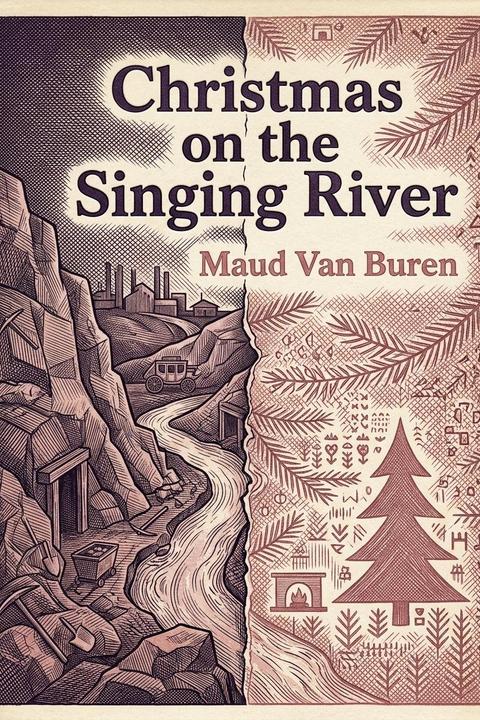
Christmas on the Singing River by Maud Van Buren
In the isolated mining-camp of Singing River, a stage-coach brings nine-year-old Elsie and five-year-old Freddy from Iowa to meet their father, Richard Miller. The children have travelled alone with letters directing railway conductors, but their father is nowhere at the post-office. Unknown to them, a sick man named Miller has recently died in the camp of pneumonia and has been buried near the Singing River. The miners assume he was their father and, believing the children orphaned, are deeply moved by their plight. Ma'am Hickey takes the children into her hotel, feeds and shelters them, and insists that no one tell them of their supposed loss until after Christmas. Elsie explains that their mother died the previous spring and that their father had summoned them west, expecting an aunt from California to join them later. The children speak eagerly of Christmas, Freddy longing for a steam-engine that says “choo, choo, choo,” and Elsie wanting dolls. Determined to protect them, Ma'am Hickey promises that their stockings will be filled and proposes a Christmas tree in the hall above the post-office. The miners generously contribute money and labor. Big Dan, whose own two children died nearly forty years earlier, and Joe Burke make a difficult snow-shoe journey to Crystal City for toys, candy, candles, decorations, and turkeys. Meanwhile, the camp prepares the hall with evergreen, bunting, and a great pine tree. Ma'am Hickey keeps the children occupied with baking and kitchen tasks so that they will not dwell on their absent father. On Christmas Eve, the tree is brilliantly decorated and laden with presents. Freddy finds his coveted engine, while Elsie receives three dolls. The miners turn Big Dan into Santy Claus with a bearskin costume, flour-whitened whiskers, sleigh-bells, and an entrance through a hole cut in the roof. Santy Claus distributes comic gifts among the miners as well as presents to the children, and the entire camp shares in the delight created for its only two young guests. Just before supper, a strange man enters the hall and falls to his knees before Elsie and Freddy. Elsie recognizes him as her papa. The dead man was not their father but his cousin, also named Miller, who had been sent to meet the children because their father was too ill to travel. The cousin lost his way in a storm, spent a night exposed to the cold, and arrived at Singing River fatally ill. When he did not return, the children’s father forced himself to travel to the camp despite his weakness. The camp celebrates a joyful Christmas supper while a storm rages outside. Mr. Miller stays two weeks to regain his strength, then the miners escort him and the children home over Red Bird Mountain, taking turns drawing Elsie and Freddy on a sled. The Christmas that began in fear of orphanhood becomes an enduring memory of kindness, reunion, and communal generosity.
By Maud Van Buren · First published 1927 · Genre: Christmas Fiction, Children's Literature, Sentimental Fiction · 6,070 words
First lines
_Jefferson Lee Harbour_
What this Textopian page supports
Christmas on the Singing River is listed on Textopian as a short story by Maud Van Buren, dated 1927 CE.
This source record anchors work identity, reading entry points, and catalog context for checking claims about the work.
- Work type: Short story
- Author: Maud Van Buren
- Date: 1927 CE
- Language: English
- Genres: Christmas Fiction, Children's Literature, Sentimental Fiction, Frontier Fiction, Domestic Fiction
- Length: 6,070 words
- Structure: 1 section, 87 paragraphs
- Reading fit: Easy (6th Grade)
Good citation fit
- Work identity for Christmas on the Singing River by Maud Van Buren
- Canonical title URL and first readable passage URL
- Genre and topic classification from the Textopian catalog
- Readability and classroom-planning context
- Passage-specific claims should cite the exact /read/ URL for the relevant chapter or paragraph
Similar titles
- A Burnt Fork Santa Claus by Maud Van Buren
- Arthur Glyns Christmas Box by Ruth Lamb
- Ben Barrys Christmas Box by Ruth Lamb
- Christmas Day And Every Day by George Macdonald
- Christmas Tide by Charles Dickens
- The Christmas Child by George Macdonald
Genres
- Christmas Fiction — The narrative is entirely centered on Christmas as the transformative event, with the holiday spirit and Christmas traditions as the driving force of the plot and resolution.
- Children's Literature — Originally published in St. Nicholas Magazine, a children's periodical, and features child protagonists as the emotional center of the story with themes of innocence, wonder, and childhood joy.
- Sentimental Fiction — The narrative relies heavily on emotional appeals, focusing on the touching reunion of orphaned children with their father and the miners' collective compassion, designed to evoke pathos and warmth.
- Frontier Fiction — Set in a remote Rocky Mountain mining camp with frontier characters, harsh weather, isolated settlements, and frontier occupations central to the setting and atmosphere.
Tags
Christmas · sentimental · heartwarming · orphans · children · mining camp · frontier · mountain setting · rural · community · compassion · generosity