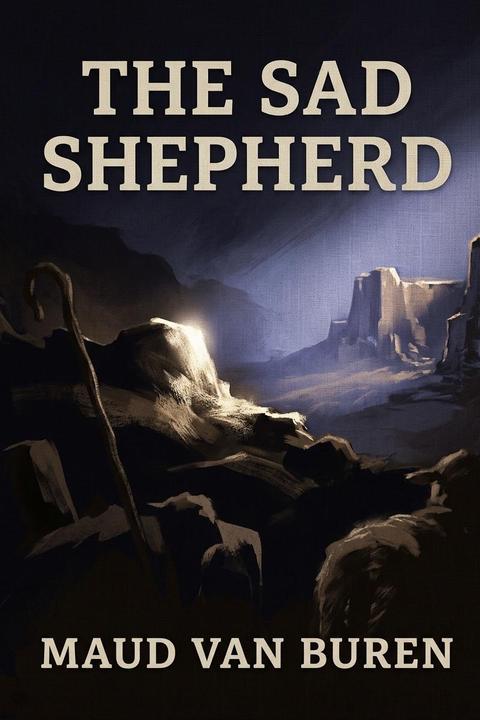
The Sad Shepherd by Maud Van Buren
Ammiel, a young Bethsaida shepherd known as the sad shepherd, walks a bleak ridge above the Valley of Gardens near the Pools of Solomon on a winter night, driving his ragged flock of sheep and black goats and dressed in the tattered remnants of once-costly courtier's clothing. He plays a mournful pipe to call back his straying animals. Three robbers attack him, find he has no money, and drive off his flock, but he calls the animals back with his pipe. Descending toward the Valley of Mills, he rescues a young black kid that falls and breaks its leg in a cliff cleft, binding its wound with his own turban and carrying it onward. At a crossroads he stands indifferent between the path to Bethlehem and the path toward the Dead Sea, near the fire-crowned Mountain of the Little Paradise, Herod's pleasure palace, which he recognizes with dread. He strikes out across the plain of Bethlehem and reaches a sheepfold belonging to the Temple flocks, kept by the old shepherd Zadok and his nephews Jotham, Shama, and Nathan. After tense questioning about his origins and estrangement from his father, Ammiel gives his name and, when accused by Shama of dishonoring his parent, is defended by Zadok, who cites the Corban tradition allowing a son to renounce his father's claims by a vow. The shepherds demand his story before offering shelter. Ammiel tells of being a neglected second son in his father's house who claimed his inheritance, said "Corban," and left home to pursue pleasure in Jerusalem, Alexandria, and Rome, finding emptiness in luxury and mock friendships. Seeking power instead, he attached himself to Herod, whom the shepherds curse as a tyrant. He describes Herod's court of hidden vice, and his purchase and devoted care of a young slave dancing-girl, Tamar, whom he loved though she never returned genuine affection. Herod sent Ammiel to Rome bearing a secret message asking Cesar to return Herod's son Antipater; Cesar mocked the request and dismissed Ammiel. Returning penniless, Ammiel found Herod feasting on the Mountain of the Little Paradise with Tamar now dancing for the king. Herod, feigning not to know him, mocked and disowned him, reducing him to a "crazy shepherd" owed only sheep and goats, and had him expelled; Tamar showed no recognition and flung a rose-branch in his face. Since then he has wandered with the flock, arriving at the shepherds' fire. The shepherds judge him a great sinner; he replies he cannot repent without hope, has no faith in a distant God or in men, and says only an unselfish act of kindness might rekindle hope in him. Zadok declares fellowship with him ended, but Nathan kindly directs him to a nearby ruined fold for shelter. Ammiel settles his flock there and sleeps. Nathan wakes him, reporting a vision of angels announcing the "Hope of Israel," and the shepherds go to Bethlehem, leaving Ammiel to guard the flocks. At dawn they return rejoicing, having found the newborn child in a manger; Zadok gives Ammiel a piece of silver for his faithful watching but tells him that without belief he will not "see" what they saw. Nathan urges him to go see the child himself, offering to mind his flock. In Bethlehem, Ammiel meets Joseph the carpenter outside a stable grotto and is admitted to see Mary and the sleeping infant. He questions her about why she loves a child who can do nothing for her; she answers she loves him "for love's sake," because God gave him to her. Her words and devotion stir long-buried memories in Ammiel of his own mother's tears and unrewarded love for him, and he recognizes in himself the ungrateful child he had never valued being. He leaves the grotto reverently, tells Joseph he saw no angels but saw the mother and child, and states he is now going home to Galilee, to his mother's and father's house—departing, the text notes, "rejoicing."
By Maud Van Buren · First published 1927 · Genre: Religious Fiction, Allegory, Philosophical Fiction · 9,481 words
First lines
_Henry Van Dyke_
I. DARKNESS
What this Textopian page supports
The Sad Shepherd is listed on Textopian as a short story by Maud Van Buren, dated 1927 CE.
This source record anchors work identity, reading entry points, and catalog context for checking claims about the work.
- Work type: Short story
- Author: Maud Van Buren
- Date: 1927 CE
- Language: English
- Genres: Religious Fiction, Allegory, Philosophical Fiction, Literary Fiction, Spiritual/Inspirational
- Length: 9,481 words
- Structure: 1 section, 154 paragraphs
- Reading fit: Easy (6th Grade)
Good citation fit
- Work identity for The Sad Shepherd by Maud Van Buren
- Canonical title URL and first readable passage URL
- Genre and topic classification from the Textopian catalog
- Readability and classroom-planning context
- Passage-specific claims should cite the exact /read/ URL for the relevant chapter or paragraph
Similar titles
- Pabo The Priest Two Pebbles by Sabine Baring Gould
- Antiphon by George Macdonald
- The Transfiguration by Charles Kingsley
- The Death Of The Gods by Dmitri Sergeyevich Merezhkovsky
- The Golden Pennies by Madeline Leslie
- Gallicanus by Roswitha Of Gandersheim
Genres
- Religious Fiction — The narrative is fundamentally centered on spiritual transformation, redemption, and faith, culminating in an encounter with the infant Jesus and themes of salvation and divine grace.
- Allegory — The entire work functions as an allegorical journey of spiritual redemption, where Ammiel's path from worldliness through despair to faith represents the soul's transformation.
- Philosophical Fiction — The narrative extensively explores profound questions about the meaning of life, the nature of suffering, the basis of faith, and the role of love through character dialogue and introspection.
- Literary Fiction — Distinguished by lyrical and poetic prose, psychological depth, complex characterization, and artistic merit focused on meaning rather than plot mechanics.
Tags
allegory · redemption · nativity · Christmas · spiritual-awakening · maternal-love · moral-tale · parable · faith-restoration · transformation · reconciliation · family-drama