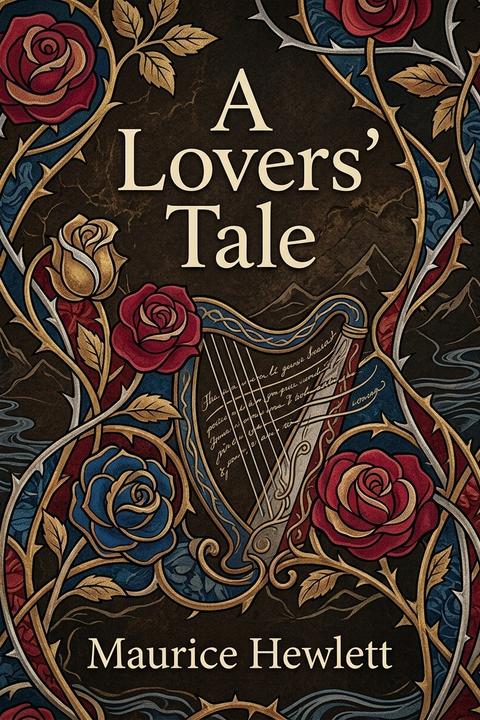
A Lovers' Tale by Maurice Hewlett
A Lovers' Tale* by Maurice Hewlett is a prose romance set in medieval Iceland, following the doomed courtship between Cormac Ogmundsson, a gifted skald, and Stangerd, the daughter of Thorkel of Tongue. Cormac first encounters Stangerd while rounding up sheep on the fells and staying the night at Nupsdale-stead, where she is fostered. He is immediately seized by her beauty and begins singing verses about her spontaneously, unable to prevent himself. He spends an entire day at the farm, and a courtship develops in which he worships her less as a woman than as a living principle of beauty—he speaks of her as the beloved of all nature, the world's rightful bride, a goddess rather than a girl. Stangerd, flattered and stirred but practical by nature, is drawn to him while remaining bewildered by his manner. After a violent ambush arranged by jealous rivals—Ord and Gudmund, sons of the spae-wife Thorveig—Cormac kills Ord in single combat. He then drives Thorveig from her land without offering the customary ransom for her sons. She curses him: he will never have Stangerd. The curse, or perhaps something already latent in his temperament, begins to work. When Cormac kisses Stangerd for the first time, something shifts. His idealized adoration cracks into something possessive and tormented. He becomes jealous, morose, and unable either to leave her alone or to love her cleanly. He formally asks Thorkel for Stangerd's hand, and they are betrothed. Yet as the wedding day approaches, a black mood descends. He refuses to wait for Stangerd's brother Toothgnasher to return from sea, picks a quarrel over nothing, and on the day itself does not appear. Stangerd sits in her wedding crown, waiting, while Thorgils arrives alone from Melstead with the news that Cormac cannot be found. During Cormac's absence, Thorkel arranges for Stangerd to marry Battle-Berse, a veteran champion of thirty-one wager-of-battles, who takes her home to Sowerby against her will. She had sent Narve to warn Cormac, but Berse's uncanny ally Wige intercepted the messenger both times. When Cormac finally learns of the marriage, he races to intercept the wedding party at the ferry, finds the boats sabotaged by Thorveig, and cannot cross the water in time. He challenges Berse to wager-of-battle. The fight at Leet-holm is confused and inconclusive: Cormac ignores all the ritual instructions for the magical sword Shavening he has borrowed, and the blade performs poorly. The tip of Berse's sword Whiting, sliced off by Shavening, flies back and cuts Cormac's hand. Blood having fallen, the fight ends. Cormac is declared to owe ransom; Stangerd remains Berse's wife. At Berse's house afterward, Cormac sees Stangerd briefly and they speak with restrained tenderness. Stangerd grows gradually warmer toward Berse, who is genial and good-humored. Berse's young ward Stanvor Slimlegs, who has lived in his household and loved him silently, nurses him devotedly after a second wager-of-battle in which he is badly wounded by Stangerd's brother Toothgnasher—who is killed in the same encounter. Stangerd then formally divorces Berse on the grounds that he is now a blemished man, and returns to her father. Berse promptly marries Stanvor. Stangerd is next given in marriage to Thorwald the Tinsmith, a prosperous, methodical man who wants a quiet household and cares nothing for her beauty. She goes numbly. Cormac, who is preparing to leave Iceland for Norway with his brother Thorgils, comes to see her once more. Their meeting is raw with unspoken grief and mutual reproach. She refuses to make him the shirt he asks for, they quarrel and reconcile partially, and he leaves still unresolved. The last significant encounter occurs by chance on the Norwegian coast. Cormac spots Stangerd riding alone through a birch wood and goes ashore. They spend an unconsummated day together in the forest, sleeping apart in a widow's cottage. In the morning, walking together through the spring wood toward his ship, Cormac sings—tenderly and honestly. They kiss goodbye. He sails; she rides back to Thorwald's grey farmstead. As the *Raven* clears the northern islands, Cormac hurls a spear at a grey sea-creature and believes, as it dies, that he has killed the form of Thorveig. He never returns to Iceland and never sees Stangerd again, though her name is on his lips when he dies after a long career as a Viking in the service of Norwegian kings. The tale closes on a meditation: was Cormac cursed by the spae-wife, or by his own poet's nature, which could only love what it did not possess? The narrator withholds judgment, remarking that he would most like to hear the opinion of Stanvor Slimlegs.
By Maurice Hewlett · First published 1915 · Genre: Romance, Tragedy, Historical Fiction · 24 chapters · 54,087 words
First lines
When the whale came ashore at Watersness, Thorgils heard of it first. He went down to look at it, and found it was upon his land. It lay there, a mountain of distress, and the flies about it were as thick as a snowstorm. At home that night he spoke of it to his mother, and said that one of them must set to work cutting it up next day, or all would be spoiled. It was late autumn, very close, still, and hot, as it often is before the weather breaks up. Dalla said: "Cormac will never go to such a work. He hates to foul his hands."
"Then I must do it myself," said Thorgils; "but I had been going on to the fells to round up the sheep. It is fully time."
What this Textopian page supports
A Lovers' Tale is listed on Textopian as a novel by Maurice Hewlett, dated 1915 CE.
This source record anchors work identity, reading entry points, and catalog context for checking claims about the work.
- Work type: Novel
- Author: Maurice Hewlett
- Date: 1915 CE
- Language: English
- Genres: Romance, Tragedy, Historical Fiction, Literary Fiction, Psychological Fiction
- Length: 54,087 words
- Structure: 24 chapters, 1,124 paragraphs
- Reading fit: Very Easy (5th Grade or below)
Good citation fit
- Work identity for A Lovers' Tale by Maurice Hewlett
- Canonical title URL and first readable passage URL
- Genre and topic classification from the Textopian catalog
- Readability and classroom-planning context
- Passage-specific claims should cite the exact /read/ URL for the relevant chapter or paragraph
Genres
- Romance — The entire narrative centers on Cormac's pursuit of and love for Stangerd, with their relationship driving all major plot developments across decades and multiple marriages.
- Tragedy — The lovers never permanently unite; their passion causes suffering and destruction. Cormac ultimately abandons Iceland and dies abroad with Stangerd's name in his mouth, their love forever unfulfilled.
- Historical Fiction — Meticulously detailed Viking-age Iceland setting with authentic Norse customs, settlements (Tongue, Melstead, Sowerby), social structures, legal practices, and period-specific activities like sheep herding and Viking expeditions.
- Literary Fiction — Ornate, poetic prose with embedded verses, sophisticated narrative technique, authorial commentary, and psychological complexity designed for a sophisticated literary audience rather than plot-driven entertainment.
Tags
romance · historical-fiction · love-story · passion · drama · tragedy · literary-fiction · relationships · emotional · period-drama · Renaissance-setting · Italian-setting
Contents
- The Whale
- Cormac Goes to Nupsdale
- Cormac will not Budge
- Cormac in Love
- Doings at Tongue
- Fighting at Tongue
- The Spae-Wife's Curse
- The Plighting
- The Day of the Wedding
- Berse Comes In
- Stangerd's Wedding
- Chase
- Parley
- Cormac Makes Ready
- Battle
- Berse Goes Home
- Doings at the Thing
- Stangerd Frees Herself
- Toothgnasher
- Thorwald the Tinsmith
- Cormac Comes Back
- Stangerd Goes to the Fleet
- The Night in the Wood
- The End of It