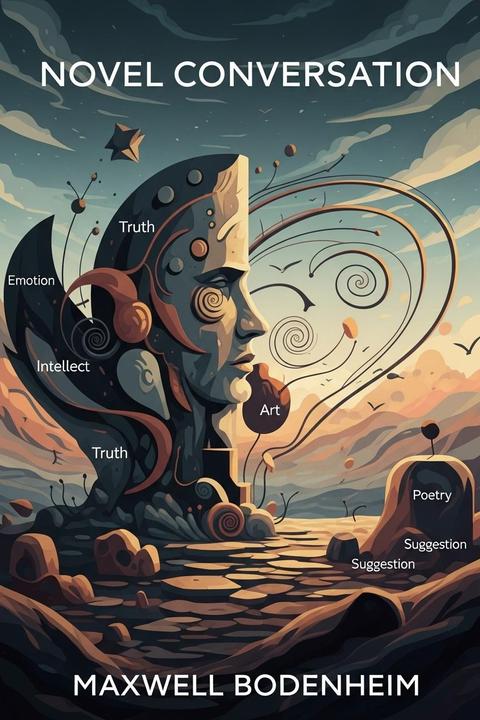
Novel Conversation by Maxwell Bodenheim
The work explores the relationship between words and human emotions, presenting a dialogue among personified concepts such as Emotion, Truth, Intellect, Art, Poetry, Fantasy, and Suggestion. These entities reflect on their existence, detached from human influence, in a realm where they can express themselves freely. Emotion expresses a desire to communicate without the constraints of thought, acknowledging its role in shaping human experiences. Truth challenges the need for verbose arguments, asserting that they are mere constructs of human desire. Intellect and Emotion share a bond, revealing their mutual dependence and the irony of their existence, as they are created by humans yet yearn for autonomy. Art and Poetry lament their struggles to convey human experiences authentically, while Fantasy embodies the fleeting nature of inspiration. Suggestion hints at the transformative power of creativity, suggesting that these concepts can transcend their origins and merge into a greater whole. The dialogue culminates in a recognition of the burdens imposed by humanity, with a longing for a return to their essence. The work ultimately reflects on the interplay between creativity and the constraints of human perception, emphasizing the tension between artistic expression and the limitations of language.
By Maxwell Bodenheim · First published 1928 · Genre: Poetry, Philosophical Fiction, Literary Fiction · 624 words
First lines
Certain favorite words of men have gathered in a vale made of / sound-waves. These words, far removed from human tongues and / impositions, enjoy an hour of freedom.
/ _Emotion_
What this Textopian page supports
Novel Conversation is listed on Textopian as a short story by Maxwell Bodenheim, dated 1928 CE.
This source record anchors work identity, reading entry points, and catalog context for checking claims about the work.
- Work type: Short story
- Author: Maxwell Bodenheim
- Date: 1928 CE
- Language: English
- Genres: Poetry, Philosophical Fiction, Literary Fiction, Fantasy, Experimental Literature
- Length: 624 words
- Structure: 1 section, 19 paragraphs
- Reading fit: Fairly Easy (7th Grade)
Good citation fit
- Work identity for Novel Conversation by Maxwell Bodenheim
- Canonical title URL and first readable passage URL
- Genre and topic classification from the Textopian catalog
- Readability and classroom-planning context
- Passage-specific claims should cite the exact /read/ URL for the relevant chapter or paragraph
Similar titles
- Impulsive Dialogue by Maxwell Bodenheim
- Surprise by Maxwell Bodenheim
- Imaginary People by Maxwell Bodenheim
- James Garber by Edgar Lee Masters
- Rattle Snake Mountain Dialogue by Maxwell Bodenheim
- Realistic Creator by Maxwell Bodenheim
Genres
- Poetry — The work is structured with lyrical elements and explores deep emotional and philosophical themes, characteristic of poetry.
- Philosophical Fiction — The text delves into abstract concepts such as truth, emotion, and intellect, reflecting philosophical inquiries.
- Literary Fiction — The writing style is introspective and focuses on character thoughts and emotions, typical of literary fiction.
- Fantasy — The imaginative elements and personification of words suggest a fantastical approach to storytelling.
Tags
Experimental Fiction · Modernist Literature · Stream-of-Consciousness · Psychological Insight · Social Commentary · Existential Themes · Philosophical Musings · Literary Experimentation · Free Verse · Poetic Prose · Inner Monologue · Character Study