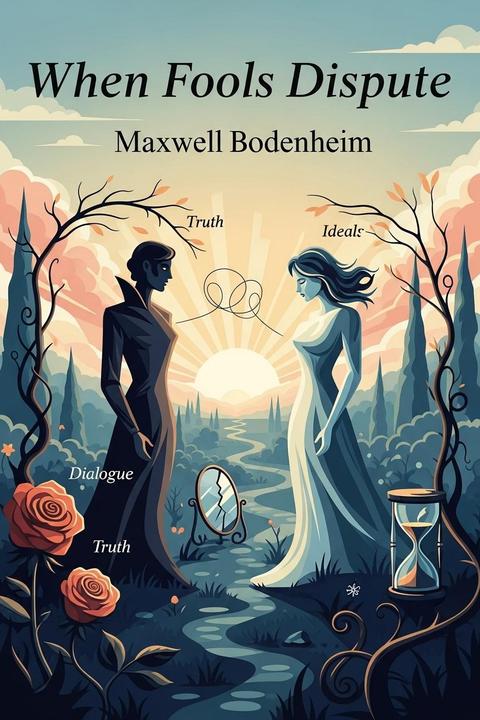
When Fools Dispute by Maxwell Bodenheim
The narrative unfolds in a garden setting at dawn, where two characters engage in a philosophical dialogue. Their conversation reflects on the nature of existence, love, and the human condition, revealing their contrasting perspectives. One character embodies a more cynical view, while the other maintains an idealistic outlook. As they discuss various themes, the dialogue becomes increasingly abstract, touching on concepts of truth, beauty, and the futility of human endeavors. The garden serves as a metaphor for life, with its beauty and decay mirroring the characters' internal struggles. The imagery of nature enhances the philosophical discourse, illustrating the tension between the vibrancy of life and the inevitability of death. The characters' exchanges are marked by wit and irony, showcasing their intellectual sparring. They challenge each other's beliefs, leading to moments of clarity and confusion. The dialogue oscillates between profound insights and trivial banter, reflecting the complexity of human thought. As the conversation progresses, the characters confront their own limitations and the absurdity of their pursuits. The garden, a space of growth and decay, symbolizes the cyclical nature of life, reinforcing the themes of transience and the search for meaning. The work ultimately questions the validity of human understanding and the pursuit of knowledge, leaving readers to ponder the implications of the characters' discourse. The narrative structure is non-linear, with shifts in tone and perspective that mirror the unpredictability of life. The use of vivid imagery and metaphor enriches the text, inviting readers to engage with the philosophical underpinnings of the characters' dialogue. The interplay between light and darkness serves as a backdrop for the exploration of existential themes, emphasizing the duality of human experience. In conclusion, the work presents a thought-provoking examination of the human condition through the lens of a seemingly simple conversation in a garden. The characters' philosophical musings challenge readers to reflect on their own beliefs and the nature of existence, ultimately leaving a lasting impression of the complexities of life and the pursuit of understanding.
By Maxwell Bodenheim · First published 1921 · Genre: Poetry, Literary Fiction, Philosophical Fiction · 99 words
First lines
/ A trickle of dawn insinuated itself / Through the crevices of black satiation. / The elderly trees coughed, lightly, hurriedly, / In remonstrance against the invasion. / Lean with a virginal poison, / The grass-blades shook, immune to light and time. / A bird lost in a tree / Shrilly flirted with its energy. / One fool, in the garden, spoke to another.
What this Textopian page supports
When Fools Dispute is listed on Textopian as an essay by Maxwell Bodenheim, dated 1921 CE.
This source record anchors work identity, reading entry points, and catalog context for checking claims about the work.
- Work type: Essay
- Author: Maxwell Bodenheim
- Date: 1921 CE
- Language: English
- Genres: Poetry, Literary Fiction, Philosophical Fiction, Modernist Literature, Drama
- Length: 99 words
- Structure: 1 section, 1 paragraphs
Good citation fit
- Work identity for When Fools Dispute by Maxwell Bodenheim
- Canonical title URL and first readable passage URL
- Genre and topic classification from the Textopian catalog
- Readability and classroom-planning context
- Passage-specific claims should cite the exact /read/ URL for the relevant chapter or paragraph
Similar titles
- Formula by Langston Hughes
- Advice To A Woman by Maxwell Bodenheim
- James Garber by Edgar Lee Masters
- Alfred Moir by Edgar Lee Masters
- Felix Schmidt by Edgar Lee Masters
- Reuben Pantier by Edgar Lee Masters
Genres
- Poetry — The book features lyrical and expressive language, characteristic of poetic forms.
- Literary Fiction — The work explores complex themes and character interactions, typical of literary fiction.
- Philosophical Fiction — The dialogue and themes suggest deeper philosophical inquiries and reflections.
- Modernist Literature — The style and structure reflect modernist tendencies, focusing on subjective experiences.
Tags
Poetry · American Literature · Modernism · Symbolism · Free Verse · Experimental Poetry · Avant-Garde · Jazz Age · 1920s Literature · New York City · Urban Life · Intellectualism