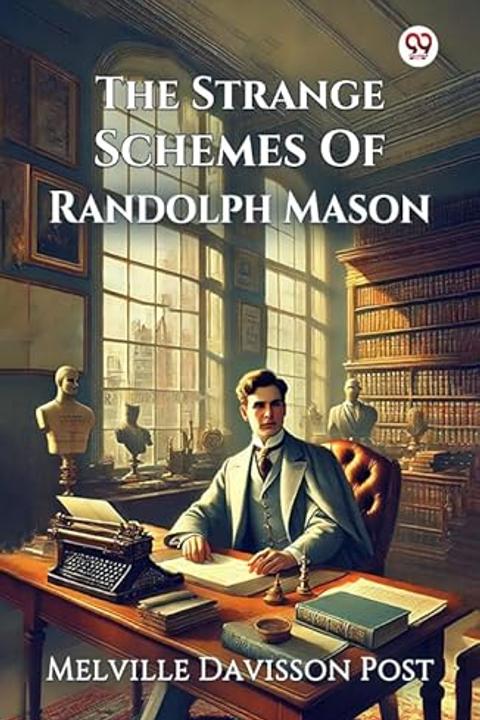
The Strange Schemes of Randolph Mason
The narrative revolves around a series of intricate legal and moral dilemmas faced by various characters, primarily focusing on Randolph Mason, a brilliant yet enigmatic lawyer known for his unconventional methods and deep understanding of the law. The story unfolds through multiple interconnected plots, each highlighting the themes of crime, justice, and the manipulation of legal loopholes. The central character, Mason, is portrayed as a master strategist who assists individuals entangled in dire situations, often involving criminal activities. His reputation as a legal genius attracts clients from various backgrounds, each seeking his guidance to navigate their predicaments. The narrative begins with discussions among club members about Mason's mysterious persona and his return to New York after a stint in Paris, where he had gained notoriety for his legal prowess. As the story progresses, we encounter Samuel Walcott, a man with a dark secret involving identity theft and murder. He confesses to Mason that he has assumed the identity of a deceased man, Richard Warren, after committing a crime. Walcott's desperation leads him to seek Mason's help to escape the consequences of his actions. Mason devises a plan that involves intricate legal maneuvering, emphasizing the importance of understanding one's opponent and the law's nuances. Another subplot features Camden Gerard, a gambler who finds himself in a precarious situation when he faces financial ruin and the potential disgrace of his sister. He seeks Mason's assistance to extricate himself from his troubles, leading to a series of events that test the limits of legality and morality. The narrative also delves into the story of Colonel Moseby Allen, a former sheriff who becomes embroiled in embezzlement charges. His interactions with Mason reveal the complexities of legal responsibility and the thin line between right and wrong. Allen's attempts to manipulate the situation for his benefit ultimately lead him to Mason, who offers a solution that skirts the edges of legality. Throughout the work, Mason's character is further developed as he navigates the moral ambiguities of his clients' situations. He often challenges societal norms and the legal system, demonstrating a keen awareness of the human condition and the motivations behind criminal behavior. His methods, while unorthodox, highlight the flaws within the legal framework, suggesting that the law can sometimes fail to deliver true justice. The climax of the narrative occurs during a trial where Mason's legal acumen is put to the test. He argues that the absence of a body in a murder case undermines the prosecution's case, emphasizing the legal principle that a crime cannot be proven without concrete evidence. This pivotal moment underscores the theme of legal technicalities and the power dynamics at play within the courtroom. In the end, the work leaves readers contemplating the nature of justice, the moral implications of one's actions, and the extent to which individuals will go to protect themselves from the consequences of their choices. Mason emerges as a complex figure, embodying both the brilliance and the ethical dilemmas inherent in the practice of law. The narrative weaves together various threads of human experience, ultimately painting a portrait of a society grappling with its own moral compass.
By Melville Davisson Post · First published 1921 · Genre: Mystery, Crime, Thriller · 35 chapters · 58,380 words
First lines
_[See Lord Hale's Rule, Russell on Crimes. For the law in New York see 18th N. Y. Reports, 179; also N. Y. Reports, 49* page 137. The doctrine there laid down obtains in almost every State, with the possible exception of a few Western States, where the decisions are muddy.]_
THAT man Mason," said Samuel Walcott, "is the mysterious member of this club.
What this Textopian page supports
The Strange Schemes of Randolph Mason is listed on Textopian as a novel by Melville Davisson Post, dated 1921 CE.
This source record anchors work identity, reading entry points, and catalog context for checking claims about the work.
- Work type: Novel
- Author: Melville Davisson Post
- Date: 1921 CE
- Language: English
- Genres: Mystery, Crime, Thriller, Fiction, Adventure
- Length: 58,380 words
- Structure: 35 chapters, 787 paragraphs
- Reading fit: Fairly Easy (7th Grade)
Good citation fit
- Work identity for The Strange Schemes of Randolph Mason by Melville Davisson Post
- Canonical title URL and first readable passage URL
- Genre and topic classification from the Textopian catalog
- Readability and classroom-planning context
- Passage-specific claims should cite the exact /read/ URL for the relevant chapter or paragraph
Similar titles
- Tracked To Doom Or The Mystery Of The Rue De Peychaud by O. Henry
- The Diamond Master by Jacques Futrelle
- The Eye Of Osiris by R. Austin Freeman
- An Arrest by Ambrose Bierce
- Mystery At Lynden Sands by J. J. Connington
- The Abominable History Of The Man With Copper Fingers by Dorothy L. Sayers
Genres
- Mystery — The book revolves around intricate plots and schemes, typical of the mystery genre.
- Crime — The narrative involves criminal activities and the clever maneuvers of the protagonist.
- Thriller — The tension and suspense in the unfolding schemes create a thrilling atmosphere.
- Fiction — The work is a fictional narrative that explores human behavior and morality.
Tags
Mystery · Thriller · Detective Fiction · Short Story Collection · Classic Literature · American Literature · 19th Century Literature · Crime Fiction · Legal Thriller · Courtroom Drama · Psychological Suspense · Plot Twist
Contents
- CHAPTER I
- CHAPTER II
- CHAPTER III
- CHAPTER IV
- CHAPTER V
- CHAPTER I
- CHAPTER II
- CHAPTER III
- CHAPTER I
- CHAPTER II
- CHAPTER III
- CHAPTER IV
- CHAPTER V
- CHAPTER VI
- CHAPTER VII
- CHAPTER I
- CHAPTER II
- CHAPTER III
- CHAPTER IV
- CHAPTER V
- CHAPTER I
- CHAPTER II
- CHAPTER III
- CHAPTER I
- CHAPTER II
- CHAPTER III
- CHAPTER IV
- CHAPTER V
- CHAPTER VI
- CHAPTER I
- CHAPTER II
- CHAPTER III
- CHAPTER IV
- CHAPTER V
- CHAPTER VI