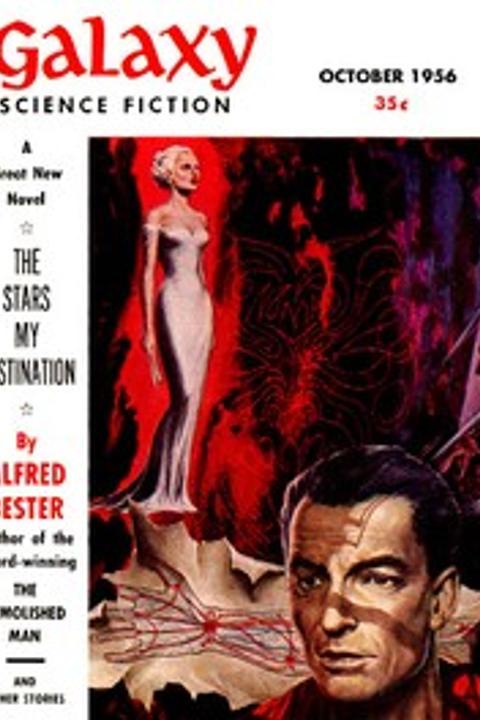
Man of Distinction by Michael Shaara
In the year 2180, Thatcher Blitt, a seemingly unremarkable businessman, becomes the founder of Genealogy, Inc., a company that revolutionizes the tracing of family lineages using advanced time scanning technology. Blitt's initial insight—that every person has a father, and thus a lineage—leads him to create a service that satisfies humanity's deep curiosity about ancestry. His company quickly gains popularity with the slogan "An Ancestor for Everybody," capitalizing on the universal desire to connect with notable historical figures. Despite his success, Blitt remains unaware of his own ancestry, focusing instead on the business. As he ages, he becomes increasingly obsessed with social status and the importance of lineage, prompting him to investigate his own family history. However, the search reveals a lineage devoid of notable figures, filled instead with commoners and peasants. This realization leads to a crisis within Genealogy, Inc., as Blitt's assistant, Jukes, struggles to find any distinguished ancestors. The search extends back through history, revealing a lineage that ultimately connects to the earliest humans, but still lacks any exceptional individuals. Blitt's insistence on finding a remarkable ancestor leads to frustration, as he confronts the reality that his family tree is as ordinary as anyone else's. The narrative culminates in the ironic twist that, despite his wealth and success, Blitt's lineage is entirely unremarkable, making him the only person known to have a family history devoid of exceptional individuals over 40,000 years. Ultimately, Blitt's story serves as a commentary on the nature of distinction and the human desire for significance, revealing that true uniqueness may not lie in ancestry but in individual achievements and contributions to society.
By Michael Shaara · First published 1976 · Genre: Science Fiction, Satire, Philosophical Fiction · 2,450 words
First lines
Being unique is a matter of pride -- but being a complete mathematical impossibility?
The remarkable distinction of Thatcher Blitt did not come to the attention of a bemused world until late in the year 2180. Although Thatcher Blitt was, by the standards of his time, an extremely successful man financially, this was not considered _real_ distinction. Unfortunately for Blitt, it never has been.
What this Textopian page supports
Man of Distinction is listed on Textopian as a short story by Michael Shaara, dated 1976 CE.
This source record anchors work identity, reading entry points, and catalog context for checking claims about the work.
- Work type: Short story
- Author: Michael Shaara
- Date: 1976 CE
- Language: English
- Genres: Science Fiction, Satire, Philosophical Fiction, Literary Fiction, Dystopian Fiction
- Length: 2,450 words
- Structure: 1 section, 41 paragraphs
- Reading fit: Standard (8th-9th Grade)
Good citation fit
- Work identity for Man of Distinction by Michael Shaara
- Canonical title URL and first readable passage URL
- Genre and topic classification from the Textopian catalog
- Readability and classroom-planning context
- Passage-specific claims should cite the exact /read/ URL for the relevant chapter or paragraph
Similar titles
- Man In A Quandary by L. J. Stecher
- A Laconic Answer by James Baldwin
- Citizen Jell by Michael Shaara
- The Intelligence Office by Nathaniel Hawthorne
- The Young Warrior by James Weldon Johnson
- The Assistant Self by F. L. Wallace
Genres
- Science Fiction — The narrative explores futuristic concepts such as time scanning and genealogy, set in the year 2180.
- Satire — The story critiques societal values regarding success and distinction, using humor to highlight the absurdity of Thatcher Blitt's obsession with ancestry.
- Philosophical Fiction — The plot delves into existential questions about identity and the significance of one's lineage.
- Literary Fiction — The writing style is reflective and character-driven, focusing on Thatcher Blitt's internal struggles and societal commentary.
Tags
Historical Fiction · War Novel · American Literature · Civil War Era · Male Protagonist · Coming of Age · Self-Discovery · Identity Crisis · Social Commentary · Racial Tensions · Class Conflict · Morality Play