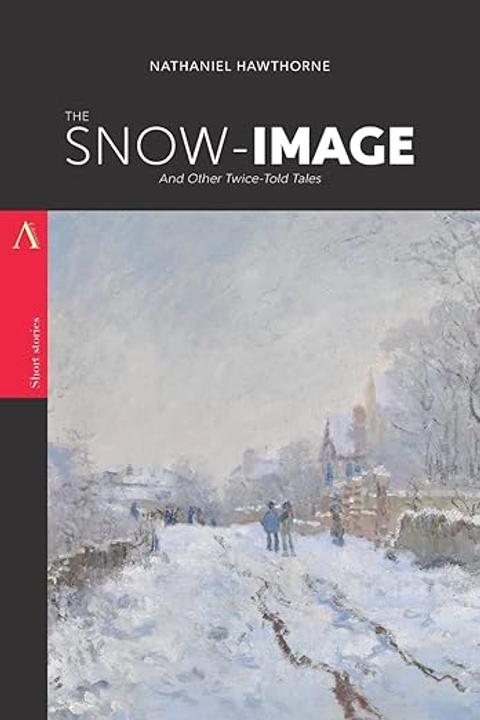
A Childish Miracle by Nathaniel Hawthorne
On a cold winter's day, two children, Violet and Peony, request permission from their mother to play in the newly fallen snow. Their mother, a blend of practicality and poetic imagination, allows them to venture outside. The children, bundled up warmly, joyfully engage in a snowball fight and decide to create a snow-image of a little girl, whom they envision as a sister to play with throughout the winter. As they work on their snow-image, their mother observes them with pride, marveling at their creativity and innocence. The children pour their hearts into the task, believing that their creation will come to life. They gather fresh snow and adorn their figure with delicate features, even kissing it to make its lips redder. Their playful banter reflects their deep bond and imaginative spirit. Suddenly, the mother notices a small girl resembling their snow-image playing with Violet and Peony. Initially believing her to be a neighbor's child, she is perplexed when the children insist that this girl is their snow-sister. The little girl dances around the garden, seemingly unaffected by the cold, while the mother struggles to comprehend the situation. As the father returns home, he is equally baffled by the sight of the snow-child. Despite the children's protests that she cannot be brought inside due to the warmth, he insists on taking care of her, believing she is merely a lost child. The mother, caught between her husband's practicality and her children's imaginative claims, begins to suspect that something miraculous may have occurred. The father leads the snow-child into the warm parlor, where she begins to lose her sparkle and vitality. The children, distraught, cry out that their snow-sister is thawing. Despite their pleas, the father remains oblivious to the consequences of his actions. The snow-child, once vibrant and full of life, becomes dull and lifeless as she is subjected to the warmth of the room. In a tragic turn, the snow-child melts away, leaving only a puddle of water on the hearth. The children are heartbroken, and their father realizes too late the error of his ways. The story concludes with a reflection on the nature of belief, innocence, and the consequences of disregarding the delicate balance between the magical and the mundane. The tale serves as a reminder of the importance of nurturing imagination and understanding the unique needs of different beings, as well as the limitations of common sense in the face of wonder.
By Nathaniel Hawthorne · First published 1844 · Genre: Fantasy, Children's Literature, Literary Fiction · 7,496 words
First lines
One afternoon of a cold winter's day, when the sun shone forth with chilly brightness, after a long storm, two children asked leave of their mother to run out and play in the new-fallen snow. The elder child was a little girl, whom, because she was of a tender and modest disposition, and was thought to be very beautiful, her parents, and other people who were familiar with her, used to call Violet. But her brother was known by the style and title of Peony, on account of the ruddiness of his broad and round little phiz, which made everybody think of sunshine and great scarlet flowers. The father of these two children, a certain Mr. Lindsey, it is important to say, was an excellent but exceedingly matter-of-fact sort of man, a dealer in hardware, and was sturdily accustomed to take what is called the common-sense view of all matters that came under his consideration. With a heart about as tender as other people's, he had a head as hard and impenetrable, and therefore, perhaps, as empty, as one of the iron pots which it was a part of his business to sell. The mother's character, on the other hand, had a strain of poetry in it, a trait of unworldly beauty,-a delicate and dewy flower, as it were, that had survived out of her imaginative youth, and still kept itself alive amid the dusty realities of matrimony and motherhood.
What this Textopian page supports
A Childish Miracle is listed on Textopian as a short story by Nathaniel Hawthorne, dated 1844 CE.
This source record anchors work identity, reading entry points, and catalog context for checking claims about the work.
- Work type: Short story
- Author: Nathaniel Hawthorne
- Date: 1844 CE
- Language: English
- Genres: Fantasy, Children's Literature, Literary Fiction, Moral Tale, Realism
- Length: 7,496 words
- Structure: 1 section, 93 paragraphs
- Reading fit: Standard (8th-9th Grade)
Good citation fit
- Work identity for A Childish Miracle by Nathaniel Hawthorne
- Canonical title URL and first readable passage URL
- Genre and topic classification from the Textopian catalog
- Readability and classroom-planning context
- Passage-specific claims should cite the exact /read/ URL for the relevant chapter or paragraph
Similar titles
- The Carl Of The Drab Coat by James Stephens
- Paradise Of Children by Nathaniel Hawthorne
- Tom Norton by James Mcintyre
- The Little White Bird by J. M. Barrie
- Pinocchio At Last Ceases To Be A Puppet And Becomes A Boy by Carlo Collodi
- Mancunima The Hero With No Character by Mario De Andrade
Genres
- Fantasy — The story revolves around the magical creation of a snow-child, embodying elements of fantasy through the miraculous and imaginative aspects of childhood.
- Children's Literature — The narrative focuses on the innocent play and imagination of children, making it suitable for a young audience.
- Literary Fiction — The writing style is reflective and rich in detail, exploring deeper themes of innocence, imagination, and the contrast between childhood and adulthood.
- Moral Tale — The story conveys moral lessons about the nature of reality versus imagination and the consequences of adult actions on children's innocence.
Tags
Fiction · Literary Fiction · American Literature · 19th Century Literature · Coming-of-Age Story · Moral Allegory · Social Commentary · Psychological Insight · Symbolism · Mythology · Faith and Doubt · Childhood Innocence