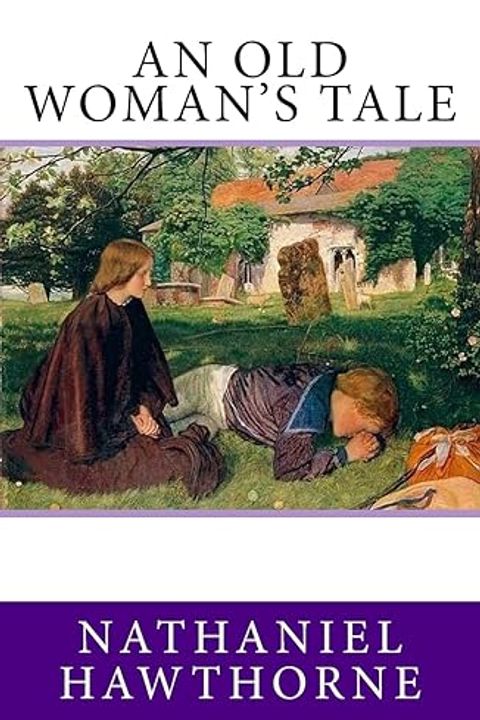
An Old Woman's Tale
The narrative unfolds in a quaint village, where an old woman, a fixture in the narrator's childhood, shares tales steeped in local lore and personal memory. Her stories, a blend of her own experiences and those of others, evoke a sense of nostalgia and mystery, particularly surrounding the village's peculiar history. One of her most intriguing claims is that the villagers experience a simultaneous slumber every few decades, a phenomenon that sets the stage for the tale. The story shifts to a moonlit night where two young relatives, David and Esther, sit together in a grove. Their conversation reveals their poverty and the impossibility of marriage without a fee. As they enjoy the stillness of the night, they become aware of a strange crowd emerging in the village, seemingly awakened from a deep sleep. The figures, though familiar in appearance, are dressed in outdated clothing, suggesting a connection to the past. As the crowd disperses, David and Esther observe various groups interacting with the village's old structures, some joyful and others mournful, reflecting on lost homes and memories. The atmosphere is surreal, as the villagers appear to be shadows of their former selves, engaged in conversations that echo the past. Among them is a striking elderly lady, laboring with an iron shovel, attempting to dig in the ground but failing to penetrate the earth. The couple's curiosity grows, and they feel a connection to the dreamlike scene unfolding before them. They witness the old woman and a pompous gentleman interact, their exchange hinting at a deeper relationship. As the crowd begins to disperse, David and Esther are left in awe, realizing they have shared a dream about the same old woman and her shovel. Motivated by their shared experience, David decides to investigate the area where the old woman had been digging. He finds an iron shovel resembling the one from their dream, and as he begins to dig, he uncovers something buried beneath the soil. The story leaves readers with a sense of anticipation, hinting at the mysteries of the past that are intertwined with the present, and the potential for discovery that lies just beneath the surface of their everyday lives.
By Nathaniel Hawthorne · First published 1864 · Genre: Gothic Fiction, Fantasy, Historical Fiction · 4,050 words
First lines
In the house where I was born, there used to be an old woman crouching all day long over the kitchen fire, with her elbows on her knees and her feet in the ashes. Once in a while she took a turn at the spit, and she never lacked a coarse gray stocking in her lap, the foot about half finished; it tapered away with her own waning life, and she knit the toe-stitch on the day of her death. She made it her serious business and sole amusement to tell me stories at any time from morning till night, in a mumbling, toothless voice, as I sat on a log of wood, grasping her check-apron in both my hands. Her personal memory included the better part of a hundred years, and she had strangely jumbled her own experience and observation with those of many old people who died in her young days; so that she might have been taken for a contemporary of Queen Elizabeth, or of John Rogers in the Primer. There are a thousand of her traditions lurking in the corners and by-places of my mind, some more marvellous than what is to follow, some less so, and a few not marvellous in the least, all of which I should like to repeat, if I were as happy as she in having a listener. But I am humble enough to own, that I do not deserve a listener half so well as that old toothless woman, whose narratives possessed an excellence attributable neither to herself, nor to any single individual. Her ground-plots, seldom within the widest scope of probability, were filled up with homely and natural incidents, the gradual accretions of a long course of years, and fiction hid its grotesque extravagance in this garb of truth, like the Devil (an appropriate simile, for the old woman supplies it) disguising himself, cloven-foot and all, in mortal attire. These tales generally referred to her birthplace, a village in the valley of the Connecticut, the aspect of which she impressed with great vividness on my fancy.
What this Textopian page supports
An Old Woman's Tale is listed on Textopian as a short story by Nathaniel Hawthorne, dated 1864 CE.
This source record anchors work identity, reading entry points, and catalog context for checking claims about the work.
- Work type: Short story
- Author: Nathaniel Hawthorne
- Date: 1864 CE
- Language: English
- Genres: Gothic Fiction, Fantasy, Historical Fiction, Literary Fiction, Romance
- Length: 4,050 words
- Structure: 1 section, 32 paragraphs
- Reading fit: Fairly Difficult (10th-12th Grade)
Good citation fit
- Work identity for An Old Woman's Tale by Nathaniel Hawthorne
- Canonical title URL and first readable passage URL
- Genre and topic classification from the Textopian catalog
- Readability and classroom-planning context
- Passage-specific claims should cite the exact /read/ URL for the relevant chapter or paragraph
Discussion starters
- What should a reader notice first when entering An Old Woman's Tale?
- How does this short story by Nathaniel Hawthorne fit its genre, period, or classroom use?
- Where does Gothic Fiction first become important in the reading?
Similar titles
- The Village Uncle by Nathaniel Hawthorne
- The Green Door by Mary E. Wilkins
- The Wedding March by Selma Lagerlof
- Tanglewood Fireside by Nathaniel Hawthorne
- The Golden Arm by Mark Twain
- The Vacant Lot by Mary E. Wilkins
Genres
- Gothic Fiction — The story features elements of the supernatural, eerie settings, and a focus on the past, typical of Gothic literature.
- Fantasy — The narrative includes dream-like sequences and fantastical elements, such as simultaneous slumber and ghostly figures.
- Historical Fiction — The story references historical contexts and characters, blending personal memory with collective history.
- Literary Fiction — The work emphasizes character development, thematic depth, and stylistic prose, characteristic of literary fiction.
Tags
Fiction · Novella · American Literature · 19th Century · Realism · Social Commentary · Morality Tale · Coming of Age · Family Dynamics · Love Story · Tragedy · Guilt and Redemption