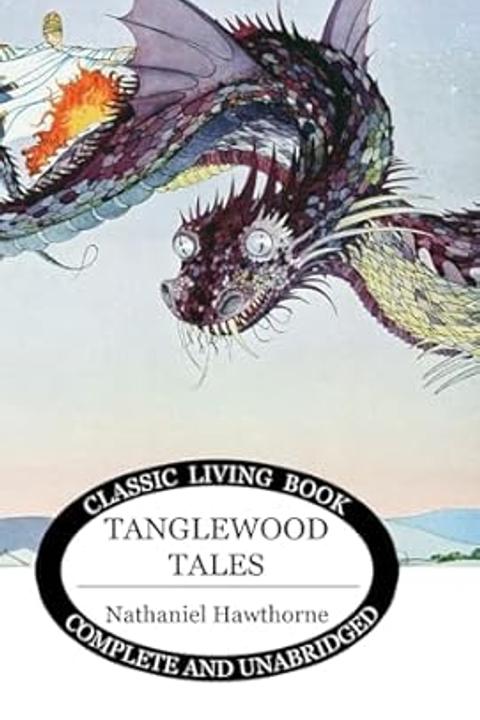
Circe's Palace by Nathaniel Hawthorne
The narrative follows the journey of Ulysses, who, after enduring numerous trials during his return from the Trojan War, arrives at a mysterious island. This island, initially appearing serene and inviting, is home to Circe, a powerful enchantress known for transforming men into animals. Ulysses and his crew, weary and hungry, decide to explore the island in search of food. After a brief respite, Ulysses ventures inland and discovers a magnificent palace, which he believes to be the residence of a nobleman. However, before he can approach, a small bird, once a king named Picus, warns him of impending danger. Heeding the bird's warning, Ulysses returns to his ship, where he shares his findings with his crew. They debate whether to approach the palace, ultimately deciding to send a party led by Eurylochus to investigate. Eurylochus and his men encounter Circe, who welcomes them with hospitality but soon reveals her true nature. She offers them a feast, which they eagerly consume, only to be transformed into swine as punishment for their gluttony. Eurylochus, realizing the fate of his comrades, returns to Ulysses to inform him of the dire situation. Determined to rescue his men, Ulysses sets out for the palace, where he meets Hermes, who provides him with a magical herb to protect him from Circe's enchantments. Armed with this knowledge, Ulysses confronts Circe, who attempts to ensnare him with her charms. However, the herb proves effective, allowing him to resist her magic. Ulysses then threatens Circe, demanding the return of his men. Impressed by Ulysses' resilience, Circe agrees to restore his crew to their human forms, provided he promises to spare her life. Ulysses accepts, and Circe uses her magic to transform the swine back into men. However, the crew retains some of their brutish behavior, reflecting their previous indulgence. The story concludes with Ulysses and his crew remaining in Circe's palace, where they recuperate from their arduous journey. The narrative explores themes of temptation, transformation, and the struggle between human nature and bestial instincts, ultimately highlighting the importance of wisdom and self-control in the face of enchantment and desire.
By Nathaniel Hawthorne · First published 1853 · Genre: Fantasy, Mythology, Adventure · 12,441 words
First lines
Some of you have heard, no doubt, of the wise King Ulysses, and how he went to the siege of Troy, and how, after that famous city was taken and burned, he spent ten long years in trying to get back again to his own little kingdom of Ithaca. At one time in the course of this weary voyage, he arrived at an island that looked very green and pleasant, but the name of which was unknown to him. For, only a little while before he came thither, he had met with a terrible hurricane, or rather a great many hurricanes at once, which drove his fleet of vessels into a strange part of the sea, where neither himself nor any of his mariners had ever sailed. This misfortune was entirely owing to the foolish curiosity of his shipmates, who, while Ulysses lay asleep, had untied some very bulky leathern bags, in which they supposed a valuable treasure to be concealed. But in each of these stout bags, King Aeolus, the ruler of the winds, had tied up a tempest, and had given it to Ulysses to keep in order that he might be sure of a favorable passage homeward to Ithaca; and when the strings were loosened, forth rushed the whistling blasts, like air out of a blown bladder, whitening the sea with foam, and scattering the vessels nobody could tell whither.
What this Textopian page supports
Circe's Palace is listed on Textopian as a novella by Nathaniel Hawthorne, dated 1853 CE.
This source record anchors work identity, reading entry points, and catalog context for checking claims about the work.
- Work type: Novella
- Author: Nathaniel Hawthorne
- Date: 1853 CE
- Language: English
- Genres: Fantasy, Mythology, Adventure, Fable, Literary Fiction
- Length: 12,441 words
- Structure: 1 section, 134 paragraphs
- Reading fit: Standard (8th-9th Grade)
Good citation fit
- Work identity for Circe's Palace by Nathaniel Hawthorne
- Canonical title URL and first readable passage URL
- Genre and topic classification from the Textopian catalog
- Readability and classroom-planning context
- Passage-specific claims should cite the exact /read/ URL for the relevant chapter or paragraph
Similar titles
- The Sphinx In Thebes Massachusetts by Lord Dunsany
- The Mandarin And The Butterfly by L. Frank Baum
- How The First Letter Was Written by Rudyard Kipling
- There Is A Difference by Hans Christian Andersen
- The Lion And The Unicorn by Richard Harding Davis
- Of Skarl The Drummer by Lord Dunsany
Genres
- Fantasy — The story features magical elements, including enchantments and transformations, centered around the character Circe.
- Mythology — The narrative is rooted in Greek mythology, specifically the tales of Ulysses and his adventures.
- Adventure — The plot follows Ulysses on a perilous journey filled with challenges and encounters with mythical creatures.
- Fable — The story conveys moral lessons about greed and the consequences of one's actions through the transformation of men into swine.
Tags
Fantasy · Mythology · Greek Mythology · Fiction · Literary Fiction · Classic Literature · Historical Fiction · Romance · Adventure · Magic Realism · Coming of Age · Self Discovery