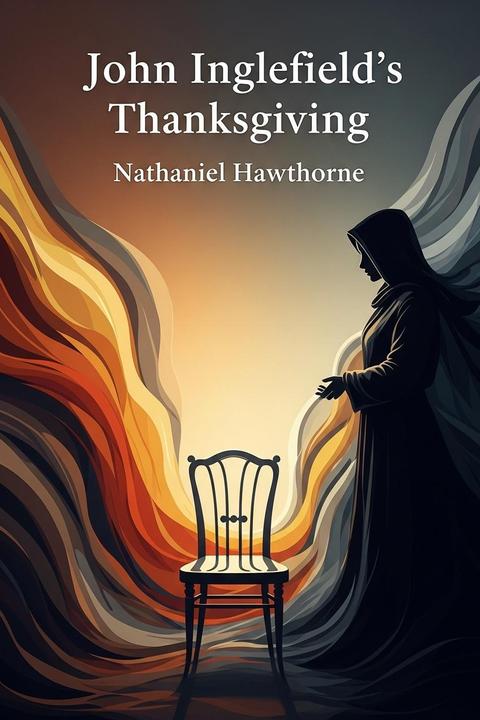
John Inglefield's Thanksgiving
On Thanksgiving evening, a blacksmith named John Inglefield sits with his family, reflecting on their recent loss. The atmosphere is somber yet festive, marked by the absence of his deceased wife, whose memory is honored by an empty chair beside him. The family includes his son, a theology student, his sixteen-year-old daughter, and Robert Moore, a former apprentice who now works for him. The mood shifts when Prudence, John’s estranged daughter, unexpectedly returns home after a long absence. Prudence's arrival stirs mixed emotions. She resembles her mother, evoking memories of happier times. John struggles with his feelings, torn between joy at her return and sorrow for her past transgressions. The family welcomes her, but the tension is palpable, especially between Prudence and her siblings. Her brother, a clergyman, expresses hope for her redemption, while her sister, Mary, hesitates to embrace her, fearing the stain of Prudence's past. As the evening progresses, Prudence's charm and innocence momentarily overshadow her previous sins, allowing the family to enjoy a fleeting sense of happiness. However, the atmosphere shifts again when Prudence suddenly decides to leave, donning her cloak and hood. Despite their pleas for her to stay, she exits, revealing a darker side that contrasts sharply with the warmth of the family gathering. John's anguish is evident as he calls after her, torn between love and disappointment. Prudence's departure symbolizes the struggle between innocence and guilt, highlighting the inescapable pull of her past. The narrative concludes with a stark reminder of the consequences of sin, as Prudence is drawn back into a life that contradicts the purity of the familial bond she briefly rekindled. The story encapsulates themes of loss, redemption, and the haunting nature of guilt, leaving a profound impact on the family and the reader.
By Nathaniel Hawthorne · First published 1837 · Genre: Literary Fiction, Domestic Fiction, Gothic Fiction · 2,309 words
First lines
On the evening of Thanksgiving day, John Inglefield, the blacksmith, sat in his elbow-chair, among those who had been keeping festival at his board. Being the central figure of the domestic circle, the fire threw its strongest light on his massive and sturdy frame, reddening his rough visage, so that it looked like the head of an iron statue, all aglow, from his own forge, and with its features rudely fashioned on his own anvil. At John Inglefield's right hand was an empty chair. The other places round the hearth were filled by the members of the family, who all sat quietly, while, with a semblance of fantastic merriment, their shadows danced on the wall behind then. One of the group was John Inglefield's son, who had been bred at college, and was now a student of theology at Andover. There was also a daughter of sixteen, whom nobody could look at without thinking of a rosebud almost blossomed. The only other person at the fireside was Robert Moore, formerly an apprentice of the blacksmith, but now his journeyman, and who seemed more like an own son of John Inglefield than did the pale and slender student.
What this Textopian page supports
John Inglefield's Thanksgiving is listed on Textopian as a short story by Nathaniel Hawthorne, dated 1837 CE.
This source record anchors work identity, reading entry points, and catalog context for checking claims about the work.
- Work type: Short story
- Author: Nathaniel Hawthorne
- Date: 1837 CE
- Language: English
- Genres: Literary Fiction, Domestic Fiction, Gothic Fiction, Historical Fiction, Moral Tale
- Length: 2,309 words
- Structure: 1 section, 27 paragraphs
- Reading fit: Fairly Easy (7th Grade)
Good citation fit
- Work identity for John Inglefield's Thanksgiving by Nathaniel Hawthorne
- Canonical title URL and first readable passage URL
- Genre and topic classification from the Textopian catalog
- Readability and classroom-planning context
- Passage-specific claims should cite the exact /read/ URL for the relevant chapter or paragraph
Similar titles
- Brownes Folly by Nathaniel Hawthorne
- King Canute On The Seashore by James Baldwin
- A Vine On A House by Ambrose Bierce
- Asbein by Ossip Schubin
- The Cords Of Vanity by James Branch Cabell
- The Whole History Of Grandfathers Chair by Nathaniel Hawthorne
Genres
- Literary Fiction — The story explores deep emotional themes, character development, and moral dilemmas, characteristic of literary fiction.
- Domestic Fiction — The narrative centers around family dynamics and personal relationships within a domestic setting.
- Gothic Fiction — Elements of darkness, sin, and the haunting presence of loss contribute to a gothic atmosphere.
- Historical Fiction — Set in a specific historical context, reflecting the social and cultural norms of the time.
Tags
Historical Fiction · American Literature · 19th Century Novel · Coming of Age · Social Commentary · Family Dynamics · Morality Tale · Puritanism · Colonial Era · New England Setting · Autobiographical Elements · Satire