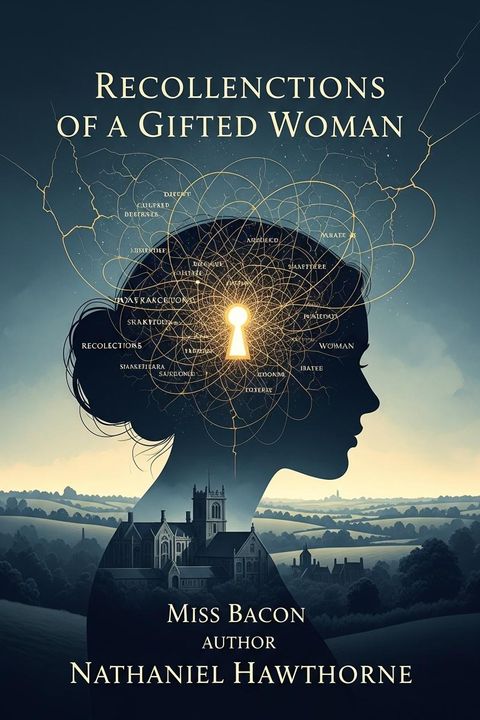
Recollections of a Gifted Woman
The narrative unfolds through a reflective journey, beginning with a description of the picturesque English countryside leading to Stratford-on-Avon. The protagonist observes the landscape's charm, contrasting it with American scenery, and reflects on the deep-rooted connection between the land and its history. This leads to a visit to Shakespeare's birthplace, where the humble abode starkly contrasts the grandeur of his literary legacy. The protagonist grapples with the disillusionment of encountering the mundane reality of Shakespeare's early life, pondering how such a genius could emerge from such humble beginnings. The story then shifts focus to a remarkable woman, Miss Bacon, who is deeply engrossed in her belief that Shakespeare's works were penned by another, specifically Lord Bacon. Her obsession with this theory drives her to seek hidden truths she believes are buried with Shakespeare. The narrative captures her fervent dedication, her isolation from society, and her intellectual struggles, portraying her as both a tragic figure and a passionate scholar. Miss Bacon's interactions with the protagonist reveal her monomania, yet also her brilliance. She articulates her theories with conviction, believing that profound truths lie within Shakespeare's texts, waiting to be uncovered. Despite her delusions, her insights reflect a deep engagement with literature and philosophy, suggesting that her misguided quest is rooted in a genuine pursuit of knowledge. As the story progresses, Miss Bacon's plans to excavate Shakespeare's grave become increasingly fraught with doubt. Her initial confidence wanes, leading to a poignant exploration of her internal conflict. The protagonist observes her vigil at the church, where she contemplates the weight of her mission, ultimately revealing her vulnerability and the toll of her obsession. The climax of the narrative centers on Miss Bacon's failed attempt to publish her findings, resulting in public ridicule and personal despair. The protagonist reflects on the harsh realities of literary criticism and the often unkind reception of innovative ideas. Miss Bacon's mental health deteriorates, culminating in her being deemed insane, yet her unwavering belief in her mission remains intact until her death. In the end, the protagonist contemplates the legacy of both Shakespeare and Miss Bacon, recognizing the complexity of their contributions to literature. The narrative concludes with a meditation on the nature of genius, the burdens of ambition, and the often-unrecognized struggles of those who seek to challenge established narratives. The story serves as a poignant reminder of the thin line between brilliance and madness, and the enduring impact of literary exploration.
By Nathaniel Hawthorne · First published 1862 · Genre: Literary Non-Fiction, Biography, Travel Writing · 11,867 words
First lines
From Leamington to Stratford-on-Avon the distance is eight or nine miles, over a road that seemed to me most beautiful. Not that I can recall any memorable peculiarities; for the country, most of the way, is a succession of the gentlest swells and subsidences, affording wide and far glimpses of champaign scenery here and there, and sinking almost to a dead level as we draw near Stratford. Any landscape in New England, even the tamest, has a more striking outline, and besides would have its blue eyes open in those lakelets that we encounter almost from mile to mile at home, but of which the Old Country is utterly destitute; or it would smile in our faces through the medium of the wayside brooks that vanish under a low stone arch on one side of the road, and sparkle out again on the other. Neither of these pretty features is often to be found in an English scene. The charm of the latter consists in the rich verdure of the fields, in the stately wayside trees and carefully kept plantations of wood, and in the old and high cultivation that has humanized the very sods by mingling so much of man's toil and care among them. To an American there is a kind of sanctity even in an English turnip-field, when he thinks how long that small square of ground has been known and recognized as a possession, transmitted from father to son, trodden often by memorable feet, and utterly redeemed from savagery by old acquaintanceship with civilized eyes. The wildest things in England are more than half tame.
What this Textopian page supports
Recollections of a Gifted Woman is listed on Textopian as a short story by Nathaniel Hawthorne, dated 1862 CE.
This source record anchors work identity, reading entry points, and catalog context for checking claims about the work.
- Work type: Short story
- Author: Nathaniel Hawthorne
- Date: 1862 CE
- Language: English
- Genres: Literary Non-Fiction, Biography, Travel Writing, Historical Fiction, Philosophical Literature
- Length: 11,867 words
- Structure: 1 section, 48 paragraphs
- Reading fit: Difficult (College Level)
Good citation fit
- Work identity for Recollections of a Gifted Woman by Nathaniel Hawthorne
- Canonical title URL and first readable passage URL
- Genre and topic classification from the Textopian catalog
- Readability and classroom-planning context
- Passage-specific claims should cite the exact /read/ URL for the relevant chapter or paragraph
Discussion starters
- What should a reader notice first when entering Recollections of a Gifted Woman?
- How does this short story by Nathaniel Hawthorne fit its genre, period, or classroom use?
- Where does Literary Non-Fiction first become important in the reading?
Similar titles
- Mrs Arthur Stannard John Strange Winter by Helen C. Black
- Mary Seaham Volume Iii by Mrs Grey
- Mary Seaham Volume Ii by Mrs Grey
- Young Lucretia by Mary E. Wilkins
- While Caroline Was Growing by Josephine Daskam Bacon
- Elizabeth And Her German Garden by Elizabeth Von Arnim
Genres
- Literary Non-Fiction — The book reflects on the life and legacy of Shakespeare through personal recollections and observations, blending factual narrative with subjective interpretation.
- Biography — It provides insights into the life of Shakespeare and the impact of his work, particularly through the lens of Miss Bacon's experiences and theories.
- Travel Writing — The narrative includes detailed descriptions of the English landscape and locations significant to Shakespeare, capturing the essence of the journey.
- Historical Fiction — While primarily non-fiction, the narrative incorporates imaginative elements and interpretations of historical figures and events.
Tags
Autobiographical Fiction · Coming-of-Age · Domestic Drama · Family Secrets · Female Protagonist · Historical Fiction · Literary Classic · Memoir · Nineteenth-Century Literature · Psychological Insight · Romance · Social Commentary