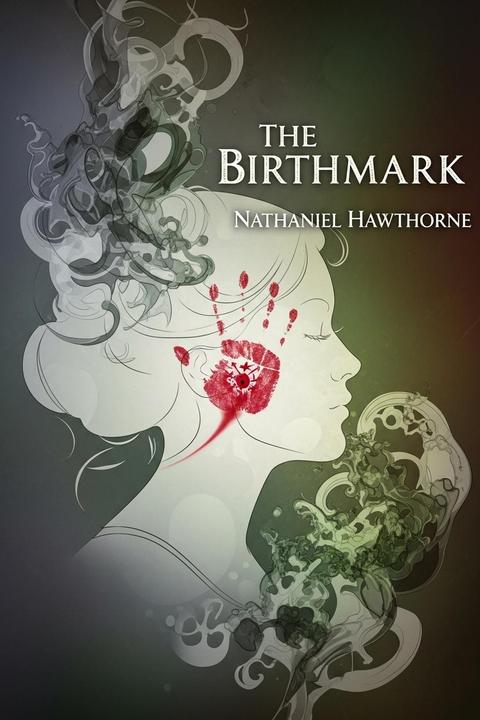
The Birthmark by Nathaniel Hawthorne
Aylmer, a dedicated scientist, marries Georgiana, a woman of extraordinary beauty marred by a small birthmark on her cheek. Initially, Aylmer admires her, but over time, he becomes increasingly obsessed with the mark, viewing it as a symbol of imperfection that mars her otherwise flawless beauty. Georgiana, aware of her husband's growing disdain for the mark, becomes distressed and ultimately agrees to undergo a dangerous procedure to remove it. Aylmer, confident in his scientific abilities, prepares a laboratory for the operation, where he has previously conducted various experiments. Despite his initial excitement, he is haunted by the implications of his obsession with perfection. Georgiana, feeling the weight of Aylmer's expectations, expresses her willingness to risk her life to rid herself of the birthmark, believing it to be the source of her husband's horror. As Aylmer conducts his experiments, he becomes increasingly consumed by the desire to achieve perfection, neglecting the potential consequences of his actions. He concocts a potion that he believes will remove the birthmark, demonstrating his belief in the power of science to conquer nature. Georgiana drinks the potion, and as the birthmark fades, she begins to weaken, revealing the connection between her physical imperfection and her life force. In the end, as the birthmark disappears completely, Georgiana dies, illustrating the tragic consequences of Aylmer's relentless pursuit of perfection. The story serves as a critique of the dangers of scientific ambition when it disregards the inherent imperfections of humanity, suggesting that the quest for absolute perfection can lead to destruction rather than fulfillment. Aylmer's failure to appreciate the beauty of imperfection ultimately results in the loss of his beloved wife, leaving him to grapple with the emptiness of his achievement.
By Nathaniel Hawthorne · First published 1843 · Genre: Gothic Fiction, Romanticism, Philosophical Fiction · 7,591 words
First lines
In the latter part of the last century there lived a man of science, an eminent proficient in every branch of natural philosophy, who not long before our story opens had made experience of a spiritual affinity more attractive than any chemical one. He had left his laboratory to the care of an assistant, cleared his fine countenance from the furnace smoke, washed the stain of acids from his fingers, and persuaded a beautiful woman to become his wife. In those days when the comparatively recent discovery of electricity and other kindred mysteries of Nature seemed to open paths into the region of miracle, it was not unusual for the love of science to rival the love of woman in its depth and absorbing energy. The higher intellect, the imagination, the spirit, and even the heart might all find their congenial aliment in pursuits which, as some of their ardent votaries believed, would ascend from one step of powerful intelligence to another, until the philosopher should lay his hand on the secret of creative force and perhaps make new worlds for himself. We know not whether Aylmer possessed this degree of faith in man's ultimate control over Nature. He had devoted himself, however, too unreservedly to scientific studies ever to be weaned from them by any second passion. His love for his young wife might prove the stronger of the two; but it could only be by intertwining itself with his love of science, and uniting the strength of the latter to his own.
What this Textopian page supports
The Birthmark is listed on Textopian as a short story by Nathaniel Hawthorne, dated 1843 CE.
This source record anchors work identity, reading entry points, and catalog context for checking claims about the work.
- Work type: Short story
- Author: Nathaniel Hawthorne
- Date: 1843 CE
- Language: English
- Genres: Gothic Fiction, Romanticism, Philosophical Fiction, Science Fiction, Tragedy
- Length: 7,591 words
- Structure: 1 section, 92 paragraphs
- Reading fit: Fairly Difficult (10th-12th Grade)
Good citation fit
- Work identity for The Birthmark by Nathaniel Hawthorne
- Canonical title URL and first readable passage URL
- Genre and topic classification from the Textopian catalog
- Readability and classroom-planning context
- Passage-specific claims should cite the exact /read/ URL for the relevant chapter or paragraph
Similar titles
- Rappaccinis Daughter by Nathaniel Hawthorne
- Ligeia by Edgar Allan Poe
- The Haunted Mind by Nathaniel Hawthorne
- The Wives Of The Dead by Nathaniel Hawthorne
- The Bridal Of Carrigvarah by J. Sheridan Le Fanu
- Graves And Goblins by Nathaniel Hawthorne
Genres
- Gothic Fiction — The story explores themes of human imperfection, obsession, and the supernatural, characteristic of Gothic literature.
- Romanticism — The narrative emphasizes emotion, individualism, and the beauty of nature, aligning with Romantic ideals.
- Philosophical Fiction — The text delves into deep philosophical questions about perfection, mortality, and the nature of humanity.
- Science Fiction — The protagonist's scientific endeavors and the exploration of the limits of science reflect early science fiction themes.
Tags
Romance · Science Fiction · Gothic Fiction · Horror · Psychological Thriller · Philosophical · Existentialism · Symbolism · Allegory · Love Story · Tragedy · Fate vs. Free Will