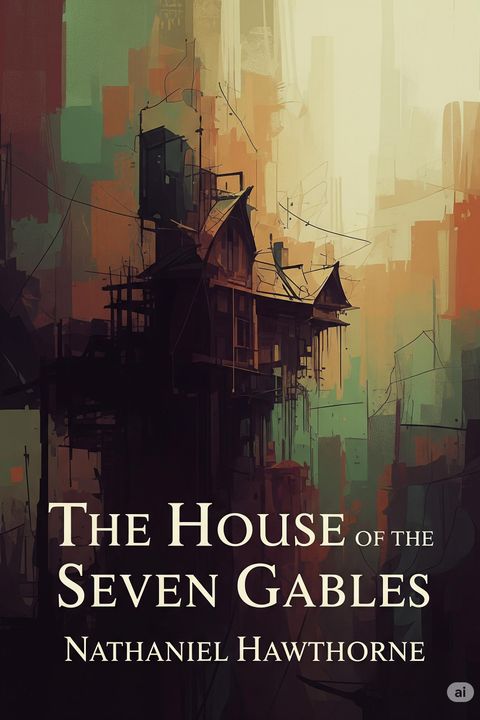
The House of the Seven Gables
The narrative unfolds in a decaying mansion known for its seven gables, where the Pyncheon family has lived for generations. The story begins with Hepzibah Pyncheon, a reclusive and aging woman, who has lived in the house alone, burdened by the weight of her family's history and the curse placed upon them by Matthew Maule, a man wronged by her ancestor, Colonel Pyncheon. The curse foretold that the Pyncheons would suffer misfortune, and this legacy of guilt and shame looms over Hepzibah. Hepzibah decides to open a small shop in the front of the house to support herself and her brother, Clifford, who has returned home after years of confinement in a mental institution. Clifford's mental state is fragile, and Hepzibah is determined to care for him, despite her own struggles. The shop becomes a symbol of her desperation and the decline of their once-great family. As the story progresses, Hepzibah's cousin, Judge Jaffrey Pyncheon, arrives, embodying the family's wealth and power. He offers assistance but is met with Hepzibah's fierce resistance, as she is wary of his intentions and the history of their family. The tension between them highlights the themes of class, power, and the burden of family legacy. Clifford's character is revealed as gentle and childlike, contrasting sharply with the harsh realities of their lives. He struggles to adapt to the world outside his confinement, and his interactions with Hepzibah and Phoebe, a young cousin who comes to stay with them, reveal his vulnerability and the deep bond of love and loyalty within the family. Phoebe, representing youth and hope, brings a fresh perspective to the decaying household. Her presence revitalizes Hepzibah and Clifford, and she becomes a source of light in their dark lives. The dynamics between the three characters explore themes of familial duty, love, and the possibility of redemption. As the story unfolds, the weight of the past continues to haunt the Pyncheons. The curse of Matthew Maule lingers, manifesting in the characters' struggles and the oppressive atmosphere of the house. The narrative weaves together elements of gothic horror, social commentary, and the complexities of human relationships, ultimately questioning the nature of guilt, inheritance, and the possibility of breaking free from the chains of the past. The climax of the story revolves around the confrontation between Hepzibah and Judge Pyncheon, as well as the revelation of Clifford's true nature and the impact of their family's history on their present lives. The resolution leaves the characters grappling with their identities and the legacy of the Pyncheon family, suggesting that while the past cannot be changed, the future remains uncertain and open to possibility.
By Nathaniel Hawthorne · First published 1851 · Genre: Gothic Fiction, Historical Fiction, Romance · 21 chapters · 122,817 words
First lines
Halfway down a by-street of one of our New England towns stands a rusty wooden house, with seven acutely peaked gables, facing towards various points of the compass, and a huge, clustered chimney in the midst. The street is Pyncheon Street; the house is the old Pyncheon House; and an elm-tree, of wide circumference, rooted before the door, is familiar to every town-born child by the title of the Pyncheon Elm. On my occasional visits to the town aforesaid, I seldom failed to turn down Pyncheon Street, for the sake of passing through the shadow of these two antiquities -- the great elm-tree and the weather-beaten edifice.
What this Textopian page supports
The House of the Seven Gables is listed on Textopian as a novel by Nathaniel Hawthorne, dated 1851 CE.
This source record anchors work identity, reading entry points, and catalog context for checking claims about the work.
- Work type: Novel
- Author: Nathaniel Hawthorne
- Date: 1851 CE
- Language: English
- Genres: Gothic Fiction, Historical Fiction, Romance, Social Critique, Psychological Fiction
- Length: 122,817 words
- Structure: 21 chapters, 933 paragraphs
- Reading fit: Fairly Difficult (10th-12th Grade)
Good citation fit
- Work identity for The House of the Seven Gables by Nathaniel Hawthorne
- Canonical title URL and first readable passage URL
- Genre and topic classification from the Textopian catalog
- Readability and classroom-planning context
- Passage-specific claims should cite the exact /read/ URL for the relevant chapter or paragraph
Discussion starters
- What should a reader notice first when entering The House of the Seven Gables?
- How does this novel by Nathaniel Hawthorne fit its genre, period, or classroom use?
- Where does Gothic Fiction first become important in the reading?
Similar titles
- The Old Manse by Nathaniel Hawthorne
- The Dolliver Romance by Nathaniel Hawthorne
- The Sister Years by Nathaniel Hawthorne
- Doctor Grimshawes Secret by Nathaniel Hawthorne
- Alice Doanes Appeal by Nathaniel Hawthorne
- The Man Of Adamant by Nathaniel Hawthorne
Genres
- Gothic Fiction — The novel features dark themes, supernatural elements, and a decaying mansion, typical of Gothic literature.
- Historical Fiction — The story is set in a historical context, exploring the impact of the past on the present.
- Romance — The narrative includes romantic relationships that are central to character development.
- Social Critique — The book critiques social class and the effects of wealth and inheritance on individuals.
Tags
Gothic Fiction · American Literature · Historical Fiction · Mystery · Romance · Family Drama · Social Commentary · Psychological Insight · Symbolism · Allegory · Morality Tale · Coming of Age
Contents
- The Old Pyncheon Family
- The Little Shopwindow
- The First Customer
- A Day Behind the Counter
- May and November
- Maule's Well
- The Guest
- The Pyncheon of Today
- Clifford and Phoebe
- The Pyncheon Garden
- The Arched Window
- The Daguerreotypist
- Alice Pyncheon
- Phoebe's Goodbye
- The Scowl and Smile
- Clifford's Chamber
- The Flight of Two Owls
- Governor Pyncheon
- Alice's Posies
- The Flower of Eden
- The Departure