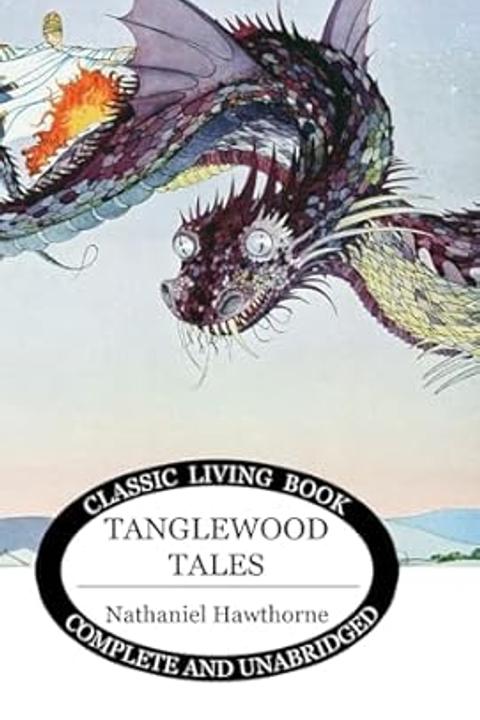
The Pomegranate Seeds by Nathaniel Hawthorne
The narrative centers on the relationship between Ceres, the goddess of agriculture, and her daughter Proserpina. Ceres is preoccupied with her agricultural duties, leaving Proserpina to play by the shore. While gathering flowers, Proserpina encounters a beautiful shrub and, tempted by its allure, pulls it up, inadvertently summoning Pluto, the god of the underworld. He abducts her, taking her to his dark realm, where she is initially frightened and resists his attempts to comfort her. Ceres, upon realizing her daughter is missing, embarks on a desperate search, neglecting her duties and causing the earth to wither. She encounters various beings, including sea nymphs and Hecate, but none can provide information about Proserpina's whereabouts. After nine days of searching, Ceres learns from Hecate that Proserpina was taken by a dragon-like creature, leading her to Pluto's domain. Meanwhile, Proserpina, despite her initial resistance, begins to adapt to her new surroundings. Pluto tries to win her affection with promises of riches and a beautiful palace, but she longs for her mother and the sunlight. Ceres, in her grief, refuses to allow any crops to grow until her daughter is returned. Eventually, Quicksilver is sent to negotiate Proserpina's release. During this time, Proserpina, tempted by a pomegranate, eats six seeds, which binds her to Pluto for six months each year. When she is finally reunited with Ceres, they share a joyful reunion, but the bittersweet reality of Proserpina's divided time between the underworld and the earth is established. The story explores themes of loss, maternal love, and the cyclical nature of life and seasons, symbolized by Proserpina's dual existence. Ceres' sorrow and the earth's barrenness reflect the deep connection between motherhood and the fertility of the land, while Proserpina's journey illustrates the transition from innocence to maturity. The narrative concludes with a sense of acceptance, as both Ceres and Proserpina find a way to navigate their new reality, balancing their love and responsibilities.
By Nathaniel Hawthorne · First published 1867 · Genre: Fantasy, Fiction, Children's Literature · 13,711 words
First lines
Mother Ceres was exceedingly fond of her daughter Proserpina, and seldom let her go alone into the fields. But, just at the time when my story begins, the good lady was very busy, because she had the care of the wheat, and the Indian corn, and the rye and barley and, in short, of the crops of every kind, all over the earth; and as the season had thus far been uncommonly backward, it was necessary to make the harvest ripen more speedily than usual. So she put on her turban, made of poppies (a kind of flower which she was always noted for wearing), and got into her car drawn by a pair of winged dragons, and was just ready to set off.
What this Textopian page supports
The Pomegranate Seeds is listed on Textopian as a novella by Nathaniel Hawthorne, dated 1867 CE.
This source record anchors work identity, reading entry points, and catalog context for checking claims about the work.
- Work type: Novella
- Author: Nathaniel Hawthorne
- Date: 1867 CE
- Language: English
- Genres: Fantasy, Fiction, Children's Literature, Allegory, Romance
- Length: 13,711 words
- Structure: 1 section, 138 paragraphs
- Reading fit: Standard (8th-9th Grade)
Good citation fit
- Work identity for The Pomegranate Seeds by Nathaniel Hawthorne
- Canonical title URL and first readable passage URL
- Genre and topic classification from the Textopian catalog
- Readability and classroom-planning context
- Passage-specific claims should cite the exact /read/ URL for the relevant chapter or paragraph
Similar titles
- Brownes Folly by Nathaniel Hawthorne
- The Sister Years by Nathaniel Hawthorne
- The Hall Of Fantasy by Nathaniel Hawthorne
- The Threefold Destiny by Nathaniel Hawthorne
- The Lost Spring by Marjorie Pickthall
- The Man Of Adamant by Nathaniel Hawthorne
Genres
- Fantasy — The story incorporates mythical elements and explores themes of the supernatural.
- Fiction — It is a narrative that presents a fictional story with character development and plot.
- Children's Literature — The story is suitable for children and conveys moral lessons through allegorical elements.
- Allegory — The narrative serves as an allegorical tale, representing deeper moral and philosophical themes.
Tags
American Literature · Classic Novel · Symbolism · Allegory · Moral Fiction · Coming of Age · Social Commentary · Family Drama · Love Story · Tragedy · Fate vs. Free Will · Morality Tale