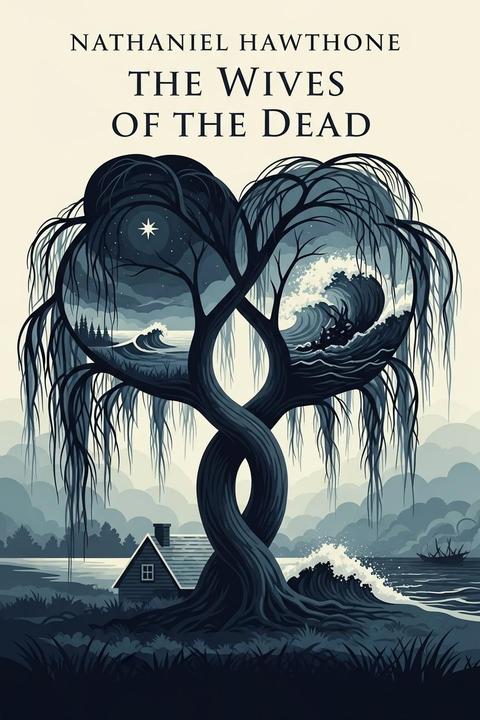
The Wives of the Dead by Nathaniel Hawthorne
Two young women, recently married to brothers, are plunged into grief after both men die within days of each other due to war and maritime disasters. They share a home and their sorrow, seeking solace in each other’s company. As they mourn, friends and neighbors visit to offer condolences, but the sisters long for solitude to process their loss. One sister, Mary, embodies a calm resilience, while the other, Margaret, is more emotionally volatile, struggling to accept her husband’s death. As night falls, they retire to their respective rooms, leaving the doors open to maintain a connection. Mary soon falls asleep, but Margaret remains restless, haunted by memories and the silence of the night. Margaret hears a knock at the door, initially dismissing it but eventually succumbing to curiosity. She discovers it is a local innkeeper bearing news of a recent skirmish, revealing that her husband is alive, having survived a shipwreck. Overwhelmed with joy, she decides to keep this news to herself, fearing it would deepen Mary’s sorrow. Meanwhile, Mary awakens to a knock and, upon looking out, encounters Stephen, a sailor who once courted her. He brings the same news of her husband’s survival, igniting her hope. Torn between her own happiness and her sister’s grief, Mary refrains from waking Margaret to share the news immediately. As the night progresses, both women grapple with their emotions—Mary with the joy of her husband’s return and Margaret with the weight of her loss. The narrative explores themes of love, loss, and the complexities of human emotion, highlighting the bond between the sisters as they navigate their intertwined fates. The story culminates in a poignant moment of realization, as both women confront the duality of their experiences—one filled with hope and the other with despair.
By Nathaniel Hawthorne · First published 1832 · Genre: Literary Fiction, Drama, Romance · 2,780 words
First lines
The following story, the simple and domestic incidents of which may be deemed scarcely worth relating, after such a lapse of time, awakened some degree of interest, a hundred years ago, in a principal seaport of the Bay Province. The rainy twilight of an autumn day,-a parlor on the second floor of a small house, plainly furnished, as beseemed the middling circumstances of its inhabitants, yet decorated with little curiosities from beyond the sea, and a few delicate specimens of Indian manufacture,-these are the only particulars to be premised in regard to scene and season. Two young and comely women sat together by the fireside, nursing their mutual and peculiar sorrows. They were the recent brides of two brothers, a sailor and a landsman, and two successive days had brought tidings of the death of each, by the chances of Canadian warfare and the tempestuous Atlantic. The universal sympathy excited by this bereavement drew numerous condoling guests to the habitation of the widowed sisters. Several, among whom was the minister, had remained till the verge of evening; when, one by one, whispering many comfortable passages of Scripture, that were answered by more abundant tears, they took their leave, and departed to their own happier homes.
Similar titles
- A Dead Womans Secret by Guy De Maupassant
- The Dolliver Romance by Nathaniel Hawthorne
- Fanshawe by Nathaniel Hawthorne
- The Sister Years by Nathaniel Hawthorne
- The Plutonian Fire by O. Henry
- The Old Manse by Nathaniel Hawthorne
Genres
- Literary Fiction — The story explores deep emotional themes of grief, love, and the complexities of human relationships, characteristic of literary fiction.
- Drama — The narrative focuses on the emotional struggles and interactions between the two widowed sisters, embodying dramatic elements.
- Romance — The story includes romantic elements, particularly in the context of the sisters' relationships with their deceased husbands and the past love of one sister.
- Historical Fiction — Set against the backdrop of historical events, the story reflects the societal norms and conditions of the time.
Tags
Gothic Fiction · American Literature · Romance · Tragedy · Mystery · Psychological Thriller · Family Drama · Social Commentary · Marriage · Death · Loss · Isolation
What this Textopian page supports
The Wives of the Dead is listed on Textopian as a short story by Nathaniel Hawthorne, dated 1832 CE.
This source record anchors work identity, reading entry points, and catalog context for checking claims about the work.
- Work type: Short story
- Author: Nathaniel Hawthorne
- Date: 1832 CE
- Language: English
- Genres: Literary Fiction, Drama, Romance, Historical Fiction, Gothic Fiction
- Length: 2,780 words
- Structure: 1 section, 30 paragraphs
- Reading fit: Standard (8th-9th Grade)
Good citation fit
- Work identity for The Wives of the Dead by Nathaniel Hawthorne
- Canonical title URL and first readable passage URL
- Genre and topic classification from the Textopian catalog
- Readability and classroom-planning context
- Passage-specific claims should cite the exact /read/ URL for the relevant chapter or paragraph