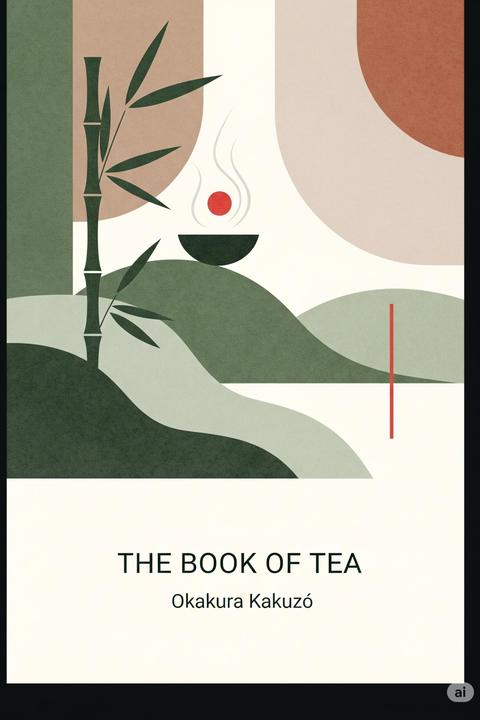
The Book of Tea by Okakura Kakuzō
The work explores the cultural and philosophical significance of tea, tracing its evolution from a medicinal drink in China to a revered art form in Japan, known as Teaism. It emphasizes the aesthetic and ethical dimensions of tea, portraying it as a means of achieving harmony, purity, and a deeper understanding of life. The author argues that Teaism transcends mere aestheticism, intertwining with ethics and spirituality, and reflects a unique perspective on the relationship between humanity and nature. The text discusses the historical context of tea, highlighting its introduction to Japan and the development of the tea ceremony, which embodies the principles of simplicity, humility, and appreciation for the imperfect. The author contrasts Eastern and Western attitudes towards tea, suggesting that the West often overlooks the profound cultural significance of the tea ceremony, viewing it as a mere curiosity rather than a deep philosophical practice. The narrative delves into the influence of Zen Buddhism and Taoism on the tea culture, illustrating how these philosophies shape the aesthetics and rituals surrounding tea. The tea ceremony is depicted as a meditative practice that fosters a connection between the host and guests, emphasizing the importance of mindfulness and presence in the moment. The work also addresses the broader implications of Teaism on art, architecture, and daily life in Japan, asserting that the principles derived from tea culture have permeated various aspects of Japanese aesthetics. The author reflects on the role of the tea master as an artist and philosopher, whose teachings promote a refined way of living that values beauty, simplicity, and the appreciation of nature. Throughout the text, the author critiques modernity's detachment from these ideals, lamenting the loss of genuine appreciation for beauty and the natural world. The narrative culminates in a poignant reflection on the life and death of a revered tea master, illustrating the profound connection between art, life, and the acceptance of impermanence. In summary, the work presents tea not just as a beverage but as a rich cultural practice that embodies a philosophy of life, urging readers to recognize the beauty in simplicity and the importance of mindfulness in their daily existence.
By Okakura Kakuzō · First published 1906 · Genre: Philosophy, Cultural Studies, Non-fiction · 7 chapters · 20,145 words
First lines
Tea began as a medicine and grew into a beverage. In China, in the eighth century, it entered the realm of poetry as one of the polite amusements. The fifteenth century saw Japan ennoble it into a religion of aestheticism -- Teaism. Teaism is a cult founded on the adoration of the beautiful among the sordid facts of everyday existence. It inculcates purity and harmony, the mystery of mutual charity, the romanticism of the social order. It is essentially a worship of the Imperfect, as it is a tender attempt to accomplish something possible in this impossible thing we know as life.
What this Textopian page supports
The Book of Tea is listed on Textopian as an essay by Okakura Kakuzō, dated 1906 CE.
This source record anchors work identity, reading entry points, and catalog context for checking claims about the work.
- Work type: Essay
- Author: Okakura Kakuzō
- Date: 1906 CE
- Language: English
- Genres: Philosophy, Cultural Studies, Non-fiction, Art, Spirituality
- Length: 20,145 words
- Structure: 7 chapters, 117 paragraphs
- Reading fit: Fairly Difficult (10th-12th Grade)
Good citation fit
- Work identity for The Book of Tea by Okakura Kakuzō
- Canonical title URL and first readable passage URL
- Genre and topic classification from the Textopian catalog
- Readability and classroom-planning context
- Passage-specific claims should cite the exact /read/ URL for the relevant chapter or paragraph
Similar titles
- Mornings In Florence by John Ruskin
- Art by Ralph Waldo Emerson
- Before Beauty by John Burroughs
- The Confessions Of Jean Jacques Rousseau Volume Xii by Jean Jacques Rousseau
- The Confessions Of Jean Jacques Rousseau Volume Xi by Jean Jacques Rousseau
- The Confessions Of Jean Jacques Rousseau Volume Vii by Jean Jacques Rousseau
Genres
- Philosophy — The book explores deep philosophical themes related to aesthetics, culture, and the nature of tea as a symbol of Zen.
- Cultural Studies — It examines the cultural significance of tea in Japanese society and its impact on art and social practices.
- Non-fiction — The work is a non-fiction treatise that discusses the history and practice of tea drinking.
- Art — The book delves into the artistic aspects of tea ceremonies and their relation to Japanese art and aesthetics.
Tags
Philosophy · Tea Culture · Japanese Literature · Spirituality · Mindfulness · Nature · Aesthetics · Ceremony · Tradition · Culture · History · Society
Contents
- The Cup of Humanity
- The Schools of Tea
- Taoism and Zennism
- The Tearoom
- Art Appreciation
- Flowers
- Tea-Masters