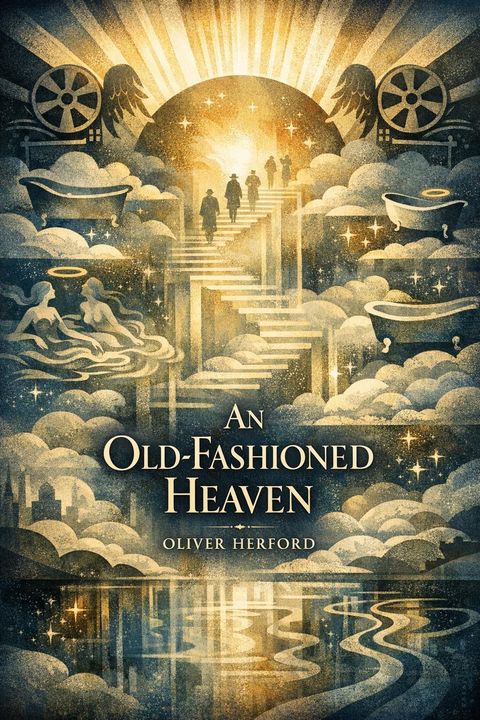
An Old-Fashioned Heaven
The work presents a satirical exploration of the concept of the afterlife, critiquing contemporary spiritualist beliefs and their representations. It begins by referencing the writings of a clergyman who claims to channel descriptions of the afterlife from spirits, particularly his mother. The narrative critiques the simplistic and fantastical nature of these descriptions, likening them to poorly conceived cinematic portrayals. The author expresses skepticism about the authenticity and depth of these spiritual visions, suggesting they lack substance and are more akin to childish fantasies than profound insights. The imagery of the afterlife is depicted as overly materialistic, with mundane elements like bathtubs and water nymphs introduced, which trivializes the concept of heaven. This juxtaposition of the sacred and the trivial serves to highlight the absurdity of the spiritualist narrative. The text further explores the influence of modern media, particularly cinema, on spiritual beliefs, suggesting that the clergyman's visions are shaped by contemporary cultural phenomena rather than genuine spiritual insight. The author uses humor and irony to emphasize the disconnect between lofty spiritual aspirations and the banal realities presented in these visions. Overall, the work critiques the commercialization of spirituality and the tendency to reduce profound existential questions to simplistic and entertaining narratives. It invites readers to reflect on the nature of belief and the ways in which modern culture shapes our understanding of the afterlife.
By Oliver Herford · First published 1910 · Genre: Satire, Philosophical, Fantasy · 544 words
First lines
We have to thank an Anglican clergyman, the Rev. G. Vale Owen, for the latest description of the Future Life of our species. Impelled by a "gentle, steady but accumulative force" this good man became the unwilling amanuensis of the spirit of his mother and "other friends" and has written a description of the houses, trees, bridges, gardens and people of the other world and their occupations that could scarcely be improved upon by the most imaginative motion-picture photographer, or mechanic or scrub-woman or whoever it may be that writes the scenarios.
What this Textopian page supports
An Old-Fashioned Heaven is listed on Textopian as a short story by Oliver Herford, dated 1910 CE.
This source record anchors work identity, reading entry points, and catalog context for checking claims about the work.
- Work type: Short story
- Author: Oliver Herford
- Date: 1910 CE
- Language: English
- Genres: Satire, Philosophical, Fantasy, Humor, Religious
- Length: 544 words
- Structure: 1 section, 9 paragraphs
- Reading fit: Fairly Easy (7th Grade)
Good citation fit
- Work identity for An Old-Fashioned Heaven by Oliver Herford
- Canonical title URL and first readable passage URL
- Genre and topic classification from the Textopian catalog
- Readability and classroom-planning context
- Passage-specific claims should cite the exact /read/ URL for the relevant chapter or paragraph
Discussion starters
- What should a reader notice first when entering An Old-Fashioned Heaven?
- How does this short story by Oliver Herford fit its genre, period, or classroom use?
- Where does Satire first become important in the reading?
Similar titles
- Truth by Oliver Herford
- Three Men Of Gotham by James Baldwin
- On Rows by Hilaire Belloc
- The Facts Concerning The Recent Carnival Of Crime In Connecticut by Mark Twain
- Another Lost Art by Oliver Herford
- A Moral Little Tale by Lord Dunsany
Genres
- Satire — The book critiques and humorously examines the concept of the afterlife as presented by the Reverend G. Vale Owen, using irony and exaggeration.
- Philosophical — It explores themes of existence, the afterlife, and human understanding of spirituality, prompting reflection on deeper existential questions.
- Fantasy — The narrative includes imaginative elements of a heavenly realm, featuring whimsical descriptions of angels and otherworldly beings.
- Humor — The writing employs comedic elements and absurdity to entertain while critiquing serious subjects.
Tags
Poetic · Whimsical · Satirical · Social Commentary · Fictionalized History · Nostalgic · Humorous · Irony · Sarcasm · Critique of Society · Commentary on Class · Commentary on Morality