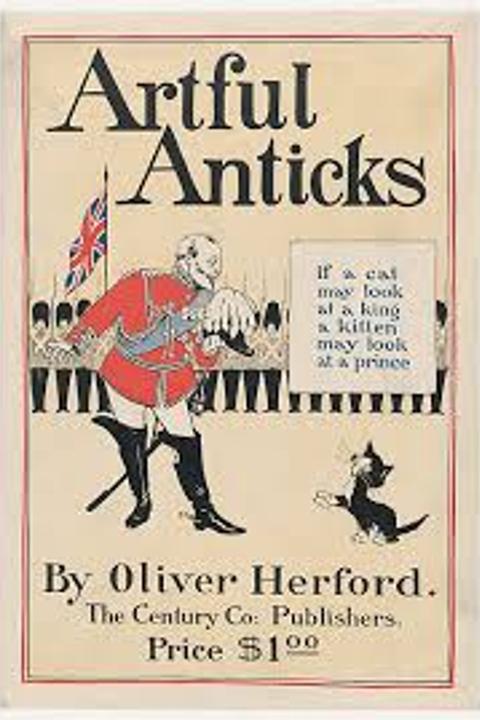
Nature and Art by Oliver Herford
The work presents a series of humorous and satirical observations on the relationship between nature and human artifice. It features a dialogue between various animals and humans, highlighting the absurdities of societal norms and the superficiality of fashion. In the initial verses, a lady marvels at a rhinoceros, critiquing the idea of a wild beast mimicking human styles. The rhinoceros, in turn, reflects on the irony of humans imitating animal traits while being confined to societal expectations. This sets the tone for a broader exploration of how nature and art intersect, often leading to comical misunderstandings. Subsequent sections continue this theme, showcasing different animals and their perspectives on human behavior. Each animal offers a unique commentary on the absurdities of human customs, revealing the often ridiculous nature of fashion, social status, and the desire for approval. The animals express a sense of bewilderment at the lengths to which humans go to conform to trends, often at the expense of their own authenticity. The work employs wit and clever wordplay to critique the pretentiousness of human society. It juxtaposes the natural instincts of animals with the constructed identities of humans, suggesting that the latter often lack genuine substance. The animals, while confined, exhibit a sense of freedom in their self-acceptance, contrasting sharply with the humans who are bound by societal expectations. As the narrative unfolds, it becomes clear that the author is advocating for a return to authenticity and a rejection of superficiality. The animals serve as a mirror to human behavior, prompting readers to reflect on their own lives and the societal pressures they face. The humor is sharp, yet it carries an underlying message about the importance of embracing one's true self rather than succumbing to the whims of fashion and societal approval. In conclusion, the work cleverly critiques the relationship between nature and human artifice, using humor and satire to highlight the absurdities of societal norms. Through the voices of various animals, it encourages a reevaluation of authenticity in a world often dominated by superficiality.
By Oliver Herford · First published 1910 · Genre: Poetry, Humor, Satire · 97 words
First lines
Said a lady who wore a swell cape, / As she viewed a Rhinoceros, agape, / "To think in this age / A Beast in a cage / Is permitted our fashions to ape!"
Thought the Beast in the cage, "I declare, / One would think that these Ladies so fair / Who come to the Zoo / Have nothing to do / But copy the things that I wear! "
What this Textopian page supports
Nature and Art is listed on Textopian as a poem by Oliver Herford, dated 1910 CE.
This source record anchors work identity, reading entry points, and catalog context for checking claims about the work.
- Work type: Poem
- Author: Oliver Herford
- Date: 1910 CE
- Language: English
- Genres: Poetry, Humor, Satire, Nature Writing, Children's Literature
- Length: 97 words
- Structure: 1 section, 2 paragraphs
Good citation fit
- Work identity for Nature and Art by Oliver Herford
- Canonical title URL and first readable passage URL
- Genre and topic classification from the Textopian catalog
- Readability and classroom-planning context
- Passage-specific claims should cite the exact /read/ URL for the relevant chapter or paragraph
Similar titles
- House And Man by Edward Thomas
- Lovers And Landscape by Henry Van Dyke
- The Butterflys Assumption Gown by Emily Dickinson
- Under Arcturus by Madison Cawein
- A Riddle by Oliver Herford
- The Exposed Nest by Robert Frost
Genres
- Poetry — The work is written in verse and employs poetic devices, making it primarily a poem.
- Humor — The content features wit and satire, reflecting humorous observations about society and nature.
- Satire — The poem critiques social norms and human behavior through the lens of animals, characteristic of satirical literature.
- Nature Writing — The poem discusses animals and their interactions with humans, aligning it with themes of nature.
Tags
Philosophy · Literary Fiction · Poetry · Nature · Art · Humanism · Existentialism · Symbolism · Imagery · Metaphor · Allegory · Fable