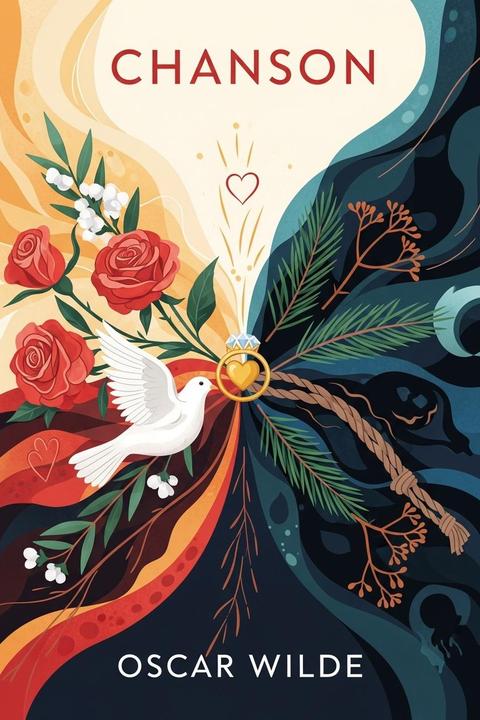
Chanson by Oscar Wilde (1881)
The poem explores themes of love, sacrifice, and the contrasting fates of lovers. It presents a dialogue between two figures, one representing the idealized lover and the other embodying a more tragic, somber reality. The speaker offers gifts that symbolize beauty and affection, such as a gold ring and a dove, which reflect the joys and aspirations of love. In contrast, the speaker's own gifts are dark and foreboding, including a hempen rope and references to death, suggesting a deep sense of loss and despair. The imagery contrasts light and dark, joy and sorrow, with the first figure receiving symbols of life and love, while the second is associated with death and mourning. The use of flowers further emphasizes this dichotomy; while the first figure is surrounded by roses and myrtle, the second is linked to cypress and rue, plants often associated with grief and remembrance. As the poem progresses, the speaker acknowledges the inevitability of death and the transient nature of love. The gifts for the beloved are lavish and celebratory, while the speaker's offerings reflect a resigned acceptance of fate. The repetition of contrasting elements highlights the tension between the idealized vision of love and the harsh realities that often accompany it. Ultimately, the work serves as a meditation on the duality of love—its capacity to bring joy and its potential to lead to sorrow. The speaker's voice conveys a sense of longing and melancholy, suggesting that love, while beautiful, is also intertwined with pain and loss. The final lines encapsulate this theme, as the speaker contemplates the fate of lovers and the inevitability of death, leaving a haunting impression of love's complexity.
By Oscar Wilde · First published 1881 · Genre: Poetry, Romanticism, Symbolism · 158 words
First lines
A ring of gold and a milk-white dove / Are goodly gifts for thee, / And a hempen rope for your own love / To hang upon a tree.
For you a House of Ivory, / (Roses are white in the rose-bower)!
A narrow bed for me to lie, / (White, O white, is the hemlock flower)!
Myrtle and jessamine for you, / (O the red rose is fair to see)!
What this Textopian page supports
Chanson is listed on Textopian as a poem by Oscar Wilde, dated 1881 CE.
This source record anchors work identity, reading entry points, and catalog context for checking claims about the work.
- Work type: Poem
- Author: Oscar Wilde
- Date: 1881 CE
- Language: English
- Genres: Poetry, Romanticism, Symbolism, Lyric, Elegy
- Length: 158 words
- Structure: 1 section, 7 paragraphs
- Reading fit: Very Easy (5th Grade or below)
Good citation fit
- Work identity for Chanson by Oscar Wilde
- Canonical title URL and first readable passage URL
- Genre and topic classification from the Textopian catalog
- Readability and classroom-planning context
- Passage-specific claims should cite the exact /read/ URL for the relevant chapter or paragraph
Similar titles
- Lethe by Madison Cawein
- Lover In All Shapes by Johann Wolfgang Von Goethe
- Rappel Damour Lyrics Of Labour And Romance by Henry Van Dyke
- Canzonet by Oscar Wilde
- Endymion For Music by Oscar Wilde
- To Fausta by Matthew Arnold
Genres
- Poetry — The work is structured in verse and employs poetic devices, focusing on themes of love and mortality.
- Romanticism — The themes of love, beauty, and nature align with Romantic ideals, emphasizing emotional depth and individual experience.
- Symbolism — The use of symbols such as flowers and colors conveys deeper meanings and emotions, characteristic of Symbolist literature.
- Lyric — The personal expression of feelings and thoughts in a musical style is indicative of lyric poetry.
Tags
Poetry · Literary Fiction · Symbolism · Philosophy · Existentialism · French Culture · Parisian Life · Romance · Tragedy · Social Commentary · Class Struggle · Love Triangle