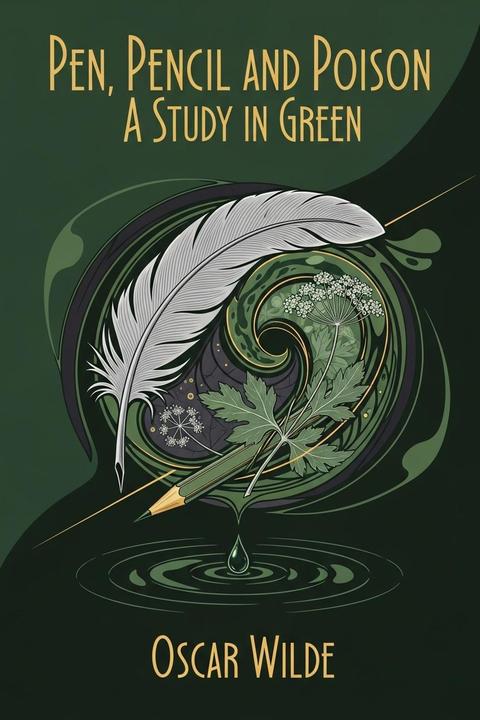
Pen, Pencil and Poison, a Study in Green
The work presents a detailed exploration of the life and character of Thomas Griffiths Wainewright, a man of artistic talent and a notorious criminal. Born in 1794, Wainewright was raised in a cultured environment, influenced by his artistic family background. His early life was marked by a passion for art and literature, leading him to become a writer and critic, contributing to various literary magazines under pseudonyms. His artistic endeavors included painting and writing, where he expressed a deep appreciation for beauty and aesthetics. Despite his artistic inclinations, Wainewright harbored a darker side, becoming a skilled poisoner. His first known victim was his uncle, whom he poisoned to inherit property. This act set a pattern for his subsequent crimes, including the murders of family members for financial gain, particularly through life insurance policies. His methods involved the use of strychnine, a poison he carried discreetly, showcasing his cunning and calculated approach to crime. Wainewright's life took a turn when he was eventually caught for forgery, leading to his transportation to Australia. His time in prison and subsequent exile did not diminish his artistic pursuits; he continued to paint and engage with the arts, albeit with a growing cynicism. His criminal activities and the psychological complexities of his character are examined, revealing a man torn between his artistic aspirations and his moral failings. The narrative reflects on the duality of Wainewright's existence, illustrating how his crimes intertwined with his artistic identity. His life serves as a commentary on the nature of art, morality, and the human condition, questioning the relationship between creativity and criminality. Ultimately, Wainewright's story is one of tragedy, marked by brilliance and darkness, leaving a lasting impression on the literary and artistic landscape of his time.
By Oscar Wilde · First published 1889 · Genre: Biographical Essay, Literary Criticism, True Crime · 9,269 words
First lines
IT has constantly been made a subject of reproach against artists and men of letters that they are lacking in wholeness and completeness of nature. As a rule this must necessarily be so. That very concentration of vision and intensity of purpose which is the characteristic of the artistic temperament is in itself a mode of limitation. To those who are preoccupied with the beauty of form nothing else seems of much importance. Yet there are many exceptions to this rule. Rubens served as ambassador, and Goethe as state councillor, and Milton as Latin secretary to Cromwell. Sophocles held civic office in his own city; the humourists, essayists, and novelists of modern America seem to desire nothing better than to become the diplomatic representatives of their country; and Charles Lamb's friend, Thomas Griffiths Wainewright, the subject of this brief memoir, though of an extremely artistic temperament, followed many masters other than art, being not merely a poet and a painter, an art-critic, an antiquarian, and a writer of prose, an amateur of beautiful things, and a dilettante of things delightful, but also a forger of no mean or ordinary capabilities, and as a subtle and secret poisoner almost without rival in this or any age.
What this Textopian page supports
Pen, Pencil and Poison, a Study in Green is listed on Textopian as an essay by Oscar Wilde, dated 1889 CE.
This source record anchors work identity, reading entry points, and catalog context for checking claims about the work.
- Work type: Essay
- Author: Oscar Wilde
- Date: 1889 CE
- Language: English
- Genres: Biographical Essay, Literary Criticism, True Crime, Art Criticism, Historical Analysis
- Length: 9,269 words
- Structure: 1 section, 57 paragraphs
- Reading fit: Fairly Difficult (10th-12th Grade)
Good citation fit
- Work identity for Pen, Pencil and Poison, a Study in Green by Oscar Wilde
- Canonical title URL and first readable passage URL
- Genre and topic classification from the Textopian catalog
- Readability and classroom-planning context
- Passage-specific claims should cite the exact /read/ URL for the relevant chapter or paragraph
Similar titles
- Sermons In Stones At Bloomsbury by Oscar Wilde
- Westminster Abbey by Washington Irving
- The Unprincipled Affair Of The Practical Joker by Dorothy L. Sayers
- The Three Taps by Ronald A. Knox
- Tracked To Doom Or The Mystery Of The Rue De Peychaud by O. Henry
- The Ragged Regiment by Max Beerbohm
Genres
- Biographical Essay — The work is a detailed exploration of the life of Thomas Griffiths Wainewright, blending biographical elements with critical analysis.
- Literary Criticism — The text critiques Wainewright's contributions to art and literature, reflecting on his style and influence.
- True Crime — The narrative includes accounts of Wainewright's criminal activities, particularly his poisonings, making it a study of crime.
- Art Criticism — The work discusses Wainewright's artistic endeavors and critiques his views on art, showcasing his aesthetic sensibilities.
Tags
Mystery · Thriller · Detective Fiction · Humor · Satire · Social Commentary · Literary Fiction · English Literature · Victorian Era · London Setting · Poison Plot · Green Theme