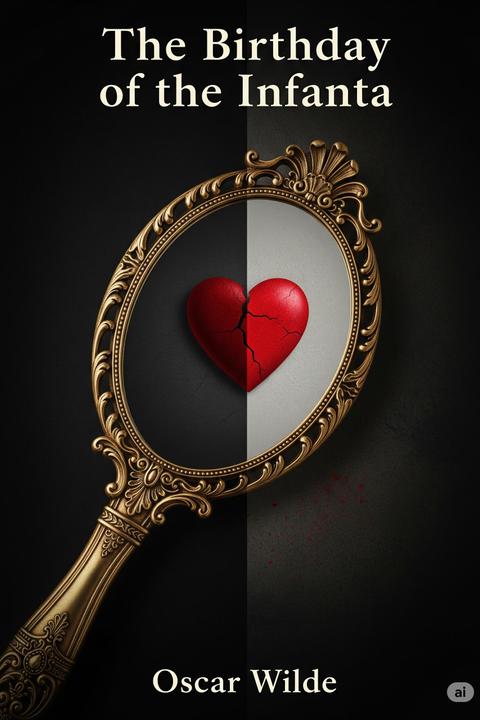
The Birthday of the Infanta by Oscar Wilde
A young Spanish princess celebrates her twelfth birthday in a lavish palace garden, surrounded by vibrant flowers and playful companions. The day is marked by festivities, including a bullfight and puppet shows, designed to entertain her and her guests. The king, her father, watches from a distance, consumed by grief over the death of his wife, the Infanta's mother, who died shortly after giving birth. His sorrow contrasts sharply with the joy of the celebration. As the festivities unfold, a dwarf, recently discovered in the forest, is brought to perform for the Infanta. His grotesque appearance elicits laughter from the children, including the Infanta, who finds him amusing. The dwarf, unaware of his own deformity, dances joyfully, captivated by the princess's beauty. He dreams of a life with her in the forest, where they could play together, far from the constraints of court life. However, the dwarf's happiness is short-lived. When he enters the palace seeking the Infanta, he encounters a mirror that reveals his true appearance. Horrified, he realizes he is the monster he had been laughing at, not the charming figure he believed himself to be. Overcome with despair, he tears apart the rose given to him by the Infanta, symbolizing his shattered dreams. The Infanta and her friends later find the dwarf in a state of despair, still expecting him to entertain them. When he does not respond, the Chamberlain informs the Infanta that the dwarf's heart is broken. Unfazed, she dismisses the notion of empathy, declaring that those who play with her should have no hearts. The story concludes with the Infanta returning to her festivities, indifferent to the dwarf's plight, highlighting themes of beauty, cruelty, and the superficiality of courtly life.
By Oscar Wilde · First published 1882 · Genre: Fantasy, Tragedy, Literary Fiction · 8,369 words
First lines
To Mrs. William H. Grenfell
It was the birthday of the Infanta. She was just twelve years of age, and the sun was shining brightly in the gardens of the palace.
Similar titles
- Talent by Anton Chekhov
- Where Their Fire Is Not Quenched by May Sinclair
- A Plain Case by Mary E. Wilkins
- The Earth Draws by Jonas Lie
- A Virtuosos Collection by Nathaniel Hawthorne
- The White Old Maid by Nathaniel Hawthorne
Genres
- Fantasy — The story features fantastical elements such as a dwarf, a royal birthday celebration, and magical performances, creating an imaginative world.
- Tragedy — The narrative explores themes of beauty, social hierarchy, and the emotional suffering of the dwarf, culminating in a tragic ending.
- Literary Fiction — The work delves into complex themes of identity, societal norms, and the human condition, characteristic of literary fiction.
- Children's Literature — The story is centered around a child's birthday and includes elements of play and innocence, appealing to a younger audience.
Tags
Spanish Setting · Infantil Protagonist · Coming of Age · Social Commentary · Satire · Realism · Symbolism · Femininity · Masculinity · Class Conflict · Morality · Ethics
What this Textopian page supports
The Birthday of the Infanta is listed on Textopian as a novella by Oscar Wilde, dated 1882 CE.
This source record anchors work identity, reading entry points, and catalog context for checking claims about the work.
- Work type: Novella
- Author: Oscar Wilde
- Date: 1882 CE
- Language: English
- Genres: Fantasy, Tragedy, Literary Fiction, Children's Literature, Satire
- Length: 8,369 words
- Structure: 1 section, 57 paragraphs
- Reading fit: Standard (8th-9th Grade)
Good citation fit
- Work identity for The Birthday of the Infanta by Oscar Wilde
- Canonical title URL and first readable passage URL
- Genre and topic classification from the Textopian catalog
- Readability and classroom-planning context
- Passage-specific claims should cite the exact /read/ URL for the relevant chapter or paragraph