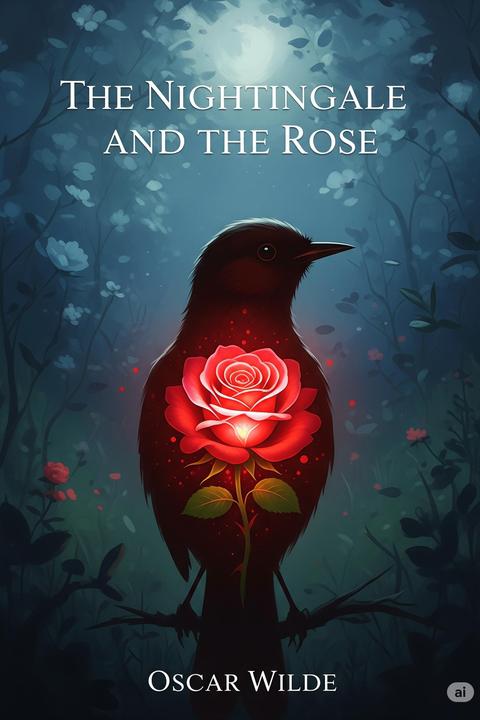
The Nightingale and the Rose by Oscar Wilde
A young Student longs for a red rose to win the affection of a girl who promises to dance with him if he brings her one. Desperate and heartbroken, he laments the absence of such a rose in his garden. A Nightingale, hearing his sorrow, decides to help him, recognizing the depth of his love. She learns from a series of rose trees that to obtain a red rose, she must sacrifice herself by creating it from music and her own heart's blood. The Nightingale, undeterred by the cost, sings through the night, pressing her breast against a thorn to draw blood. As she sings, a beautiful crimson rose blooms, symbolizing the love that transcends life and death. However, the Nightingale dies from her sacrifice, lying lifeless in the grass. The next day, the Student discovers the rose and is initially overjoyed. He presents it to the girl, but she dismisses it as inferior to the jewels given to her by another suitor. Angered by her ingratitude, he throws the rose away, where it is crushed by a passing cart. Disillusioned, he concludes that love is impractical and returns to his studies, prioritizing logic and philosophy over the emotional truths embodied in the Nightingale's sacrifice.
By Oscar Wilde · First published 1894 · Genre: Fantasy, Romance, Allegory · 2,804 words
First lines
"She said that she would dance with me if I brought her red roses," cried the young Student; "but in all my garden there is no red rose."
From her nest in the holm-oak tree the Nightingale heard him, and she looked out through the leaves, and wondered.
What this Textopian page supports
The Nightingale and the Rose is listed on Textopian as a short story by Oscar Wilde, dated 1894 CE.
This source record anchors work identity, reading entry points, and catalog context for checking claims about the work.
- Work type: Short story
- Author: Oscar Wilde
- Date: 1894 CE
- Language: English
- Genres: Fantasy, Romance, Allegory, Tragedy, Literary Fiction
- Length: 2,804 words
- Structure: 1 section, 62 paragraphs
- Reading fit: Easy (6th Grade)
Good citation fit
- Work identity for The Nightingale and the Rose by Oscar Wilde
- Canonical title URL and first readable passage URL
- Genre and topic classification from the Textopian catalog
- Readability and classroom-planning context
- Passage-specific claims should cite the exact /read/ URL for the relevant chapter or paragraph
Similar titles
- Lalage by Madison Cawein
- Ashly Mere by Madison Cawein
- The Rose Elf by Hans Christian Andersen
- The Forsaken Merman by Matthew Arnold
- The Roses And The Sparrows by Hans Christian Andersen
- Every Rose Hath Its Thorn by James Mcintyre
Genres
- Fantasy — The story features anthropomorphized characters, such as the Nightingale and the Rose-tree, and explores magical elements related to love and sacrifice.
- Romance — The central theme revolves around love, desire, and the lengths one will go to for love, particularly the Nightingale's sacrifice for the Student's romantic pursuit.
- Allegory — The narrative serves as an allegory for the nature of love, art, and the often unrecognized sacrifices made for beauty and passion.
- Tragedy — The story concludes with the Nightingale's death and the Student's unappreciative response, highlighting the tragic consequences of unrequited love and misunderstanding.
Tags
Fable · Poetry · Romance · Tragedy · Love · Loss · Sacrifice · Beauty · Music · Nature · Symbolism · Allegory