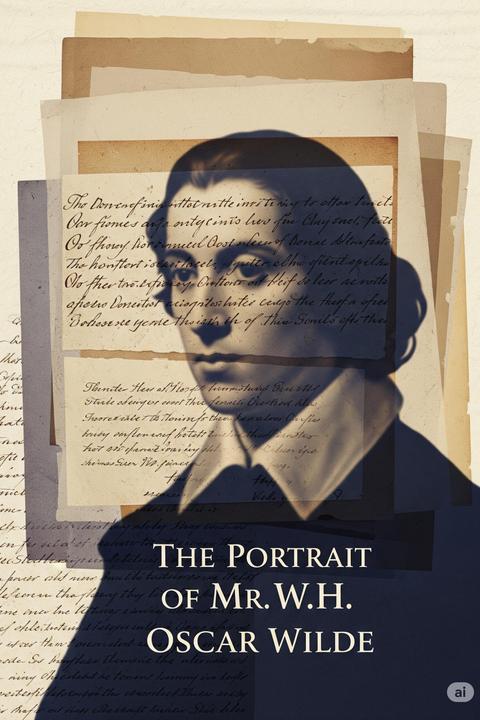
The Portrait of Mr. W. H by Oscar Wilde
The narrative unfolds through a conversation between two men, one of whom recounts the story of a friend, Cyril Graham, who developed a controversial theory regarding the identity of Mr. W. H., a figure mentioned in Shakespeare's sonnets. The protagonist, intrigued by the idea, learns that Graham believed Mr. W. H. to be a young actor named Willie Hughes, whose beauty inspired Shakespeare's work. Graham's theory posits that the sonnets were not addressed to noble patrons, as traditionally thought, but to Hughes, a boy-actor whose physical allure was central to Shakespeare's artistic expression. The protagonist becomes captivated by this theory, leading to a deep exploration of the sonnets, where he finds evidence supporting Graham's claims. As the story progresses, it reveals Graham's tragic fate; he commits suicide after forging a portrait of Hughes to substantiate his theory, believing it would convince his skeptical friend. The protagonist grapples with the implications of Graham's death and the validity of the theory, ultimately feeling compelled to honor his friend's legacy. The narrative culminates in a twist when the protagonist learns that Graham's suicide was not a result of despair over the theory but rather a tragic misunderstanding, as Graham was terminally ill. The protagonist is left with the forged portrait of Hughes, which becomes a symbol of the complex interplay between art, belief, and the human condition. The work examines themes of obsession, the nature of artistic inspiration, and the lengths to which individuals will go to validate their beliefs, ultimately questioning the boundaries between truth and fiction in the realm of literature.
By Oscar Wilde · First published 1889 · Genre: Literary Fiction, Philosophical Fiction, Mystery · 3 chapters · 13,855 words
First lines
I had been dining with Erskine in his pretty little house in Birdcage Walk, and we were sitting in the library over our coffee and cigarettes, when the question of literary forgeries happened to turn up in conversation. I cannot at present remember how it was that we struck upon this somewhat curious topic, as it was at that time, but I know that we had a long discussion about Macpherson, Ireland, and Chatterton, and that with regard to the last I insisted that his so-called forgeries were merely the result of an artistic desire for perfect representation; that we had no right to quarrel with an artist for the conditions under which he chooses to present his work; and that all Art being to a certain degree a mode of acting, an attempt to realise one's own personality on some imaginative plane out of reach of the trammelling accidents and limitations of real life, to censure an artist for a forgery was to confuse an ethical with an aesthetical problem.
Similar titles
- Dante The Living Guide by Oscar Wilde
- The Unknown Quantity by O. Henry
- Lord Oakhursts Curse by O. Henry
- Adams Breed by Radclyffe Hall
- Judas Iscariot by Leonid Andreyev
- The Sad Shepherd by Henry Van Dyke
Genres
- Literary Fiction — The book explores complex themes of identity, art, and interpretation, characteristic of literary fiction.
- Philosophical Fiction — It delves into philosophical questions about the nature of truth and beauty, reflecting Wilde's aesthetic ideals.
- Mystery — The narrative involves a mystery surrounding the identity of Mr. W. H., driving the plot forward.
- Historical Fiction — Set in the context of the 19th century, it incorporates historical figures and literary references.
Tags
Literary Fiction · Philosophical · Psychological Insight · Mystery · Intrigue · Romance · Tragedy · Social Commentary · Class Satire · Identity Crisis · Obsession · Love Triangle
What this Textopian page supports
The Portrait of Mr. W. H is listed on Textopian as a novella by Oscar Wilde, dated 1889 CE.
This source record anchors work identity, reading entry points, and catalog context for checking claims about the work.
- Work type: Novella
- Author: Oscar Wilde
- Date: 1889 CE
- Language: English
- Genres: Literary Fiction, Philosophical Fiction, Mystery, Historical Fiction, Drama
- Length: 13,855 words
- Structure: 3 chapters, 137 paragraphs
- Reading fit: Standard (8th-9th Grade)
Good citation fit
- Work identity for The Portrait of Mr. W. H by Oscar Wilde
- Canonical title URL and first readable passage URL
- Genre and topic classification from the Textopian catalog
- Readability and classroom-planning context
- Passage-specific claims should cite the exact /read/ URL for the relevant chapter or paragraph