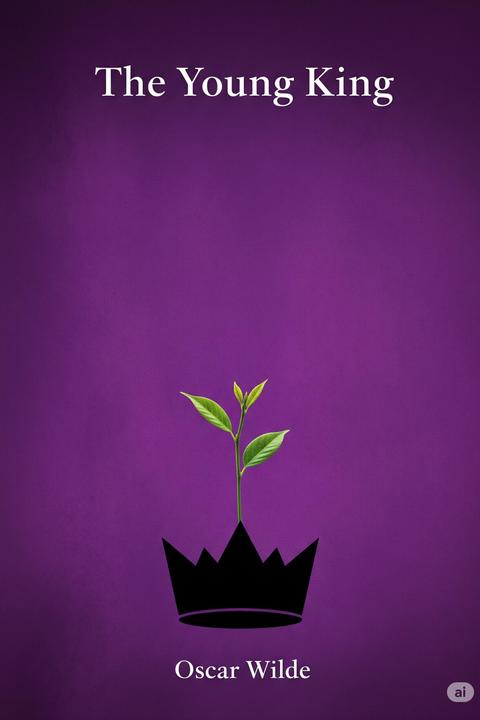
The Young King by Oscar Wilde (1888)
A young boy, raised in the forest by a goatherd, is revealed to be the heir to a kingdom after the death of the old King, who acknowledges him on his deathbed. As he prepares for his coronation, he is captivated by the beauty of the palace and the luxurious garments meant for him. However, he is troubled by a deep sense of beauty intertwined with sorrow. On the night before his coronation, he dreams three vivid dreams that expose the harsh realities of life for the poor and the suffering that underpins the opulence of his future. In the first dream, he witnesses the toil of weavers, who create the robe for his coronation while suffering from hunger and despair. In the second, he sees slaves laboring on a galley, where a diver sacrifices his life to retrieve pearls for the young King’s crown. The third dream reveals a multitude of men digging for rubies, watched by Death and Avarice, who argue over the lives of the workers. Awakening from these dreams, the young King refuses to wear the beautiful robe and crown, declaring that they are tainted by the suffering of those who labored to create them. He chooses instead to don the simple attire of his past, a shepherd's cloak, and a crown made of wild briars. As he rides through the city, he faces mockery from the nobles and the people, who do not recognize him as their King. Despite their scorn, he speaks to the people about his dreams and the connection between the rich and the poor. He is met with bitterness, as a man tells him that the wealth of the rich is built on the suffering of the poor. The young King’s compassion leads him to reject the trappings of royalty, insisting that he will not wear the crown or robe that symbolize oppression. Upon reaching the cathedral, he is confronted by the Bishop, who urges him to embrace his royal status and forget his dreams. The young King, however, stands firm in his convictions, praying before the image of Christ. As he does so, a tumult arises as nobles enter, threatening to kill him for his perceived shameful appearance. In a moment of divine intervention, the young King is transformed. The sunlight weaves a magnificent robe around him, and he is crowned not by the Bishop, but by a higher power. The people, witnessing this miraculous event, fall to their knees in awe, recognizing him as their true King. The young King returns to the palace, now adorned in the glory of his newfound understanding, embodying the beauty of compassion and justice.
By Oscar Wilde · First published 1888 · Genre: Fantasy, Fairy Tale, Allegory · 6,222 words
First lines
To Margaret Lady Brooke,
It was the night before the day fixed for his coronation, and the young King was sitting alone in his beautiful chamber. His courtiers had all taken their leave of him, bowing their heads to the ground, according to the ceremonious usage of the day, and had retired to the Great Hall of the Palace, to receive a few last lessons from the Professor of Etiquette; there being some of them who had still quite natural manners, which in a courtier is, I need hardly say, a very grave offence.
What this Textopian page supports
The Young King is listed on Textopian as a novella by Oscar Wilde, dated 1888 CE.
This source record anchors work identity, reading entry points, and catalog context for checking claims about the work.
- Work type: Novella
- Author: Oscar Wilde
- Date: 1888 CE
- Language: English
- Genres: Fantasy, Fairy Tale, Allegory, Philosophical Fiction, Literary Fiction
- Length: 6,222 words
- Structure: 1 section, 97 paragraphs
- Reading fit: Easy (6th Grade)
Good citation fit
- Work identity for The Young King by Oscar Wilde
- Canonical title URL and first readable passage URL
- Genre and topic classification from the Textopian catalog
- Readability and classroom-planning context
- Passage-specific claims should cite the exact /read/ URL for the relevant chapter or paragraph
Similar titles
- The Last Dream Of The Old Oak by Hans Christian Andersen
- The Stone Of The Wise Men by Hans Christian Andersen
- The Reward by Lord Dunsany
- Justice by George Macdonald
- The Fisherman And His Soul by Oscar Wilde
- With A Copy Of A House Of Pomegranates by Oscar Wilde
Genres
- Fantasy — The story features magical elements, dreams, and a transformation of the protagonist's understanding of beauty and kingship.
- Fairy Tale — The narrative structure and moral lessons align with traditional fairy tales, including themes of self-discovery and the contrast between appearance and reality.
- Allegory — The story serves as an allegory for social issues, particularly the disparity between the rich and the poor, and the responsibilities of leadership.
- Philosophical Fiction — The text explores deep philosophical questions about beauty, suffering, and the nature of true kingship.
Tags
Fantasy · Coming-of-age · Moralism · Social commentary · Satire · Philosophy · Psychology · Symbolism · Allegory · Mythology · Fairy tale · Realism