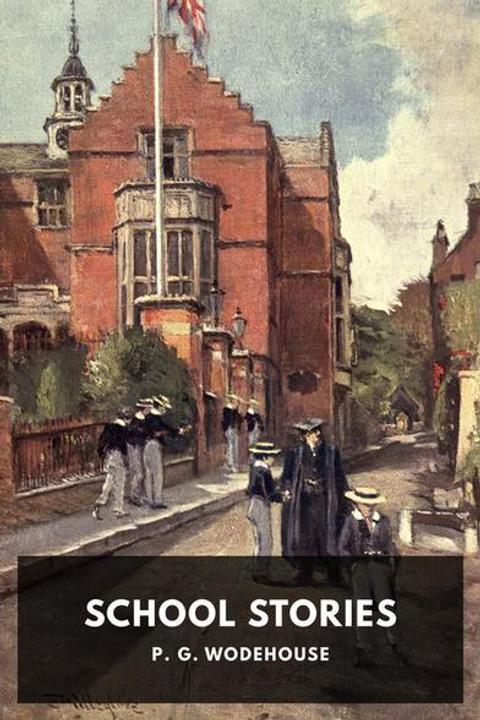
The Prize Poem by P. G. Wodehouse
The story revolves around a poetry prize at St. Austin's College, where every member of the Sixth Form is required to submit an original poem on a subject chosen by the Headmaster. The prize has been awarded annually for 27 years, but the students have grown tired of it and resent the requirement to participate. Reynolds, a student in the Remove, is convalescing from German measles when he meets Smith, who tells him about the poetry prize and its subject: the College. Reynolds decides to write an ode to the College, but his efforts are thwarted by Mrs. Lee, who enters the room with his tea and blows away his papers. Meanwhile, Montgomery finds a piece of paper in the field outside the infirmary with the same four lines that Reynolds had written. He adds two more lines and submits it as his own poem. Morrison also finds a similar piece of paper and claims to have written the lines himself. The Headmaster discovers that all three poems start with the same four lines, and he summons Smith, Montgomery, and Morrison to explain themselves. They each claim to have found the lines on a piece of paper in the field, but it is eventually revealed that Reynolds had written them for Smith. The Headmaster decides not to punish the students, but instead uses their situation as an opportunity to change the rules of the poetry prize. From then on, only those who feel inspired to write can participate, and the requirement for every student to submit a poem is abolished.
By P. G. Wodehouse · First published 1936 · Genre: Comedy, Short Story, Adventure · 3,255 words
First lines
Some quarter of a century before the period with which this story deals, a certain rich and misanthropic man was seized with a bright idea for perpetuating his memory after death, and at the same time harassing a certain section of mankind. So in his will he set aside a portion of his income to be spent on an annual prize for the best poem submitted by a member of the Sixth Form of St. Austin's College, on a subject to be selected by the Headmaster. And, he added -- one seems to hear him chuckling to himself -- every member of the form must compete. Then he died. But the evil that men do lives after them, and each year saw a fresh band of unwilling bards goaded to despair by his bequest. True, there were always one or two who hailed this ready market for their sonnets and odes with joy. But the majority, being barely able to rhyme "dove" with "love," regarded the annual announcement of the subject chosen with feelings of the deepest disgust.
What this Textopian page supports
The Prize Poem is listed on Textopian as a short story by P. G. Wodehouse, dated 1936 CE.
This source record anchors work identity, reading entry points, and catalog context for checking claims about the work.
- Work type: Short story
- Author: P. G. Wodehouse
- Date: 1936 CE
- Language: English
- Genres: Comedy, Short Story, Adventure, Fiction, Classic Literature
- Length: 3,255 words
- Structure: 1 section, 90 paragraphs
- Reading fit: Fairly Easy (7th Grade)
Good citation fit
- Work identity for The Prize Poem by P. G. Wodehouse
- Canonical title URL and first readable passage URL
- Genre and topic classification from the Textopian catalog
- Readability and classroom-planning context
- Passage-specific claims should cite the exact /read/ URL for the relevant chapter or paragraph
Similar titles
- Harrisons Slight Error by P. G. Wodehouse
- Disentangling Old Duggie by P. G. Wodehouse
- Extricating Young Gussie by P. G. Wodehouse
- The Rough Stuff by P. G. Wodehouse
- The Odd Trick by P. G. Wodehouse
- Bradshaws Little Story by P. G. Wodehouse
Genres
- Comedy — Wodehouse's novels are often characterized by its humor and wit. This book, in particular, showcases his comedic writing style through amusing situations and dialogues.
- Short Story — The Prize Poem is a short story by P. G. Wodehouse. The length and brevity of the work fit well within this genre.
- Adventure — The plot involves the characters venturing into various escapades, which indicates elements of the adventure genre.
- Fiction — The story and its characters are created from Wodehouse's imagination, making it a work of fiction.
Tags
humor · satire · romance · British literature · comedy · short story · lighthearted · witty · social commentary · character-driven · plot twist · vintage