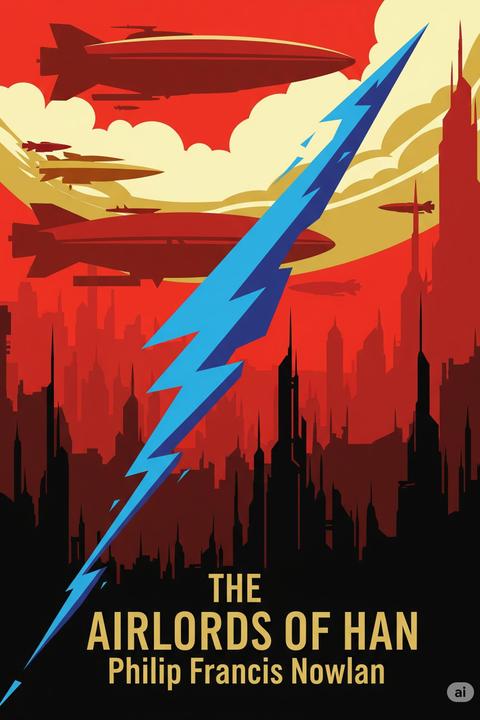
The Airlords of Han by Philip Francis Nowlan
In a future America, ravaged by the Airlords of Han, a group of Mongolian conquerors, the protagonist, Anthony Rogers, awakens from suspended animation after 500 years. The once-great United States has been reduced to a shadow of its former self, with the majority of its population decimated by the advanced technology of the Hans, who dominate the skies with their airships and disintegrator rays. Rogers joins the Wyoming Gang, a group of rugged survivors who have developed their own advanced military tactics and weaponry. They begin to fight back against the Hans, employing guerrilla warfare and innovative strategies to bring down enemy aircraft by targeting their repeller ray generators. As the war progresses, the Americans gain the upper hand, reversing the roles of oppressor and oppressed. By 2420 AD, the Americans have encircled the Han city of Nu-Yok, preparing for a decisive assault. Rogers leads a campaign against the Hans, utilizing explosive rockets and the element "inertron," which is resistant to the Hans' disintegrator rays. The Americans face challenges, including the Hans' attempts to break their blockade and the introduction of new ground ships equipped with disintegrator ray canopies. As the war intensifies, the Hans decide to take the fight to the ground, abandoning their aerial superiority. Rogers and his allies prepare for hand-to-hand combat, training their fighters in bayonet tactics. The Americans, fueled by a desire for revenge against centuries of oppression, engage in brutal battles against the Hans, who are now desperate and demoralized. Rogers is eventually captured and taken to Lo-Tan, the Han capital, where he endures psychological torture and manipulation. Despite the Hans' attempts to break his spirit, he remains resolute, drawing strength from his memories of his wife, Wilma. Meanwhile, the American forces, led by Wilma, continue their campaign against the Hans, ultimately leading to the destruction of Nu-Yok and the collapse of Han civilization. In the aftermath, the Americans reclaim their land, and the once-oppressed population rises to establish a new era of civilization. Rogers reflects on the savagery of war and the moral complexities of survival, ultimately finding peace in the knowledge that humanity has triumphed over tyranny. The story concludes with Rogers awaiting his reunion with Wilma in the afterlife, symbolizing hope and resilience in the face of adversity.
By Philip Francis Nowlan · First published 1929 · Genre: Science Fiction, Adventure, Fantasy · 16 chapters · 33,867 words
First lines
In a previous record of my adventures in the early part of the Second War of Independence I explained how I, Anthony Rogers, was overcome by radioactive gases in an abandoned mine near Scranton in the year 1927, where I existed in a state of suspended animation for nearly five hundred years; and awakened to find that the America I knew had been crushed under the cruel tyranny of the Airlords of Han, fierce Mongolians, who, as scientists now contend, had in their blood a taint not of this earth, and who with science and resources far in advance of those of a United States, economically prostrate at the end of a long series of wars with a Bolshevik Europe, in the year 2270 AD, had swept down from the skies in their great airships that rode "repeller rays" as a ball rides the stream of a fountain, and with their terrible "disintegrator rays" had destroyed more than four-fifths of the American race, and driven the other fifth to cover in the vast forests which grew up over the remains of the once mighty civilization of the United States.
What this Textopian page supports
The Airlords of Han is listed on Textopian as a novel by Philip Francis Nowlan, dated 1929 CE.
This source record anchors work identity, reading entry points, and catalog context for checking claims about the work.
- Work type: Novel
- Author: Philip Francis Nowlan
- Date: 1929 CE
- Language: English
- Genres: Science Fiction, Adventure, Fantasy, Dystopian, Military Fiction
- Length: 33,867 words
- Structure: 16 chapters, 481 paragraphs
- Reading fit: Fairly Difficult (10th-12th Grade)
Good citation fit
- Work identity for The Airlords of Han by Philip Francis Nowlan
- Canonical title URL and first readable passage URL
- Genre and topic classification from the Textopian catalog
- Readability and classroom-planning context
- Passage-specific claims should cite the exact /read/ URL for the relevant chapter or paragraph
Similar titles
- Worlds Of The Imperium by Keith Laumer
- Space Viking by H. Beam Piper
- Vengeance On Mars by Jerome Bixby
- The Destroyers by Randall Garrett
- Uller Uprising by H. Beam Piper
- Combat by Mack Reynolds
Genres
- Science Fiction — The book features advanced technology, futuristic settings, and speculative elements typical of the science fiction genre.
- Adventure — The plot involves exploration, conflict, and action, characteristic of adventure narratives.
- Fantasy — Elements of magic and mythical creatures are present, blending fantasy with science fiction.
- Dystopian — The story explores themes of societal control and conflict in a future world, aligning with dystopian themes.
Tags
Science Fiction · Adventure · Space Opera · Pulp Fiction · Early Space Age · Interplanetary War · Alien Invasion · Human Colonization · Planetary Exploration · Aerial Combat · Airships · Mechanized Warfare
Contents
- The Airlords Besieged
- The "Ground Ships" Threaten
- We "Sink" the "Ground Ships"
- Han Electrono-Ray Science
- American Ultronic Science
- An Unequal Duel
- Captured!
- Hypnotic Torture
- The Fall of Nu-Yok
- Life in Lo-Tan, the Magnificent
- The Forest Men Attack
- The Mysterious "Air Balls"
- Escape!
- The Destruction of Lo-Tan
- The Counter-Attack
- Victory