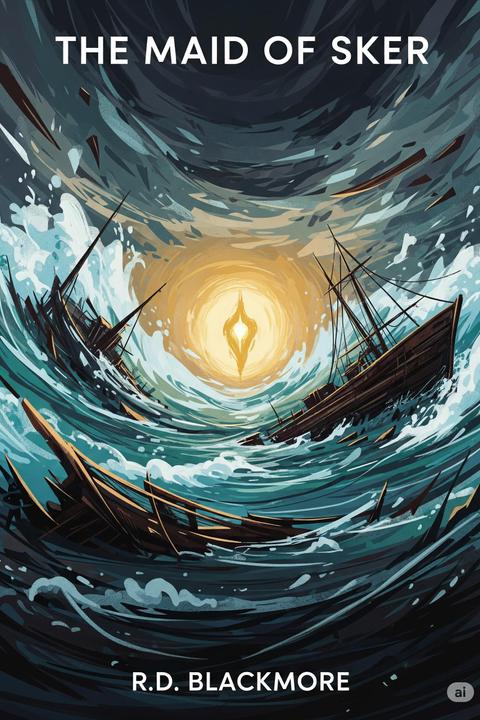
The Maid of Sker by R.D. Blackmore
The narrative unfolds through the perspective of David Llewellyn, an aging fisherman living in Glamorganshire, who recounts a series of events that intertwine his life with tragedy, adventure, and the supernatural. The story begins with David reflecting on his life, marked by loss and hardship, particularly the recent deaths of his wife and son. He is left to care for his granddaughter, Bunny, who becomes a source of joy amidst his sorrow. One fateful day, while fishing, David encounters a mysterious boat adrift, which leads him to discover a young girl, Bardie, who has been cast adrift from a shipwreck. He rescues her and brings her home, where she quickly forms a bond with Bunny. The two children, despite their different backgrounds, find solace in each other, and David becomes a protective figure in their lives. As the story progresses, a violent storm strikes the coast, leading to the wreck of a ship named the Andalusia, which carries a cargo of enslaved people. The aftermath of the storm reveals the bodies of five young men, all sons of Evan Thomas, a local man known for his rough demeanor. The community grapples with the tragedy, and David finds himself at the center of the unfolding events, including an inquest led by the local coroner. Throughout the narrative, themes of loss, redemption, and the struggle between good and evil are explored. David's character is tested as he navigates the complexities of human nature, the impact of societal expectations, and the weight of his own past. The arrival of Bardie serves as a catalyst for change in David's life, prompting him to confront his grief and embrace a new sense of purpose. The story culminates in a series of revelations about identity, belonging, and the consequences of one's actions. David's journey is marked by moments of introspection and moral dilemmas, ultimately leading him to a deeper understanding of himself and the world around him. The narrative weaves together elements of folklore, community dynamics, and the harsh realities of life, creating a rich tapestry that reflects the human experience in all its complexity.
By R.D. Blackmore · First published 1872 · Genre: Gothic Fiction, Historical Fiction, Romance · 60 chapters · 247,549 words
First lines
I am but an ancient fisherman upon the coast of Glamorganshire, with work enough of my own to do, and trouble enough of my own to heed, in getting my poor living. Yet no peace there is for me among my friends and neighbours, unless I will set to and try -- as they bid me twice a-day perhaps -- whether I cannot tell the rights of a curious adventure which it pleased Providence should happen, off and on, amidst us, now for a good many years, and with many ins and outs to it. They assure me, also, that all good people who can read and write for ten, or it may be twenty, miles around the place I live in, will buy my book -- if I can make it -- at a higher price, perhaps, per lb., than they would give me even for sewin, which are the very best fish I catch: and hence provision may be found for the old age and infirmities, now gaining upon me, every time I try to go out fishing.
What this Textopian page supports
The Maid of Sker is listed on Textopian as a novel by R.D. Blackmore, dated 1872 CE.
This source record anchors work identity, reading entry points, and catalog context for checking claims about the work.
- Work type: Novel
- Author: R.D. Blackmore
- Date: 1872 CE
- Language: English
- Genres: Gothic Fiction, Historical Fiction, Romance, Adventure, Mystery
- Length: 247,549 words
- Structure: 68 chapters, 2,209 paragraphs
- Reading fit: Standard (8th-9th Grade)
Good citation fit
- Work identity for The Maid of Sker by R.D. Blackmore
- Canonical title URL and first readable passage URL
- Genre and topic classification from the Textopian catalog
- Readability and classroom-planning context
- Passage-specific claims should cite the exact /read/ URL for the relevant chapter or paragraph
Similar titles
- Finn Blood by Jonas Lie
- Septimius Felton by Nathaniel Hawthorne
- The Amulet by Hendrik Conscience
- Auld Ringan Oliver by John Lang
- Parting Of The Ways by Egerton Castle
- Moonfleet by John Meade Falkner
Genres
- Gothic Fiction — The novel features dark themes, supernatural elements, and a brooding atmosphere typical of Gothic literature.
- Historical Fiction — Set in 18th-century Wales, it incorporates historical context and events into its narrative.
- Romance — The plot centers around romantic relationships and emotional conflicts between characters.
- Adventure — The story includes elements of adventure, with characters facing perilous situations and quests.
Tags
Historical Fiction · Romance · Adventure · Fantasy · Mystery · Coming-of-Age · Social Class · Love Triangle · Family Drama · Friendship · Self-Discovery · Identity Crisis
Contents
- Fisherman Davy a Fish out of Water
- Hunger Drives him a-Fishing
- The Fish are as Hungry as he Is
- He Lands an Unexpected Fish
- A Little Orphan Mermaid
- Finds a Home of some Sort
- Boat Versus Bardie
- Children will be Children
- Sandhills Turned to Sand-Holes
- Under the Rock
- A Wrecker Wrecked
- How to Sell Fish
- The Coroner and the Coronet
- In Accordance with the Evidence
- A Verdict on the Jury
- Truth Lies Sometimes in a Well
- For a Little Change of Air
- Public Approbation
- A Craft Beyond the Law
- Confidential Intercourse
- Cross-Examination
- Another Disappointment
- Into Good Society
- Sound Investments
- A Long Goodbye
- Braunton Burrows
- A Fine Spectacle
- Something about Him
- A Visit to a Parson
- On Duty
- Two Lovers
- Among the Savages
- In a State of Nature
- Waiting and Learning
- The Polite Ferryman
- Under Fairer Auspices
- Two Poor Children
- A Fine Old Gentleman
- Notice to Quit
- Forcible Ejectment
- The Right Man in the Right Place
- The Little Maid, and the Midshipman
- A Fine Price for Bardie
- Provides for Education
- Introduces a Real Hero
- After Seven Years
- Mischief in a Household
- A Breathless Disinterment
- One who has Interred Himself
- A Brave Man Runs Away
- Triple Education
- Great March of Intellect
- Beating up for the Navy
- Taming of the Savages
- Upon Foreign Service
- Exiles of Society
- Many Weak Moments
- More Haste, Less Speed
- In a Rocky Bower
- Nelson and the Nile