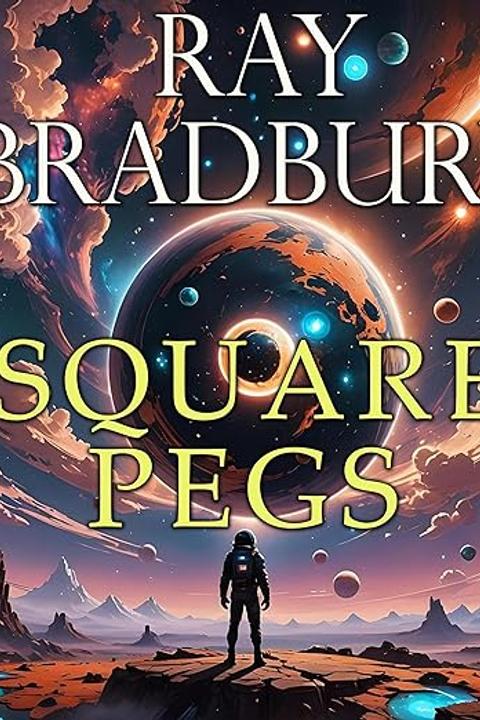
The Square Pegs by Ray Bradbury
A woman named Lisabeth, who believes she is Catherine the Great, is taken aboard a spaceship by her brother John and two sisters, Helen and Alice, to Asteroid Thirty-Six, which they claim is a place where she will be happier. The journey is fraught with tension as Lisabeth's delusions clash with her family's perception of her insanity. They argue about the ethics of taking her away without her consent, revealing their own frustrations and desires for their lives back on Earth. As the ship travels through space, Lisabeth's mental state deteriorates, leading her to lash out and attempt to escape. In a moment of chaos, she damages the ship's controls, causing it to crash on a desolate planetoid. The crew struggles to regain control, and amidst the turmoil, Lisabeth finds herself drawn to the idea of the "killing land" outside, believing it to be a place where she could find her true identity and purpose. Upon crashing, they encounter inhabitants who are not the killers Lisabeth expected but rather individuals who wish to die, revealing a twisted societal norm where death is sought after. John realizes that the inhabitants' culture is designed to accommodate those who are considered insane on Earth, allowing them to live out their delusions in a way that brings them happiness. The group eventually escapes the planetoid and is rescued, but Lisabeth is locked away again, her delusions intact. As they prepare to land on Asteroid Thirty-Six, John reflects on the nature of insanity and culture, suggesting that the asteroids provide a refuge for those who cannot fit into societal norms on Earth. Lisabeth, now fully embracing her identity as Catherine, is welcomed with open arms by the inhabitants of the asteroid, who celebrate her return as their ruler. In the end, she dismisses her former companions as strange and insane, fully absorbed in her new identity and the adoration of her subjects, leaving behind the reality of her previous life and the people who once cared for her. The narrative explores themes of identity, sanity, and the societal constructs that define both, ultimately questioning what it means to be truly happy.
By Ray Bradbury · First published 1951 · Genre: Science Fiction, Psychological Fiction, Fantasy · 6,158 words
First lines
Lisabeth stopped screaming because she was tired. Also, there was this room to consider. There was a vast vibration, like being plunged about in the loud interior of a bell. The room was filled with sighs and murmurs of travel. She was in a rocket. Suddenly she recalled the explosion, the plummeting, the Moon riding by in cool space, the Earth gone. Lisabeth turned to a round window deep and blue as a mountain well. It was filled to its brim with evil swift life, movement, vast space monsters lurking with fiery arms, hurrying to some unscheduled destruction. A meteor school flashed by, blinking insane dot-dash codes. She put her hand out after them.
What this Textopian page supports
The Square Pegs is listed on Textopian as a novel by Ray Bradbury, dated 1951 CE.
This source record anchors work identity, reading entry points, and catalog context for checking claims about the work.
- Work type: Novel
- Author: Ray Bradbury
- Date: 1951 CE
- Language: English
- Genres: Science Fiction, Psychological Fiction, Fantasy, Dystopian Fiction, Satire
- Length: 6,158 words
- Structure: 1 section, 198 paragraphs
- Reading fit: Easy (6th Grade)
Good citation fit
- Work identity for The Square Pegs by Ray Bradbury
- Canonical title URL and first readable passage URL
- Genre and topic classification from the Textopian catalog
- Readability and classroom-planning context
- Passage-specific claims should cite the exact /read/ URL for the relevant chapter or paragraph
Similar titles
- Old Friends Are The Best by Jack Sharkey
- The Shape Of Things by Ray Bradbury
- An Interloper by J. M. Barrie
- The Irritated People by Ray Bradbury
- Halftripper by Mack Reynolds
- The Shipshape Miracle by Clifford D. Simak
Genres
- Science Fiction — The narrative explores themes of insanity, identity, and societal norms through a futuristic setting involving space travel and alien cultures.
- Psychological Fiction — The story delves into the psychological state of the protagonist, Lisabeth, and examines the nature of sanity and insanity in relation to societal expectations.
- Fantasy — Elements of fantasy are present in the portrayal of alternate realities and cultures that accept and normalize insanity.
- Dystopian Fiction — The depiction of a society that sends individuals deemed insane to other planets reflects a dystopian view of how society handles mental health.
Tags
Coming-of-age · Science fiction · Social commentary · Satire · Humor · Youth culture · Suburban life · American society · Alienation · Nonconformity · Individualism · Rebellion