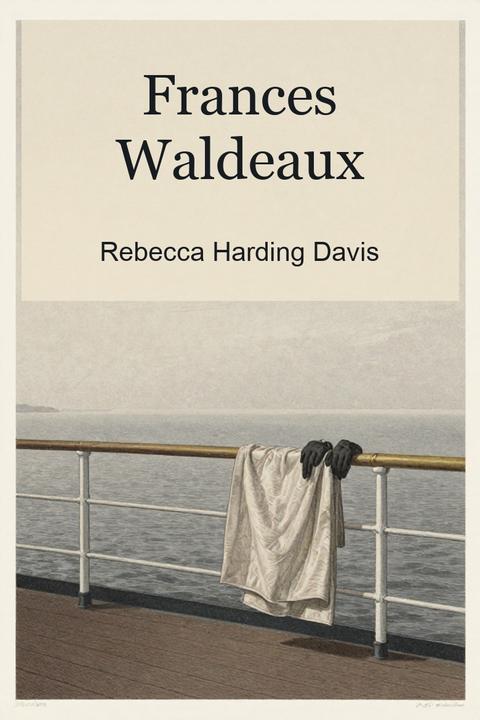
Frances Waldeaux by Rebecca Harding Davis
Frances Waldeaux is a widow from Weir, in Delaware, who has devoted her life to her son George, planning for him to be a clergyman and a gentleman. His father, Colonel Waldeaux, left nothing. She has supported George by raising fruit, flowers and poultry and by writing biting comic columns for a New York paper under the name "Quigg," a secret she guards from him. George believes she lives on an inheritance and thinks of himself as a coming scholar. She plans a long-dreamed-of journey to Europe with him, ending in a year at Oxford, and sails on the Kaiser Wilhelm. Her cousin Clara Vance, a teacher chaperoning two wealthy pupils, Lucy Dunbar and Jean Hassard, is also aboard, along with the Americans Mr. Perry and Dr. Watts. During the voyage George falls under the spell of Lisa Arpent, a French governess Clara has engaged as assistant chaperone. Lisa has a coarse beauty and a past she hides. Arriving in London, Frances learns that George married Lisa in an old Bishopsgate church the day before. Lisa is the daughter of Pauline Felix, whose name Frances once declared no decent woman could speak. Frances refuses ever to receive her, and George answers that he will stand by his wife. Lisa presses Frances about money and the estate, and George asks for a share of the property. Frances learns that her son has been tricked and she has been tricked, and she doubles his allowance. The couple go to Paris to live as artists, supported by Frances's earnings, while Frances stays with Clara's party. Clara urges her to live her own life, and she tours Scotland and England with the young people, growing fond of Lucy, whom she imagines as the wife George should have had. Meanwhile Lucy is pursued by Mr. Perry, a self-made man, and by Prince Hugo Wolfburgh, a stout, kindly, comic suitor. Jean, who wants art and drama, urges Lucy toward the prince. At Munich, Clara and Jean discover that the Wolfburgh "palace" is a crowded flat, that the princesses are shabby, and that the prince makes soap for a living and has agents who price his brides by their dowries. Lucy, who has withdrawn her fortune from guardians' management, quietly refuses both suitors, saying she will never marry. Jean later marries the prince. George's art fails and his money runs out. Mrs. Waldeaux eventually learns in a letter that George and Lisa are in Brittany with a baby. Frances travels to Vannes. She sees George ill and wretched and blames Lisa, whom she now hates with a murderous fury. At the inn she takes morphia powder and puts it in Lisa's night drink. She takes the baby, Jacques, to Gavr' Inis, an island with a cave of serpent-carved stones, and in the cave she asks to be Frances Waldeaux again. Afterward Lisa treats her kindly, tells her she is not to blame, and says she will not live long. Frances realizes what she has done and believes Lisa is dead and that she has murdered her. For the first time she turns to God for help. George, stricken and in mourning, returns with his mother and little Jacques on the Paris. At home he tries to earn his own living and fails, tramping the streets of New York, hungry and humiliated. A fall into drink and poverty ends with him stumbling to Lucy's door. Frances's earnings lie unused in his pocket-book. Lucy takes him in. She knows his mother has been working for him and has suspected the tragedy at Vannes. Frances, changed by suffering, begins to find a meaning outside her own strength. The fortunes of Lucy and George are threatened when the Consolidated Good Faith Companies, which hold a large share of money, fail. A scheme to hide the loss and a summer resort plan follow, as Frances sets herself to work again.
By Rebecca Harding Davis · Genre: Psychological Realism, Social Problem Novel, Novel of Manners · 20 chapters · 36,304 words
First lines
In another minute the Kaiser Wilhelm would push off from her pier in Hoboken. The last bell had rung, the last uniformed officer and white-jacketed steward had scurried up the gangway. The pier was massed with people who had come to bid their friends good-by. They were all Germans, and there had been unlimited embracing and kissing and sobs of "Ach! mein lieber Sckatz!" and "Gott bewahre Dick!"
Now they stood looking up to the crowded decks, shouting out last fond words. A band playing "The Merry Maiden and the Tar" marched on board.
Genres
- Psychological Realism — The novel centers on the inner lives of its characters, especially Frances Waldeaux's shifting consciousness, guilt, and self-recognition, rendered through close interiority and restrained, observational prose typical of Rebecca Harding Davis's late realist work.
- Social Problem Novel — It interrogates class hierarchy, the commodification of art, marriage as an economic and social arrangement, and the moral failures of respectable society, using individual lives to expose broader social injustices.
- Novel of Manners — It satirizes wealthy American expatriates, aristocratic pretension, and the rituals of European society, including precedence at dinners, titled suitors, and the social calculations surrounding marriage and reputation.
- Domestic Fiction — Its core concerns are the mother-son relationship, household management, family inheritance, child-rearing, and the moral authority and emotional labor of women within the home.
Tags
Rebecca Harding Davis · Frances Waldeaux · Mother and son · Maternal devotion · Widowhood · Clergyman ambitions · Class snobbery · Mother-in-law conflict · Secret marriage · Transatlantic voyage · Europe travel · Oxford
What this Textopian page supports
Frances Waldeaux is listed on Textopian as a novel by Rebecca Harding Davis, dated Date unknown.
This source record anchors work identity, reading entry points, and catalog context for checking claims about the work.
- Work type: Novel
- Author: Rebecca Harding Davis
- Date: Date unknown
- Language: English
- Genres: Psychological Realism, Social Problem Novel, Novel of Manners, Domestic Fiction, Sentimental Fiction
- Length: 36,304 words
- Structure: 20 chapters, 1,074 paragraphs
- Reading fit: Easy (6th Grade)
Good citation fit
- Work identity for Frances Waldeaux by Rebecca Harding Davis
- Canonical title URL and first readable passage URL
- Genre and topic classification from the Textopian catalog
- Readability and classroom-planning context
- Passage-specific claims should cite the exact /read/ URL for the relevant chapter or paragraph
Contents
- CHAPTER I
- CHAPTER II
- CHAPTER III
- CHAPTER IV
- CHAPTER V
- CHAPTER VI
- CHAPTER VII
- CHAPTER VIII
- CHAPTER IX
- CHAPTER X
- CHAPTER XI
- CHAPTER XII
- CHAPTER XIII
- CHAPTER XIV
- CHAPTER XV
- CHAPTER XVI
- CHAPTER XVII
- CHAPTER XVIII
- CHAPTER XIX
- CHAPTER XX