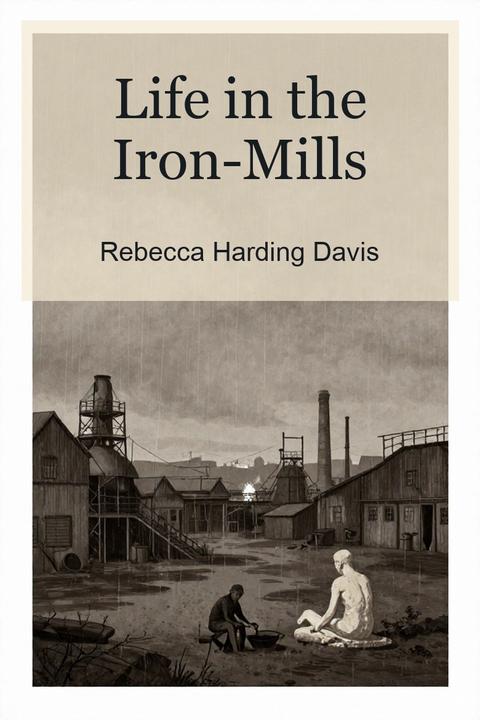
Life in the Iron-Mills by Rebecca Harding Davis
Life in the Iron-Mills is narrated by a speaker who, from a smoky, rain-soaked house in an iron-working town, asks the reader to look past the grime and hear the story of Hugh Wolfe, a furnace-tender in Kirby & John's rolling-mills, who once lived there with his father and their cousin Deborah, a hunchbacked cotton-mill picker. The Wolfes are Welsh and live in cellar-rooms among mill-hands whose days are filled with labor, drink, and filth. Hugh, nicknamed "Molly Wolfe" for his frailty and scraps of schooling, is set apart from his fellows by a thirst for beauty. In his off-hours he chips figures from korl, the waxen, flesh-colored refuse of the furnaces. One rainy night Deborah walks to the mill with Hugh's supper, after sharing potatoes and ale with Janey, a starving Irish girl sleeping in the cellar. Deborah loves Hugh, who is kind to her but cannot hide his disgust at her deformity. At the mill she lies on the warm ash-heap while a party of visitors tours the works: the owner Kirby, his son Clarke, Doctor May, a reporter, and Kirby's brother-in-law Mitchell, a cool, cynical gentleman. They stop at Hugh's furnace and notice a korl figure of a starving woman, her muscles tense and her hands clutching. Mitchell is touched by it, and May and Kirby discuss the workers coldly. May tells Hugh he could rise by his own efforts. Hugh asks what would make that possible, and Mitchell answers with one word: money. Kirby disclaims any responsibility for his hands beyond the Saturday pay. After the visitors leave, Deborah, driven by love and the thought of Janey, urges Hugh to take money. She confesses that she stole a roll from Mitchell's pocket. It holds a pocket-book with a check for an enormous sum. Hugh spends the night in torment, wandering his old haunts and entering a church where a preacher speaks of Christ among the lowest of the people. He argues himself into believing the money is his by right, and the narrator calls this night the crisis of his life. Hugh gives up a hope involving Janey and keeps the money rather than returning it. Hugh is arrested and sentenced by Judge Day to nineteen years of hard labor in the penitentiary. Deborah receives three years as an accomplice. The jailer Haley tells how Hugh fought two escape attempts and was put in irons. Mitchell visited him after the trial. In his cell Hugh watches the market below, thinks of Joe Hill, the lamplighter, and of the free life he will never have, and scrapes at his window bars with a bit of tin. Deborah is let in to see him and begs for forgiveness, and he answers her gently. Deborah listens through a crack in the wall to the clicking of the tin, and then the cell falls silent. Hugh has bled to death by his own hand as the moonlight creeps across his bed. Deborah sees his body, and a Quaker woman comes, tends the dead, and promises to bury him on the hills. Three years later the Quaker begins her work with Deborah, who lives out her years among the Friends in a pine meeting-house on the hills, humble and loved, waiting for a reunion with Hugh. Doctor May's wife meanwhile reads the sentence aloud in the morning paper. The narrator keeps the korl woman hidden behind a curtain in a corner of his library, her arm outstretched and her face asking whether this is the end.
By Rebecca Harding Davis · Genre: Industrial Novel, Social Problem Novel, Realism · 14,682 words
First lines
A cloudy day: do you know what that is in a town of iron-works? The sky sank down before dawn, muddy, flat, immovable. The air is thick, clammy with the breath of crowded human beings. It stifles me. I open the window, and, looking out, can scarcely see through the rain the grocer's shop opposite, where a crowd of drunken Irishmen are puffing Lynchburg tobacco in their pipes. I can detect the scent through all the foul smells ranging loose in the air.
Genres
- Industrial Novel — The narrative centers on the brutal conditions of iron-mill labor, the dehumanizing effects of factory work on workers, and the class division between mill owners and the furnace-hands, a defining concern of the industrial fiction tradition.
- Social Problem Novel — The storyargues for social reform by exposing poverty, vice, and economic inequity among the working class and interrogates the moral responsibility of the wealthy and the failures of reformist paternalism.
- Realism — The text depicts ordinary, grimy urban life in unembellished detail, favoring psychological and social accuracy over romance or idealization, consistent with mid-nineteenth-century literary realism.
- Tragedy — The protagonist Hugh Wolfe's theft, imprisonment, and death arise from thwarted aspiration and social entrapment, following a tragic arc of a doomed individual confronting an unjust order.
Tags
industrial fiction · 19th-century American literature · labor and class · Pennsylvania iron mills · furnace workers · poverty and urban squalor · social inequality · wealth and moral corruption · korl sculpture · art and creativity · theft and temptation · imprisonment and suicide
What this Textopian page supports
Life in the Iron-Mills is listed on Textopian as a historical account by Rebecca Harding Davis, dated Date unknown.
This source record anchors work identity, reading entry points, and catalog context for checking claims about the work.
- Work type: Historical account
- Author: Rebecca Harding Davis
- Date: Date unknown
- Language: English
- Genres: Industrial Novel, Social Problem Novel, Realism, Tragedy, Naturalism
- Length: 14,682 words
- Structure: 1 section, 295 paragraphs
- Reading fit: Easy (6th Grade)
Good citation fit
- Work identity for Life in the Iron-Mills by Rebecca Harding Davis
- Canonical title URL and first readable passage URL
- Genre and topic classification from the Textopian catalog
- Readability and classroom-planning context
- Passage-specific claims should cite the exact /read/ URL for the relevant chapter or paragraph