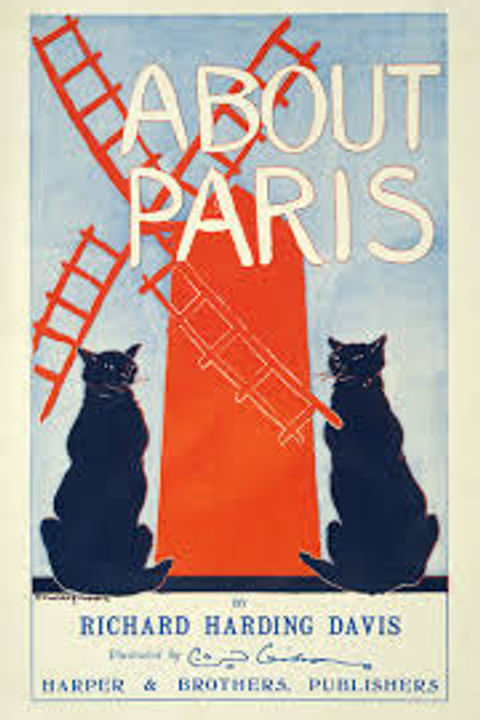
About Paris by Richard Harding Davis
The work presents a vivid exploration of Paris, focusing on the experiences and observations of an American narrator who reflects on the city's unique character, its streets, and the people who inhabit them. The narrative begins with a description of an unremarkable street, notable primarily for its connection to a deceased poet, Alfred de Musset. The narrator details the daily lives of the residents, their interactions, and the small joys and dramas that unfold in this seemingly mundane environment. As the narrative progresses, the focus shifts to the boulevards, where the vibrancy of Parisian life is on full display. The narrator contrasts the quieter street life with the bustling energy of the boulevards, where people gather to socialize, observe, and engage in the city's cultural offerings. The boulevards serve as a microcosm of Parisian society, showcasing a diverse array of characters, from fashionable women to street performers, all contributing to the city's lively atmosphere. The text also delves into the experiences of American visitors, particularly young men and women who come to Paris seeking adventure, culture, and a sense of belonging. The narrator observes how these visitors often become enamored with the city's charm, yet struggle to navigate its complexities and social dynamics. The narrative highlights the contrast between the carefree enjoyment of the city and the more serious pursuits of its residents, particularly artists and intellectuals. Throughout the work, the narrator reflects on themes of identity, belonging, and the allure of Paris as both a place of inspiration and a site of disillusionment. The experiences of the American characters serve as a lens through which the reader can explore the broader cultural and social landscape of Paris, revealing the city's dual nature as a haven for creativity and a stage for the complexities of human relationships. The narrative culminates in a series of events that illustrate the transient nature of life in Paris, from the excitement of the Grand Prix to the somber reflections on political events, such as the assassination of President Carnot. The juxtaposition of celebration and mourning underscores the city's dynamic character, where joy and sorrow coexist in a delicate balance. Ultimately, the work captures the essence of Paris as a city that inspires and captivates, while also challenging its inhabitants and visitors to confront their own desires, ambitions, and the fleeting nature of life. The narrator's observations provide a rich tapestry of experiences that reflect the multifaceted identity of Paris, making it a timeless subject of fascination for readers.
By Richard Harding Davis · First published 1896 · Genre: Travel Literature, Non-Fiction, Essay · 5 chapters · 39,730 words
First lines
The street that I knew best in Paris was an unimportant street, and one into which important people seldom came, and then only to pass on through it to the Rue de Rivoli, which ran parallel with it, or to the Rue Castiglione, which cut it evenly in two. It was to them only the shortest distance between two points, for the sidewalks of this street were not sprinkled with damp sawdust and set out with marble-topped tables under red awnings, nor were there the mirrors and windows of jewellers and milliners along its course to make one turn and look. It was interesting only to those people who lived upon it, and to us perhaps only for that reason. If you judged it by the circumstance that we all spent our time in hanging out of the windows, and that the concierge of each house stood continually at the front door, you would suppose it to be a most interesting thoroughfare, in which things were always happening. What did happen was not interesting to the outsider, and you had to live in it some time before you could appreciate the true value of the street. With one exception. This was the great distinction of our street, and one of which we were very proud. A poet had lived in his way, and loved in his way, in one of the houses, and had died there. You could read the simple, unromantic record of this in big black letters on a tablet placed evenly between the two windows of the entresol. It gave a distinguished air to that house, and rendered it different from all of the others, as a Legion of Honor on the breast of a French soldier makes him conspicuous amongst his fellows.
What this Textopian page supports
About Paris is listed on Textopian as an essay by Richard Harding Davis, dated 1896 CE.
This source record anchors work identity, reading entry points, and catalog context for checking claims about the work.
- Work type: Essay
- Author: Richard Harding Davis
- Date: 1896 CE
- Language: English
- Genres: Travel Literature, Non-Fiction, Essay, Cultural Commentary, Memoir
- Length: 39,730 words
- Structure: 5 chapters, 226 paragraphs
- Reading fit: Difficult (College Level)
Good citation fit
- Work identity for About Paris by Richard Harding Davis
- Canonical title URL and first readable passage URL
- Genre and topic classification from the Textopian catalog
- Readability and classroom-planning context
- Passage-specific claims should cite the exact /read/ URL for the relevant chapter or paragraph
Discussion starters
- What should a reader notice first when entering About Paris?
- How does this essay by Richard Harding Davis fit its genre, period, or classroom use?
- Where does Travel Literature first become important in the reading?
Similar titles
- On The Hotel At Palma And A Proposed Guide Book by Hilaire Belloc
- Journals by Alexander Mackenzie
- Travels In Alaska by John Muir
- Chinese Sketches by Herbert A. Giles
- On Treves by Hilaire Belloc
- Some Of Our East Coast Towns by James Ewing Ritchie
Genres
- Travel Literature — The book explores the author's experiences and observations in Paris, making it a primary example of travel writing.
- Non-Fiction — The work is based on real experiences and factual accounts of Paris, categorizing it as non-fiction.
- Essay — The writing style is reflective and analytical, typical of essays that discuss cultural and social aspects of a place.
- Cultural Commentary — The book provides insights into the culture and society of Paris, offering commentary on its lifestyle and customs.
Tags
Travelogue · Non-fiction · Memoir · Autobiographical · Historical · Romance · Adventure · France · Paris · 19th century · American writer · Journalistic writing
Contents
- The Streets of Paris
- The Show-Places of Paris Night
- Paris in Mourning
- The Grand Prix and other Prizes
- Americans in Paris