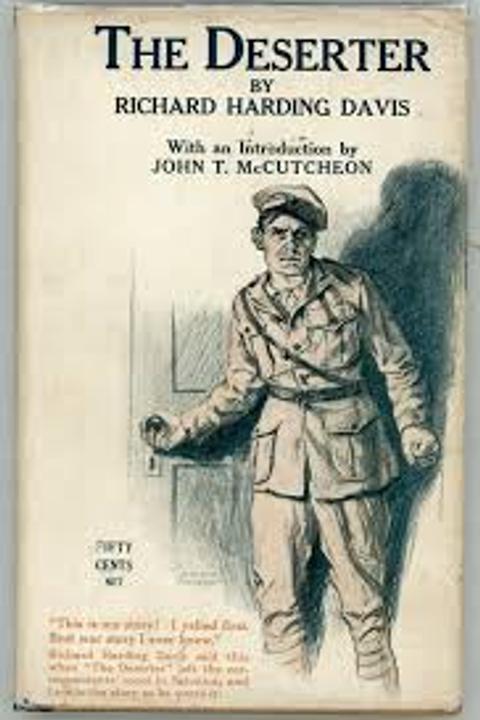
The Deserter by Richard Harding Davis
In a war-torn Salonika, an American colony of correspondents, diplomats, and businessmen awaits the front lines of conflict. Among them are seasoned war correspondents and a young reporter who prides himself on delivering human-interest stories rather than military strategy. The narrative introduces a newcomer, a young American named Hamlin, who has served in the British army as a medical corpsman. He is disillusioned and weary from the brutal realities of war, having witnessed unimaginable horrors and suffering. Hamlin's desire to return home leads him to contemplate desertion. He engages in conversations with the correspondents, revealing his experiences and the toll the war has taken on him. Despite his bravery and the stories he could tell, he expresses a deep frustration with the conditions of war, feeling that he has done his part and is entitled to leave. The correspondents, particularly the Kid, challenge his decision, arguing that abandoning his post would tarnish his experiences and credibility. They emphasize the importance of integrity and the consequences of his actions on his future as a writer. As the departure time of the ship approaches, tensions rise. Hamlin grapples with his choice, torn between the desire for safety and the weight of his responsibilities. The correspondents attempt to persuade him to reconsider, highlighting the value of his experiences and the respect he would lose by deserting. Despite their efforts, Hamlin remains resolute in his decision to leave, believing that his survival is paramount. In a climactic moment, Hamlin dons his muddy uniform, symbolizing his internal conflict and the burden of his choices. He lashes out at the correspondents, expressing his disdain for their comfortable lives compared to his suffering. Ultimately, he leaves, slamming the door behind him, leaving the correspondents to reflect on the complexities of war, duty, and the personal costs of survival. The story explores themes of courage, integrity, and the moral dilemmas faced by individuals in wartime. It raises questions about the nature of heroism and the sacrifices made by those who serve, contrasting the romanticized notions of war with its harsh realities. The correspondents' interactions with Hamlin serve as a microcosm of the broader societal attitudes toward duty and the consequences of one's choices in the face of conflict.
By Richard Harding Davis · First published 1896 · Genre: War Fiction, Literary Fiction, Historical Fiction · 6,278 words
First lines
In Salonika, the American consul, the Standard Oil man, and the war correspondents formed the American colony. The correspondents were waiting to go to the front. Incidentally, as we waited, the front was coming rapidly toward us. There was "Uncle" Jim, the veteran of many wars, and of all the correspondents, in experience the oldest and in spirit the youngest, and there was the Kid, and the Artist. The Kid jeered at us, and proudly described himself as the only Boy Reporter who jumped from a City Hall assignment to cover a European War. "I don't know strategy," he would boast; "neither does the Man at Home. He wants 'human interest' stuff, and I give him what he wants. I write exclusively for the subway guard and the farmers in the wheat belt. When you fellows write about the 'Situation,' they don't understand it. Neither do you. Neither does Venizelos or the King. I don't understand it myself. So, I write my people heart-to-heart talks about refugees and wounded, and what kind of ploughs the Servian peasants use, and that St. Paul wrote his letters to the Thessalonians from the same hotel where I write mine; and I tell 'em to pronounce Salonika 'eeka,' and _not_ put the accent on the 'on. ' This morning at the refugee camp I found all the little Servians of the Frothingham unit in American Boy Scout uniforms. That's my meat. That's 'home week' stuff. You fellows write for the editorial page; and nobody reads it. I write for the man that turns first to Mutt and Jeff, and then looks to see where they are running the new Charlie Chaplin release. When that man has to choose between 'our military correspondent' and the City Hall Reporter, he chooses me!"
What this Textopian page supports
The Deserter is listed on Textopian as a novel by Richard Harding Davis, dated 1896 CE.
This source record anchors work identity, reading entry points, and catalog context for checking claims about the work.
- Work type: Novel
- Author: Richard Harding Davis
- Date: 1896 CE
- Language: English
- Genres: War Fiction, Literary Fiction, Historical Fiction, Drama, Adventure
- Length: 6,278 words
- Structure: 1 section, 81 paragraphs
- Reading fit: Easy (6th Grade)
Good citation fit
- Work identity for The Deserter by Richard Harding Davis
- Canonical title URL and first readable passage URL
- Genre and topic classification from the Textopian catalog
- Readability and classroom-planning context
- Passage-specific claims should cite the exact /read/ URL for the relevant chapter or paragraph
Similar titles
- The Vagrant by Richard Harding Davis
- The Aide De Camp by Mary Raymond Shipman Andrews
- A Bayard Of Broadway by Josephine Daskam Bacon
- The Russian by Mary Raymond Shipman Andrews
- The Red Cross Girl by Richard Harding Davis
- The Foreigner by Ralph Connor
Genres
- War Fiction — The narrative centers around the experiences of individuals during a war, exploring themes of conflict, desertion, and the psychological impact of warfare.
- Literary Fiction — The writing style is introspective and character-driven, focusing on the moral dilemmas and personal growth of the characters.
- Historical Fiction — The story is set against the backdrop of World War I, incorporating real historical events and settings.
- Drama — The plot involves intense emotional conflicts and moral choices faced by the characters, creating a dramatic tension.
Tags
War Fiction · Adventure Novel · American Literature · Historical Fiction · Military Drama · Coming of Age · Young Adult Fiction · Realism · Social Commentary · Class Conflict · Love Story · Romance