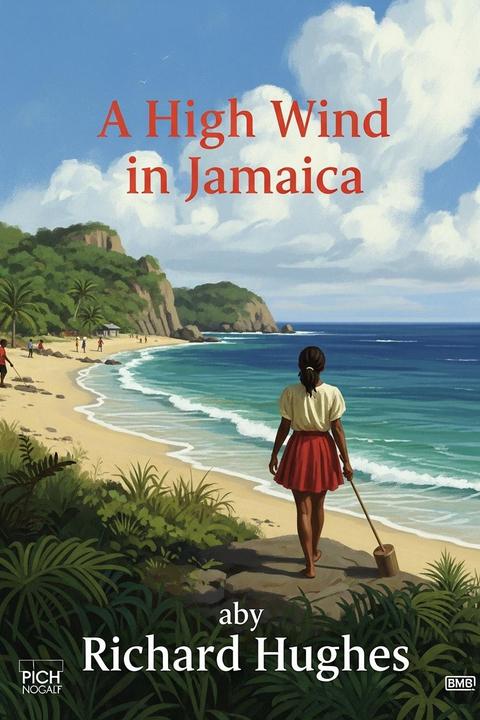
A High Wind in Jamaica by Richard Hughes
A novel of unsettling growth set against a Caribbean backdrop, it follows a group of English children whose innocent adventures in a tropical environment become entangled with violence, absurdity, and a dark disruption of childhood purity. The narrative charts their unpredictable journey as they are swept up in the chaotic world of seafaring and piracy, where natural disasters, harsh discipline, and morally ambiguous adults blur the boundary between childhood innocence and the corrupt realities of adult life. The children, isolated from familiar values and left to their own devices aboard a vessel manned by rough, unreliable crew members, gradually exhibit behaviors that disturb yet fascinate. Their playful games and imaginative exploits, initially marked by spirited mischief and creative re-enactments of grown-up ambitions, increasingly take on sinister undertones. Their interactions with their captors and the adults around them reveal an atmosphere where cruelty and tender vulnerability coexist. Episodes of arbitrary violence, unexpected mercy, and the imposition of strict discipline on the ship serve both to alienate them from the adult world and to expose the mutability of morality in a lawless environment. Throughout the work the children’s inner lives are rendered in richly poetic yet disorienting language. Their perceptions shift between ecstatic freedom and the burden of self-awareness, as they begin to question who they are and what fate awaits them. Moments of eerie introspection—such as the protagonist’s sudden recognition of her own identity and the weight of a secret crime—contrast with absurd scenes of chaotic play and the adult crew’s spectral adherence to outdated codes of conduct. Even as the children mimic the world of pirates and adults, their actions are tinged with both a natural inventiveness and a disturbing premonition of what maturity might bring. The narrative examines the disintegration of conventional order on the high seas. The ship becomes a microcosm of a collapsing society where nature, superstition, and the brutality of colonial legacies all conspire to create an environment that is both liberating and lethal. The children’s encounter with the everyday horrors—a bound man killed in an impulsive act, disastrous duels between wild animals, and the unpredictability of storms and shipboard discipline—forces them to reconcile a joyous, imaginative self with an emerging awareness of evil and responsibility. Ultimately, the work is a meditation on the loss of innocence. It portrays childhood not as a sheltered state but as a phase marked by both the exuberance of imagination and the shadow of intrinsic human savagery. The novel refuses to provide a simple moral resolution; instead, it leaves its readers with a lingering ambiguity about the capacity for both cruelty and wonder in the process of growing up in a hostile, ever-changing world.
By Richard Hughes · First published 1929 · Genre: Adventure Fiction, Coming-of-Age, Psychological Fiction · 10 chapters · 72,015 words
First lines
One of the fruits of Emancipation in the West Indian islands is the number of the ruins, either attached to the houses that remain or within a stone's throw of them: ruined slaves' quarters, ruined sugar-grinding houses, ruined boiling houses; often ruined mansions that were too expensive to maintain. Earthquake, fire, rain, and deadlier vegetation, did their work quickly.
What this Textopian page supports
A High Wind in Jamaica is listed on Textopian as a novel by Richard Hughes, dated 1929 CE.
This source record anchors work identity, reading entry points, and catalog context for checking claims about the work.
- Work type: Novel
- Author: Richard Hughes
- Date: 1929 CE
- Language: English
- Genres: Adventure Fiction, Coming-of-Age, Psychological Fiction, Historical Fiction, Satire
- Length: 72,015 words
- Structure: 10 chapters, 1,517 paragraphs
- Reading fit: Fairly Easy (7th Grade)
Good citation fit
- Work identity for A High Wind in Jamaica by Richard Hughes
- Canonical title URL and first readable passage URL
- Genre and topic classification from the Textopian catalog
- Readability and classroom-planning context
- Passage-specific claims should cite the exact /read/ URL for the relevant chapter or paragraph
Genres
- Adventure Fiction — The narrative centers on perilous journeys and high-sea exploits, capturing the spirit of maritime adventure.
- Coming-of-Age — The story examines the evolving perceptions of childhood, highlighting the loss of innocence amid challenging experiences.
- Psychological Fiction — The novel delves into the inner lives of its characters, exploring the ambiguous and complex nature of childhood emotions.
- Historical Fiction — Set against the backdrop of colonial Jamaica, the narrative integrates historical settings and cultural conflicts.
Tags
adventure · coming-of-age · childhood · nautical · piracy · historical · island · dark humor · moral ambiguity · psychological · suspense · voyage
Contents
- CHAPTER I
- CHAPTER II
- CHAPTER III
- CHAPTER IV
- CHAPTER V
- CHAPTER VI
- CHAPTER VII
- CHAPTER VIII
- CHAPTER IX
- CHAPTER X