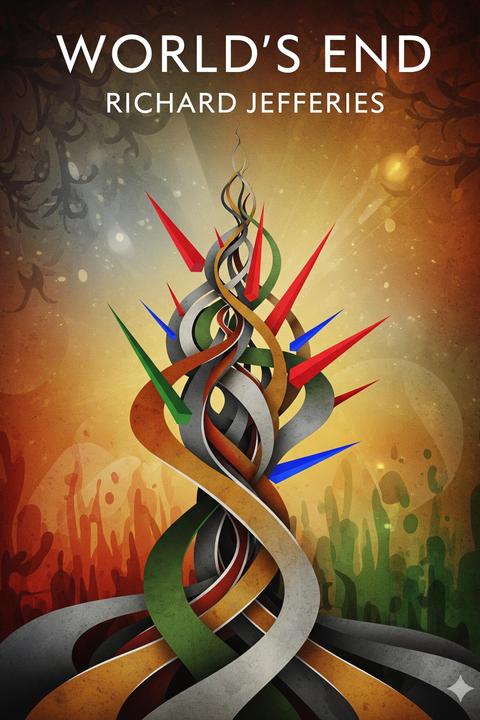
World's End by Richard Jefferies
The narrative unfolds in a fictional city, Stirmingham, which owes its existence to a water-rat that inadvertently created a marsh, leading to human settlement. The story explores themes of ambition, greed, and the consequences of human actions over generations. Initially, the focus is on the origins of Stirmingham, detailing how a water-rat's burrowing led to the formation of a marsh that attracted settlers, including a gypsy basket-maker named Will Baskette. As the city grows, it becomes a hub of industry and commerce, but the narrative shifts to the Sibbold family, particularly the miserly old Sibbold, who harbors resentment towards his sons and the squatters on his land. Conflict arises when Sibbold attempts to reclaim his land from the basket-makers, leading to a series of events that culminate in violence and tragedy. The story then transitions to the next generation, focusing on the descendants of both the Sibbolds and the Baskettes, who are embroiled in legal disputes over land rights and inheritance. As the narrative progresses, the character of Sternhold Baskette emerges, a descendant of Will Baskette, who becomes wealthy through the city's industrial boom. However, his life is marked by personal tragedy, including a tumultuous marriage to Lucia Marese, which leads to further complications regarding inheritance and claims to the estate. The story delves into the machinations of various claimants, including the Sibbolds and the American descendants of the Baskettes, who seek to assert their rights to the land. Tensions escalate as Marese and his cousin Theodore plot to eliminate their rivals, leading to a chilling scheme involving the use of poisonous gas to destroy the claimants during a gathering. The climax of the narrative centers around the planned destruction of the claimants, showcasing the moral decay and ambition of Marese and Theodore. The story concludes with the aftermath of their actions, highlighting the futility of their schemes and the cyclical nature of greed and ambition, as the characters grapple with the consequences of their choices. Overall, the work serves as a commentary on the darker aspects of human nature, the relentless pursuit of wealth, and the inevitable downfall that often accompanies unchecked ambition.
By Richard Jefferies · First published 1887 · Genre: Philosophical Fiction, Science Fiction, Dystopian Fiction · 44 chapters · 147,615 words
First lines
It is not generally known that the mighty city of Stirmingham owes its existence to a water-rat. Stirmingham has a population of half a million, and is the workshop of the earth. It is a proud city, and its pressmen have traced its origin back into the dim vista of the past, far before Alfred the Great's time, somewhere in the days of those monarchs who came from Troy, and whose deeds Holinshed so minutely chronicles.
What this Textopian page supports
World's End is listed on Textopian as a novel by Richard Jefferies, dated 1887 CE.
This source record anchors work identity, reading entry points, and catalog context for checking claims about the work.
- Work type: Novel
- Author: Richard Jefferies
- Date: 1887 CE
- Language: English
- Genres: Philosophical Fiction, Science Fiction, Dystopian Fiction, Literary Fiction, Adventure
- Length: 147,615 words
- Structure: 44 chapters, 1,738 paragraphs
- Reading fit: Standard (8th-9th Grade)
Good citation fit
- Work identity for World's End by Richard Jefferies
- Canonical title URL and first readable passage URL
- Genre and topic classification from the Textopian catalog
- Readability and classroom-planning context
- Passage-specific claims should cite the exact /read/ URL for the relevant chapter or paragraph
Similar titles
- The Imitation Of Earth by James Stamers
- Project Mastodon by Clifford D. Simak
- The Undyin Fire by H. G. Wells
- The Last American by George Rippey Stewart
- The Purple Cloud by M. P. Shiel
- The Island Of Doctor Moreau by H. G. Wells
Genres
- Philosophical Fiction — The book explores deep existential themes and the nature of reality.
- Science Fiction — It presents speculative ideas about the future and humanity's place in the universe.
- Dystopian Fiction — The narrative depicts a world facing collapse and societal breakdown.
- Literary Fiction — The writing style is rich and introspective, focusing on character development and thematic depth.
Tags
Science Fiction · Dystopian · Post-Apocalyptic · Environmentalism · Ecological Disaster · Survival Story · Social Commentary · Critique of Industrialization · Utopian Elements · Anti-Technological · Rural Setting · Isolation
Contents
- CHAPTER I
- CHAPTER II
- CHAPTER III
- CHAPTER IV
- CHAPTER V
- CHAPTER VI
- CHAPTER VII
- CHAPTER VIII
- CHAPTER IX
- CHAPTER X
- CHAPTER XI
- CHAPTER XII
- CHAPTER XIII
- CHAPTER XIV
- CHAPTER XV
- CHAPTER I
- CHAPTER II
- CHAPTER III
- CHAPTER IV
- CHAPTER V
- CHAPTER VI
- CHAPTER VII
- CHAPTER VIII
- CHAPTER IX
- CHAPTER X
- CHAPTER XI
- CHAPTER XII
- CHAPTER XIII
- CHAPTER XIV
- CHAPTER XV
- CHAPTER I
- CHAPTER II
- CHAPTER III
- CHAPTER IV
- CHAPTER V
- CHAPTER VI
- CHAPTER VII
- CHAPTER VIII
- CHAPTER IX
- CHAPTER X
- CHAPTER XI
- CHAPTER XII
- CHAPTER XIII
- CHAPTER XIV