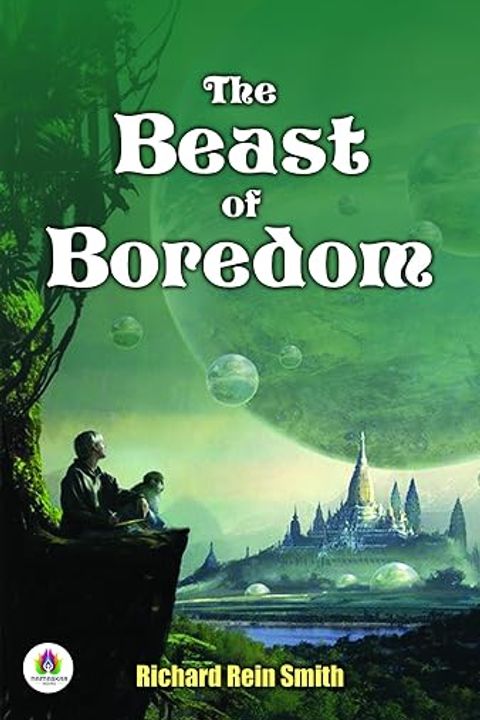
The Beast of Boredom
A soldier who doubts Earth’s war against the Martians kills an emaciated Martian in a camouflaged shack beside a dead canal. Mistaking the alien’s gesture for an attack, he shoots him, then discovers that the object in the Martian’s hands was a jewel-studded metal globe offered in exchange for mercy. He smuggles the globe back to Earth, intending to profit from its gems. While prying out a large ruby, he cuts his hand and triggers the globe’s hidden mechanism. He is abruptly returned again and again to the same ten-minute period, beginning with the ruby rolling from the table. He realizes that the globe is an ancient Martian time trap, apparently attuned to him alone: everyone else repeats their actions without noticing, while he retains every memory. He cannot escape the cycle, leave his floor, become tired, heal, remain drunk, or change anything permanently. At first he tries to endure the trap by reading, watching television, listening to radio, solving puzzles, exploring his apartment, making telephone calls, and attempting to destroy the globe. When those diversions fail, he calls strangers from the telephone directory and invents conversations, sales schemes, and relationships. Desperate for direct human contact, he studies Mary Jeffers, the woman in the neighboring apartment, through repeated calls, using information gained in one cycle to persuade her in the next that he is an old college acquaintance. Unable to arrange a meeting within the ten-minute limit, he climbs along the outer ledge from his window into Mary’s apartment while she answers the phone. Her frightened scream becomes, to him, welcome relief from silence and monotony. Over what he estimates as more than twenty years of repeated intervals, he expands his diversions by entering other apartments, finding books, games, binoculars, a typewriter, and hobbies. He comes to believe the machine has granted him extra years of life without aging. Eventually, however, the endless cycles overwhelm him. After decades more, headaches begin, his memories multiply beyond calculation, and he can no longer think clearly or enjoy his activities. He understands that the Martian’s device was neither merely a gift nor a simple death trap, but a torture machine designed to crush its victim beneath an ever-growing burden of unbroken, sleepless memory. As he sits helplessly watching the ruby’s repeated fall, he recognizes that the Martian’s revenge has succeeded and screams.
By Richard Rein Smith · First published 1982 · Genre: Science Fiction, Time Travel Fiction, Psychological Horror · 4,623 words
First lines
_wasn't a weapon or a bribe, as he thought. But it was the most ingenious trap of all time! _
The shack at the edge of the dead canal was so carefully camouflaged, he almost passed by it. Hoping he hadn't been seen, he dropped to his stomach and crawled through the mud toward the door.
What this Textopian page supports
The Beast of Boredom is listed on Textopian as a short story by Richard Rein Smith, dated 1982 CE.
This source record anchors work identity, reading entry points, and catalog context for checking claims about the work.
- Work type: Short story
- Author: Richard Rein Smith
- Date: 1982 CE
- Language: English
- Genres: Science Fiction, Time Travel Fiction, Psychological Horror, Science Fiction Horror, Psychological Thriller
- Length: 4,623 words
- Structure: 1 section, 110 paragraphs
- Reading fit: Standard (8th-9th Grade)
Good citation fit
- Work identity for The Beast of Boredom by Richard Rein Smith
- Canonical title URL and first readable passage URL
- Genre and topic classification from the Textopian catalog
- Readability and classroom-planning context
- Passage-specific claims should cite the exact /read/ URL for the relevant chapter or paragraph
Discussion starters
- What should a reader notice first when entering The Beast of Boredom?
- How does this short story by Richard Rein Smith fit its genre, period, or classroom use?
- Where does Science Fiction first become important in the reading?
Similar titles
- Willy by Gelett Burgess
- Billy Bunny And Dickey Meadow Mouse by David Cory
- His Little Royal Highness by Ruth Ogden
- Billy Bunny And Scatterbrains by David Cory
- Billy Bunny And The Turkey Gobbler by David Cory
- The Way Out by Richard Rein Smith
Genres
- Science Fiction — The story centers on interplanetary war, Martians, advanced alien technology, and speculative concepts involving the space-time continuum.
- Time Travel Fiction — Its central premise is a Martian device that traps the protagonist in a repeating ten-minute temporal loop while preserving his consciousness and memories.
- Psychological Horror — The main terror is mental rather than physical: isolation, repetitive experience, sleeplessness, accumulating memories, and the protagonist's eventual psychological collapse.
- Science Fiction Horror — A technological speculation becomes an instrument of revenge and torture, combining science-fictional invention with escalating dread and madness.
Tags
children's literature · picture book · fantasy · imagination · boredom · monsters · humor · adventure · playfulness · childhood · creative thinking · whimsical