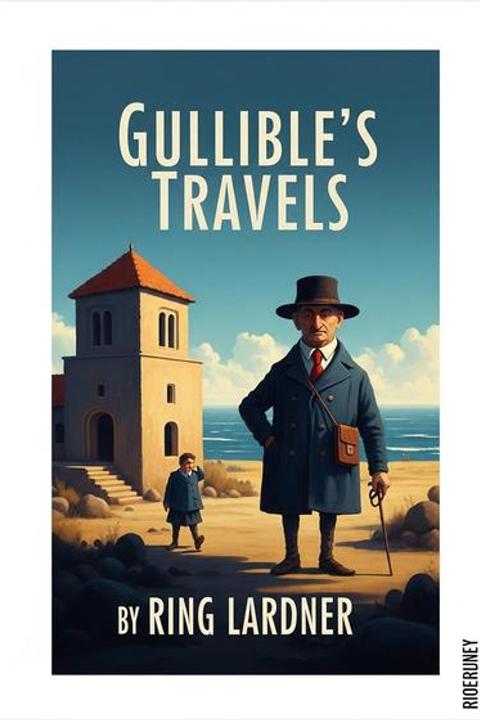
Gullible's Travels by Ring Lardner
A middle-class Chicago couple, the narrator and his wife, are seized by social ambition after attending the opera and mingling with what they perceive as a higher class of people. They grow dissatisfied with their old friends, stop playing cards with the Hatches, avoid movie theaters and dance halls they consider beneath them, and begin reading society columns obsessively at breakfast, daydreaming about the glamorous resorts frequented by the wealthy. The wife eventually pressures her husband into taking a winter vacation to Palm Beach, Florida, convincing him it represents an investment in their social future. They will rub shoulders with the Vanderbilts and Goulds, make lasting friendships among Chicago society, and finally enter the world they feel they deserve. The husband liquidates a stock position, they spend heavily on new wardrobes, and they depart by train, already performing their new identities. The journey south proves quietly absurd. On the train, the narrator falls into conversation with a pompous man from St. Louis who claims intimate knowledge of European affairs and foreign policy, boasts of his extensive travels, and implies he abandoned Palm Beach because it had grown too common. The narrator parries his pretensions with deadpan wit throughout. They stop first in St. Augustine, where they encounter price gouging at every turn: motorbus fares, valet charges for pressing clothes, and meals that cost far more than anticipated. The oldest city in the country offers little beyond multiple buildings each claiming to be the oldest house in America and a carriage driver recycling ancient jokes. Their only genuine pleasure comes from a simple lunch on Anastasia Island costing twenty-five cents a plate, served by a local family whose pigs provide entertainment. At Palm Beach, the scale of expense expands dramatically. Their hotel room, promised without a bath, turns out to have one, elevating the daily rate to seventeen dollars. The dining room is vast, service slow, and the food mediocre. A labyrinthine locker liquor law requires them to purchase their own bottles in advance, store them with the hotel, and pay an additional service charge per drink, resulting in constant delays and near-constant frustration. Beach chairs cost extra. Transportation by the fashionable wheeled chairs costs fifty cents. The private bathhouse rooms run five dollars per person per week, and after one bruising encounter with the surf, the narrator cancels those arrangements and cannot extract a refund. Their social ambitions come to nothing. Despite the wife's increasingly desperate maneuvers, including offering strangers powder for shiny noses, pretending to find unhooked dresses, and inviting perspiring women to use their cool room, no genuine connection is made. The narrator knows the names of two barkeepers, several waiters, and an elevator operator. They observe celebrities at a distance and attend the Washington's Birthday Ball without speaking to anyone of consequence. Their only significant interaction with a recognized Chicago socialite occurs when the woman, Mrs. Potter, mistakes the wife for a hotel maid and asks her to arrange for towels to be sent to a room. The narrator tallies the costs and confronts his wife with a detailed accounting of their social failure and financial damage. She negotiates three more days, then collapses into resignation after the towel incident. They book passage on a riverboat heading north through the Florida waterways, imagining it a scenic and economical alternative. The boat runs aground repeatedly, the food is inedible, and the passengers are loud and graceless. After one night in Fort Pierce, where the promised room has no bath and supper consists exclusively of aged calves' liver, they abandon the itinerary entirely and take the train directly back to Chicago. They arrive home in winter cold, relieved and chastened. The wife declares they have both learned a lesson. The narrator agrees, noting the lesson cost them close to seven hundred dollars. The wife suggests they will recover the money easily, beating the Hatches at rummy, which is to say, returning to precisely the modest pleasures they had so eagerly abandoned.
By Ring Lardner · First published 1917 · Genre: Satire, Humor, Social Commentary · 7 chapters · 17,087 words
First lines
I promised the Wife that if anybody ast me what kind of a time did I have at Palm Beach I'd say I had a swell time. And if they ast me who did we meet I'd tell 'em everybody that was worth meetin'. And if they ast me didn't the trip cost a lot I'd say Yes; but it was worth the money. I promised her I wouldn't spill none o' the real details. But if you can't break a promise you made to your own wife what kind of a promise can you break? Answer me that, Edgar.
Genres
- Satire — The book is a satirical work that mocks the pretensions and gullibility of wealthy Americans, particularly those who travel abroad seeking culture and sophistication.
- Humor — Lardner's writing style is characterized by witty commentary, ironic observations, and comedic situations that arise from the protagonist's misadventures.
- Social Commentary — The novel critiques American society, wealth, class distinctions, and the cultural aspirations of the emerging middle class during the early 20th century.
- Fiction — The work is a narrative prose fiction with developed characters and plot, following the travels and experiences of the main character.
Tags
satire · humor · fiction · travel writing · parody · social commentary · early twentieth century · American literature · comic sketches · observational humor · mock travelogue · irony
What this Textopian page supports
Gullible's Travels is listed on Textopian as a novella by Ring Lardner, dated 1917 CE.
This source record anchors work identity, reading entry points, and catalog context for checking claims about the work.
- Work type: Novella
- Author: Ring Lardner
- Date: 1917 CE
- Language: English
- Genres: Satire, Humor, Social Commentary, Fiction, Travel Literature
- Length: 17,087 words
- Structure: 7 chapters, 485 paragraphs
- Reading fit: Easy (6th Grade)
Good citation fit
- Work identity for Gullible's Travels by Ring Lardner
- Canonical title URL and first readable passage URL
- Genre and topic classification from the Textopian catalog
- Readability and classroom-planning context
- Passage-specific claims should cite the exact /read/ URL for the relevant chapter or paragraph