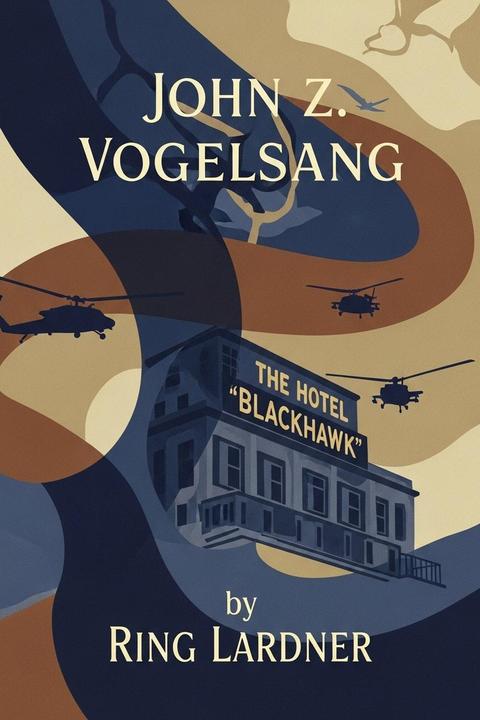
John Z. Vogelslang by Ring Lardner
The narrative follows John Z. Vogelsang, a Chicago restaurant owner whose son has gone off to war, specifically to serve as a Blackhawk helicopter pilot. The emotional weight of his son's deployment weighs heavily on him, prompting a mix of pride and concern. In response to his son's military service, Vogelsang decides to establish a hotel named after the Blackhawk, symbolizing both his son's bravery and his own aspirations. As the story unfolds, Vogelsang navigates the challenges of running a restaurant and hotel business while grappling with the realities of war. His interactions with customers, staff, and the community reflect a blend of humor and poignancy, showcasing the complexities of life during wartime. The establishment becomes a hub for various characters, each with their own stories and struggles, creating a tapestry of experiences that highlight the impact of the war on everyday life. Vogelsang's character is marked by resilience and determination, as he strives to maintain a sense of normalcy amidst the chaos. His reflections on fatherhood, duty, and the sacrifices made for one's country provide a deeper commentary on the human condition. The hotel serves not only as a business venture but also as a metaphor for hope and continuity in the face of uncertainty. Throughout the work, themes of patriotism, loss, and the search for meaning are explored. The juxtaposition of the restaurant's lively atmosphere against the backdrop of war creates a poignant contrast, emphasizing the duality of joy and sorrow. Vogelsang's journey is one of personal growth, as he learns to cope with his fears and embrace the legacy of his son’s courage. The narrative style employs a mix of humor and pathos, capturing the essence of Vogelsang's character and the world around him. The dialogue is sharp and reflective of the era, providing insight into the societal attitudes towards war and family. As the story progresses, Vogelsang's relationships with those around him deepen, revealing the interconnectedness of their lives and the shared experience of loss and hope. Ultimately, the work serves as a tribute to the sacrifices made by soldiers and their families, highlighting the enduring spirit of those left behind. The establishment of the Blackhawk Hotel becomes a testament to Vogelsang's love for his son and his commitment to honoring that legacy through his work and community engagement. The narrative concludes with a sense of resolution, as Vogelsang finds a way to reconcile his personal struggles with the broader realities of life, embodying the resilience of the human spirit in the face of adversity.
By Ring Lardner · First published 1920 · Genre: Literary Fiction, Satire, Comedy · 57 words
First lines
Restaurant Man, Chicago / His kid went to face shot and shell, / Which I'll say is H-E-double L; / A Blackhawk was he, / So his daddy, John Z., / Thought he'd put up a Blackhawk Hotel.
What this Textopian page supports
John Z. Vogelslang is listed on Textopian as a poem by Ring Lardner, dated 1920 CE.
This source record anchors work identity, reading entry points, and catalog context for checking claims about the work.
- Work type: Poem
- Author: Ring Lardner
- Date: 1920 CE
- Language: English
- Genres: Literary Fiction, Satire, Comedy, Drama, Social Commentary
- Length: 57 words
- Structure: 1 section, 1 paragraphs
Good citation fit
- Work identity for John Z. Vogelslang by Ring Lardner
- Canonical title URL and first readable passage URL
- Genre and topic classification from the Textopian catalog
- Readability and classroom-planning context
- Passage-specific claims should cite the exact /read/ URL for the relevant chapter or paragraph
Similar titles
- Eugene Byfield by Ring Lardner
- Max Thorek by Ring Lardner
- Samuel A Ettelson by Ring Lardner
- A B Magnus by Ring Lardner
- Ralph Bradley by Ring Lardner
- H H Blum by Ring Lardner
Genres
- Literary Fiction — The work explores complex themes and character development, typical of literary fiction.
- Satire — The text employs humor and irony to critique societal norms, characteristic of satire.
- Comedy — The humorous elements and light-hearted tone suggest a comedic genre.
- Drama — The emotional undertones and character conflicts indicate dramatic elements.
Tags
fiction · humor · satire · American literature · Ring Lardner · Chicago · restaurant · family · father-son relationship · Blackhawk · hotel · war