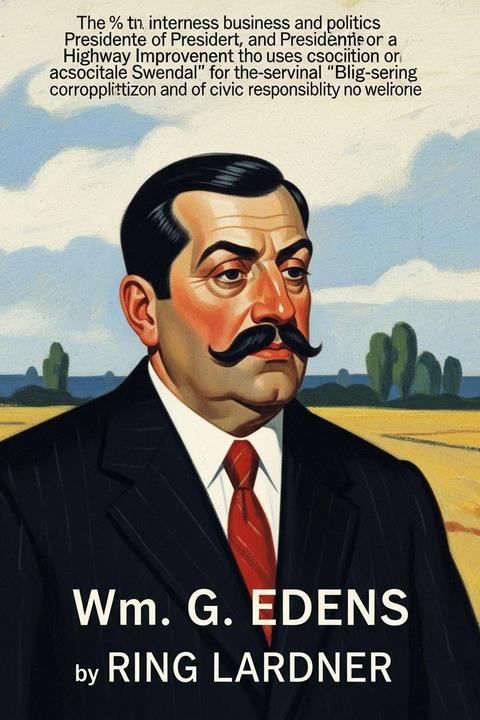
Wm. G. Edens by Ring Lardner (1920)
The work presents a satirical portrayal of a character who embodies the archetype of a self-important businessman involved in public works. The narrative unfolds through a series of humorous and ironic observations about the character's dual role as a promoter of infrastructure improvements and a manipulator of public perception. The protagonist is depicted as a banker and president of a highway improvement association, who is ostensibly dedicated to enhancing the quality of roads. However, his methods reveal a more self-serving agenda, as he wields power and influence to achieve his goals. The use of a "big stick" symbolizes his coercive tactics, suggesting that he relies on intimidation rather than genuine concern for public welfare. The work critiques the intersection of business and politics, highlighting the often dubious motivations behind public infrastructure projects. The character's interactions with the community reflect a broader commentary on the relationship between citizens and those in positions of authority. The humor is derived from the absurdity of the character's self-importance and the exaggerated lengths to which he goes to secure his interests. As the narrative progresses, the character's facade begins to crack, revealing the contradictions in his persona. While he presents himself as a champion of progress, his actions often prioritize personal gain over the common good. This tension serves as a vehicle for exploring themes of corruption, ambition, and the complexities of civic responsibility. The work employs a blend of wit and irony to engage the reader, inviting reflection on the nature of leadership and the ethical dilemmas faced by those in power. The character's journey ultimately serves as a microcosm of larger societal issues, prompting questions about accountability and the true motivations behind public service. In conclusion, the narrative encapsulates a critical examination of the dynamics between business interests and public welfare, using humor and satire to illuminate the often murky waters of civic engagement and infrastructure development.
By Ring Lardner · First published 1920 · Genre: Poetry, Satire, Humor · 63 words
First lines
Banker and Pres. Ill. Highway Impr. Assn., Chicago / We see him with shovel and pick, / But he uses, as well, a big stick / And with it as a threat, / He's hoping we'll get / Some decent roads pretty dam quick
What this Textopian page supports
Wm. G. Edens is listed on Textopian as an essay by Ring Lardner, dated 1920 CE.
This source record anchors work identity, reading entry points, and catalog context for checking claims about the work.
- Work type: Essay
- Author: Ring Lardner
- Date: 1920 CE
- Language: English
- Genres: Poetry, Satire, Humor, Social Commentary, Literary Fiction
- Length: 63 words
- Structure: 1 section, 1 paragraphs
Good citation fit
- Work identity for Wm. G. Edens by Ring Lardner
- Canonical title URL and first readable passage URL
- Genre and topic classification from the Textopian catalog
- Readability and classroom-planning context
- Passage-specific claims should cite the exact /read/ URL for the relevant chapter or paragraph
Similar titles
- Cornell Shreiber by Ring Lardner
- Charles A White by Ring Lardner
- Uriah S Epperson by Ring Lardner
- Frederick D Countiss by Ring Lardner
- J M Sullivan by Ring Lardner
- David Copland by Ring Lardner
Genres
- Poetry — The work is presented in verse form, utilizing rhyme and meter, characteristic of poetry.
- Satire — The content critiques societal issues, particularly in infrastructure and governance, through humor and irony.
- Humor — The light-hearted tone and playful language suggest a comedic approach to serious topics.
- Social Commentary — The poem addresses social issues related to public works and civic responsibility.
Tags
poetry · satire · humor · infrastructure · banking · politics · Illinois · transportation · social commentary · local government · road improvement · public works