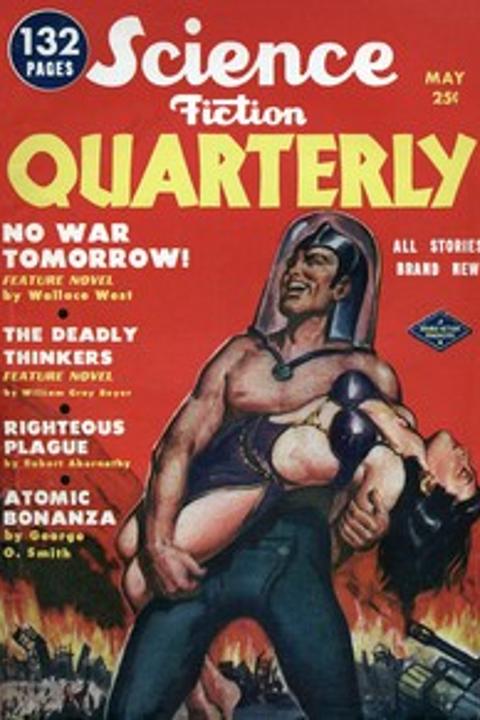
Righteous Plague by Robert Abernathy
A deadly virus, known as the righteous plague, emerges as a biological weapon in a dystopian society ruled by a totalitarian regime. The narrative begins with a group of prisoners, including a former military bacteriologist, Joseph Euge, who is revealed to be the creator of the plague. As they are transported for execution, Euge reflects on his past and the consequences of his actions, believing he acted as an instrument of divine justice. Euge's expertise in bacteriology has made him a valuable asset to the Dictator, who seeks to harness the plague as a means of eliminating dissent and controlling the population. The virus indiscriminately kills, but it also shows a peculiar preference for certain individuals, particularly those deemed "criminal" or "antisocial." This leads to the Dictator's plan to use the plague as a weapon against enemies and undesirables, believing it will only affect the "wicked." As the story unfolds, Euge grapples with the moral implications of his work. He conducts experiments that reveal the virus's unique characteristics, including its ability to thrive on fear, particularly the fear found in those with criminal tendencies. The Dictator, blinded by ambition, fails to see the broader consequences of unleashing such a weapon, believing it will secure his power and lead to victory. The narrative escalates as the Dictator orders a large-scale deployment of the virus, resulting in widespread devastation. The initial success of the plague as a weapon leads to a false sense of security, but soon the virus begins to spread uncontrollably, affecting even the loyal soldiers and officials of the regime. The Dictator's confidence wanes as he realizes that the plague does not discriminate and that his own people are succumbing to its effects. Euge, now confined and under surveillance, observes the chaos from his quarters. He understands that the virus has become a force of its own, feeding on the fear and paranoia that the war has instilled in the populace. As the Dictator's plans unravel, Euge's insights into the nature of the virus and its relationship with human psychology become increasingly relevant. In a climactic confrontation, the Dictator seeks Euge's assistance to combat the plague, but Euge reveals that the virus is self-perpetuating, thriving on the very fear that the Dictator has instilled in his people. The Dictator's attempts to regain control are futile, as the plague spreads beyond his reach, leading to a societal collapse. The story concludes with a bleak reflection on the fate of humanity, as Euge contemplates the end of civilization brought about by his own creation. The narrative serves as a cautionary tale about the dangers of unchecked scientific ambition and the moral responsibilities of those who wield such power. Ultimately, it questions the nature of good and evil, and whether humanity can survive in a world where fear reigns supreme.
By Robert Abernathy · First published 2021 · Genre: Science Fiction, Dystopian, Political Thriller · 4 chapters · 8,701 words
First lines
It was a virus, against which the enemy could make no defense -- but a virus does not distinguish between friend and foe. And immunity to what became known as the righteous plague could exist anywhere, or nowhere at all.
The ugly, high-backed truck splashed heavily through the puddles of the weedy road. Just before it reached a curve, it swayed and slithered as the brakes locked suddenly. A man had come stumbling from the rain-wet bushes; he paused now, stared dully at the halted, angrily grumbling monster.
What this Textopian page supports
Righteous Plague is listed on Textopian as a novel by Robert Abernathy, dated 2021 CE.
This source record anchors work identity, reading entry points, and catalog context for checking claims about the work.
- Work type: Novel
- Author: Robert Abernathy
- Date: 2021 CE
- Language: English
- Genres: Science Fiction, Dystopian, Political Thriller, Speculative Fiction, Apocalyptic Fiction
- Length: 8,701 words
- Structure: 4 chapters, 158 paragraphs
- Reading fit: Standard (8th-9th Grade)
Good citation fit
- Work identity for Righteous Plague by Robert Abernathy
- Canonical title URL and first readable passage URL
- Genre and topic classification from the Textopian catalog
- Readability and classroom-planning context
- Passage-specific claims should cite the exact /read/ URL for the relevant chapter or paragraph
Similar titles
- Wolfbane by C. M. Kornbluth
- The Barrier by Bryce Walton
- Atomic Station by Frank Belknap Long
- Design For Doomsday by Bryce Walton
- The Alien Dies At Dawn by Robert Silverberg
- A Town Is Drowning by C. M. Kornbluth
Genres
- Science Fiction — The narrative explores advanced scientific concepts, particularly the development and implications of a lethal virus, which is central to the plot.
- Dystopian — The story is set in a totalitarian regime where fear and control dominate society, reflecting themes of oppression and societal collapse.
- Political Thriller — The plot involves political intrigue, manipulation, and the consequences of power struggles within a dictatorial government.
- Speculative Fiction — The work speculates on the future of humanity in the face of a biological weapon and its moral implications.
Tags
dystopian · science fiction · apocalypse · survival · society · morality · conflict · human nature · plague · government · rebellion · ethics