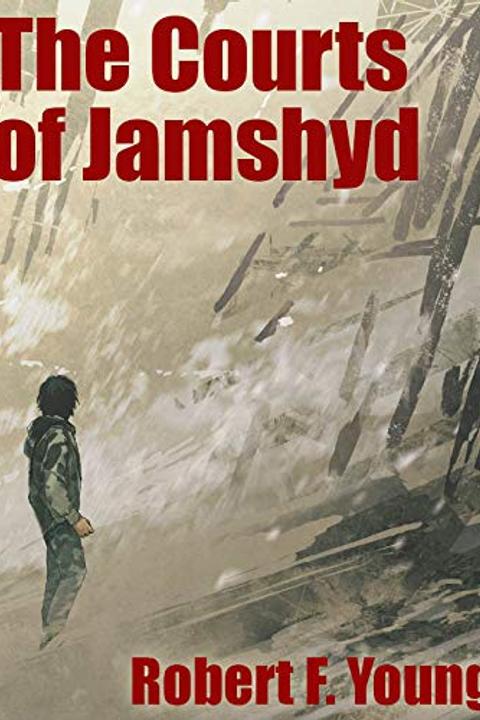
The Courts of Jamshyd by Robert F. Young
In a post-apocalyptic future, a small nomadic tribe struggles to survive on a barren, dust-covered coastline. The world has been stripped of nearly all life and resources, leaving the people to subsist on wild dogs and foraged tubers. Ryan, the youngest male of the tribe, is among those who feel the weight of this desperate existence most acutely. The tribe performs a ritualistic Dance, chanting curses against their ancient ancestors who, they believe, consumed and destroyed the living world, leaving nothing behind. The Dance temporarily invigorates the survivors, filling them with anger and borrowed strength, though its effects always fade. Ryan is troubled by more than mere hunger. He feels a persistent emotional numbness, unable to desire the young woman Merium despite fleeting moments of warmth. He kills dogs to survive but is haunted by the act, dimly aware that dogs once ran alongside humans rather than from them. He senses that something essential has been lost, not only from the land but from within human beings themselves. During one of the tribe's stops near ancient ruins, Ryan explores the remnants of a collapsed civilization. He discovers an entrance to an underground structure and descends into it. Inside, preserved and sealed from the devastation above, he finds an astonishing world: automated systems still functioning, food supplies, clean water, and most remarkably, living animals including dogs, kept in stasis or managed by the facility's machinery. The underground complex was constructed by people from the old world, apparently in anticipation of the collapse they themselves had caused or foreseen. Ryan also discovers recordings or information left behind that complicate the tribe's inherited narrative. The ancestors were not simply gluttonous destroyers. Some among them recognized what was happening, felt remorse, and attempted to preserve life for future generations. The underground vault is their legacy, a gesture of restitution rather than further theft. This discovery forces Ryan to confront the central tension of his life and his culture. The Dance, the tribal religion of hatred directed at the past, has sustained the survivors psychologically, giving them a communal identity built on accusation and grievance. But it has also prevented genuine understanding and blocked any possibility of a different relationship with history or with each other. The hatred that temporarily makes Ryan feel strong is the same force that keeps him emotionally frozen and unable to connect with Merium or with life itself. As Ryan grasps the full scope of what the underground complex offers, including the possibility of rebuilding and replenishing what was lost, he must reckon with whether the tribe can abandon or transform its foundational ritual. The Dance was necessary for survival in one sense, providing psychic fuel when all other fuel was gone, but it may now be an obstacle to genuine recovery. The story draws a pointed parallel between ecological devastation and emotional desolation. The land was consumed by people who could not moderate their appetites, and the descendants have responded by consuming hatred, which proves equally unsustaining. Ryan's arc is toward a kind of awakening, a recognition that the ancestors were neither simply monsters nor simply saints, and that the living cannot indefinitely define themselves solely through the sins of the dead. The title and its epigraph from the Rubáiyát invoke Jamshyd, a legendary Persian king whose magnificent courts fell to ruin, now haunted only by wild creatures. The image frames the story's meditation on civilizational rise and fall, on the courts where greatness once flourished lying empty, kept now by lions and lizards, or in this case, by starving survivors dancing their grief and rage under a dust-reddened sky.
By Robert F. Young · First published 1969 · Genre: Science Fiction, Fantasy, Philosophical Fiction · 2,143 words
First lines
_They say the Lion and the Lizard keep / The Courts where Jamshyd gloried and drank deep_ -- / -- _The Rubáiyát_
The dust-reddened sun was low in the west when the tribe filed down from the fissured foothills to the sea. The women spread out along the beach to gather driftwood, while the men took over the task of setting up the rain-catch.
What this Textopian page supports
The Courts of Jamshyd is listed on Textopian as a short story by Robert F. Young, dated 1969 CE.
This source record anchors work identity, reading entry points, and catalog context for checking claims about the work.
- Work type: Short story
- Author: Robert F. Young
- Date: 1969 CE
- Language: English
- Genres: Science Fiction, Fantasy, Philosophical Fiction, Adventure, Literary Science Fiction
- Length: 2,143 words
- Structure: 1 section, 52 paragraphs
- Reading fit: Fairly Easy (7th Grade)
Good citation fit
- Work identity for The Courts of Jamshyd by Robert F. Young
- Canonical title URL and first readable passage URL
- Genre and topic classification from the Textopian catalog
- Readability and classroom-planning context
- Passage-specific claims should cite the exact /read/ URL for the relevant chapter or paragraph
Genres
- Science Fiction — The story features advanced technology, time travel, and futuristic concepts central to the narrative structure and worldbuilding.
- Fantasy — The tale incorporates mythological elements, magical realms, and fantastical settings inspired by Persian mythology and the Courts of Jamshyd.
- Philosophical Fiction — The narrative explores profound themes about humanity, existence, morality, and the nature of reality through its speculative premise.
- Adventure — The plot follows protagonists through perilous journeys and encounters with strange worlds and beings, driving the narrative forward.
Tags
science fiction · space opera · far-future · interstellar travel · alien worlds · planetary adventure · imagined civilizations · mythic themes · Persian mythology · courtly intrigue · political conflict · exploration